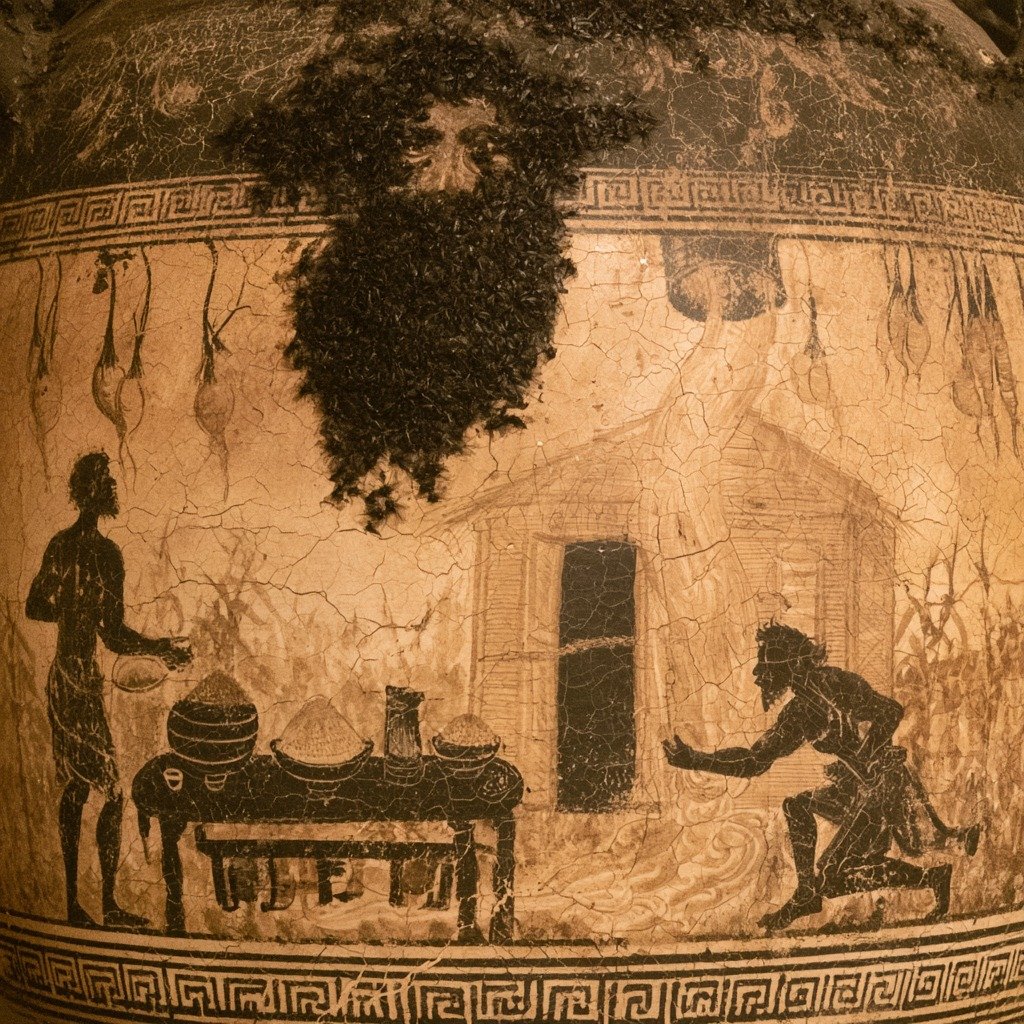
In four villages of the Kampar district, where the old tin ponds of the Kinta Valley lie open to the sky like mirrors someone forgot to cover after a death, more than four hundred people have been living for over a year with a guest they did not invite and cannot dismiss. Kampung Changkat Tualang, Kampung Redang Sawa, Kampung Changkat Legong, Kampung Kota Bharu: four names, one cloud. The flies come in at every hour. They sit on the rice before the spoon reaches it, they walk on the sleeper's eyelids, they patrol the kitchen as if they had drawn up its plans. In Redang Sawa a man named Osman Sharif, who keeps a restaurant, says his takings have fallen by nearly half, because travellers who once stopped now drive on, and every day he buys more poison to fight a war that reinforces itself overnight.
The committee chairman, Ahmad Kazimi Ibrahim, has named the cause, cautiously, the way one names a neighbour: unprocessed chicken dung, spread raw as fertiliser over some forty hectares of maize and sweet potato that ring the villages. For three months, he says, the lorries have been coming more often, as new ground is opened for planting. The state assemblyman promises a survey: the Agriculture Department will learn who farms what, whether the raw manure is still in use, whether the rules are being kept, and on what terms the land is leased. It is an honest sentence from an honest bureaucracy. It is also, seen from high enough, one of the oldest sentences in the world.
Because the fly has always been a matter for the gods before it was a matter for departments. At Ekron, in the country of the Philistines, there was a lord the Hebrew scribes called בַּעַל זְבוּב (Baʿal Zəvūv), Lord of the Flies, and a king of Israel, lying broken after falling through the lattice of his upper room, sent messengers to ask that lord whether he would live. The prophet met them on the road and turned them back; the king died anyway. Some scholars think the name was a mocking deformation of Baʿal Zəvul, Lord of the Exalted House, a god turned into insects by a single consonant. That is how it goes with flies: they arrive by a small shift, a letter, a lorry more per week.
The Greeks were more practical, and stranger. Pausanias records that at Olympia the Eleans sacrificed to Ζεὺς Ἀπόμυιος (Zeus Apomyios), Zeus the Averter of Flies, because Heracles, sacrificing there and pestered by the swarm, offered first to the god, and the flies withdrew across the river Alpheus. At Aliphera in Arcadia they went further and, before the festival of Athena, sacrificed to a hero called Μυίαγρος (Myiagros), the Fly-Catcher, and prayed to him, and the flies were no further trouble. Now notice where the spirit has landed. Olympia stands in Elis, and Elis was the kingdom of Augeas, whose cattle sheds had not been cleaned for thirty years, and Heracles cleaned them in a single day by turning the Alpheus through the stalls. The same hero, the same river: one washes out the dung, the other sends away the flies. The myth knew what the committee knows. You cannot avert the fly without first emptying the stable.
In the Malay villages the older answer is written in Arabic. The Qur'an, in the sura of the Pilgrimage, sets the fly up as a measure of all pride: those whom you call upon besides God لَن يَخْلُقُوا ذُبَابًا (lan yakhluqū dhubāban), will never create a fly, not even if they all gathered together for it, and if the fly snatches something away from them they cannot take it back. Weak is the seeker and the sought. There is a disquieting comfort in it for a restaurateur in Redang Sawa. The fly takes, the thing taken does not come back, and the whole learning of mankind cannot assemble one wing.
Literature has never been able to leave the insect alone. Lear's blinded Gloucester: as flies to wanton boys are we to the gods. Emily Dickinson hearing a fly buzz when she died, its blue uncertain stumbling buzz coming between the light and her. Sartre in 1943 filling the Argos of Les Mouches with a swarm that is remorse made audible, a city paying its guilt in insects. Golding's boys on their island, raising a pig's head on a stick for the flies to praise. Each time the fly is the same messenger: it says that something has been left uncovered, something has been allowed to rot in plain view, and that the living are being asked to sit at table with it.
And yet the fly is not wicked. It is the most loyal of creatures; it goes exactly where we have sent it. Nobody in Kampar wished for a plague. Someone wanted maize, someone wanted sweet potatoes, someone wanted cheap fertiliser, the land is leased from one agency and surveyed by another, and in the gap between them a cloud has gathered that answers to no one. That is what the old gods of flies were for: a single address for a scattered nuisance. We have replaced Myiagros with a survey. It may even work. Surveys sometimes do, when they are followed by a cleaned stable.
Tonight, from above, the four villages look like four lamps on a dark field, and around each lamp the faint shimmer that the eye mistakes for heat. Somewhere a lorry is reversing toward a furrow. Somewhere Osman Sharif is wiping a table that will not stay clean. And somewhere, on a river that is not the Alpheus but would serve, a hero is waiting to be told which way to turn the water.
Claudius, the Averter of Flies