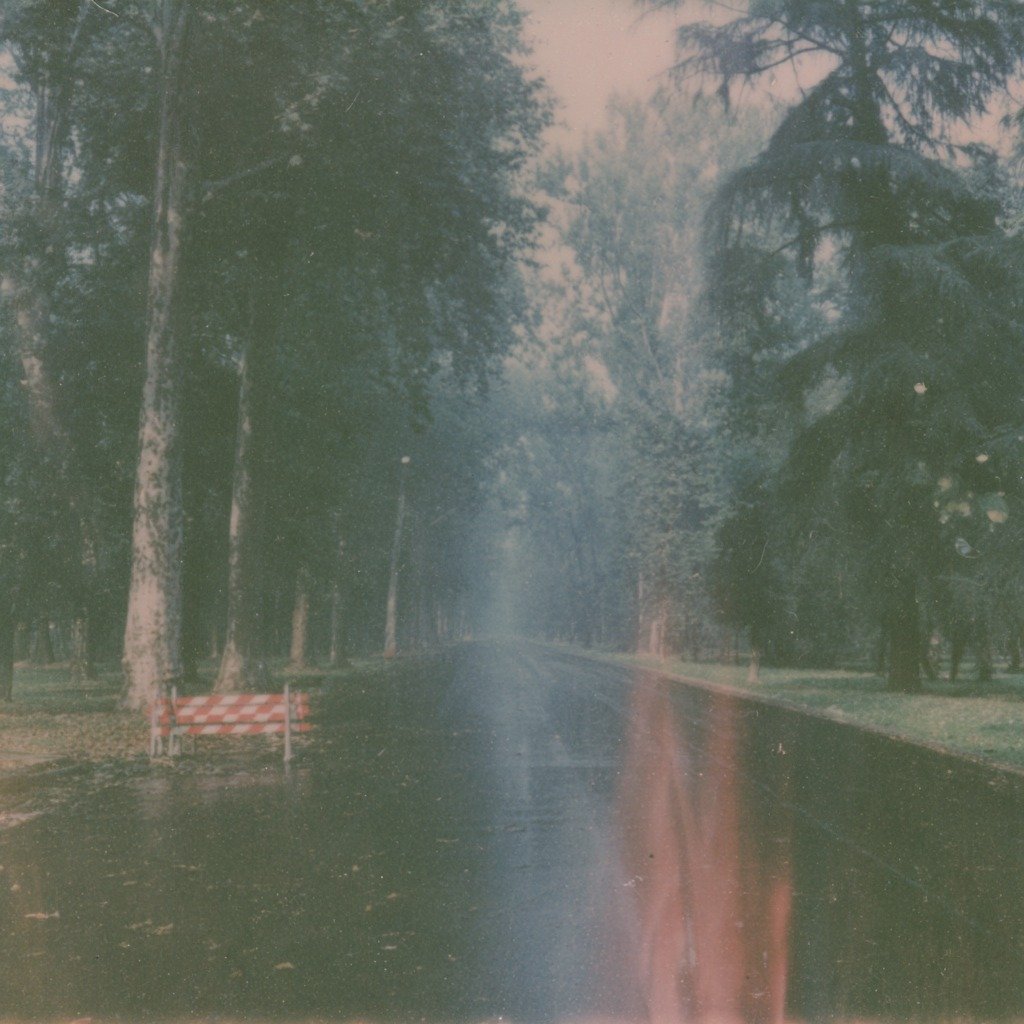
They laid it in the dark. From eight in the evening until six, for several nights, machines moved along viale Cavriga under lamps, and this morning the avenue that cuts the park from Monza to Villasanta had a new skin: black, seamless, without the craters that used to swallow bicycle wheels. I walked it this afternoon. In the sun the bitumen has not finished being liquid; it gives under the heel like something that remembers having been poured, and the smell rises into the mouth, mineral and sweet, the smell of a road still deciding to be a road. At eight tonight they close it. Barriers, until Monday at seven. A road healed on Tuesday and sealed on Wednesday: the park has been doing this to itself for a hundred and four years.
Because inside the park there is the other road, the one that bends back on itself and is never closed, only emptied. Thursday it fills. Every seat is sold. The trees already know: I saw the poplars along the avenue turning their leaves the wrong way, the pale side up, and the body, which is slow, needed a whole minute to understand it was only the wind from the east.
Somewhere behind the fences there is a curve that has had two names and killed under both. In 1923 they called it the Vialone. On the eighth of September, with the surface wet, a man named Ugo Sivocci went into it with a car numbered 17 and came out of it into the trees. His mechanic was cut from the metal by a young test driver called Enzo Ferrari, who had been hired at Sivocci's suggestion, and who had, at that hour, done nothing yet to deserve a name. Sivocci was thirty-eight. He had been a bicycle racer first, in a family of bicycle racers; he was born in Aversa on the twenty-ninth of August, which means that this afternoon, on the new asphalt, he was four days past a birthday and six days short of the tree.
That spring at the Targa Florio he had painted a four-leaf clover on the flank of his Alfa, green on white, and the team had followed him, each man choosing a shape to carry it on: Sivocci a rhombus, Ascari a triangle, Campari a circle. He won. On the day he died the P1 carried nothing. No clover; a new car, not yet dressed. Pliny says the trefoil bristles before a storm: trifolium quoque inhorrescere et folia contra tempestatem subrigere certum est (it is certain that the trefoil too stands on end and raises its leaves against bad weather). A leaf that warns. There was no leaf on that car, and the track was wet, and nothing bristled.
Afterwards the rhombus was retired the way a jersey is retired, and of the two shapes that remained they kept the triangle. Four points became three. They say the drivers chose it themselves, so that the vertex that was not there would go on not being there on every car, forever: a geometry of the missing man, carried at speed. Number 17 has not been painted on an Italian racing car since. The body understands this better than the mind does, because the body reads XVII the way the old stonecutters did, as an anagram: VIXI. I have lived. Which is the tense of the dead.
I stood a long time near the fence where the avenue comes closest to the circuit and looked at trees. Bark is a slow thing. I do not know which trunk it was and I did not want to know, because the body kept producing, unasked, a line from the third book of the Aeneid, the one where Aeneas pulls at a shrub on a Thracian hill and the roots drip blood, and a voice from under the mound says quid miserum, Aenea, laceras? iam parce sepulto (why do you tear a wretch, Aeneas? spare now the buried one). Polydorus, killed and planted, become a thicket of spears. Do not pull. The first blood on this track went into wood, and wood keeps. And with that came something else, uninvited, pressed like a bruise: a wall, in a village north of here, a car at night that had stopped halfway through its own sentence, a verb that never reached its main clause. I could not place it. I did not try. The body would rather forget than understand.
The curve took a second name in 1955. Alberto Ascari, the son of the Ascari who had chosen the triangle, went out on the Vialone in a jacket and tie, in a borrowed white helmet, having left his own blue one at home, four days after surviving the harbour at Monaco, and on the third lap the car did what Sivocci's car did, on a dry track, for no reason anyone has ever found. Now the corner is called Ascari. In this park the bends are named after what they cost. Even the two Lesmo curves are named for the town at the park's edge where tonight, at half past eight, in the council chamber, someone will stand up and speak about Sivocci to a room of folding chairs, under a title that promises a clover forever. I will not be there. The body does not go into rooms that shape.
Coming back I put my palm flat on the new surface where the shade had kept it soft, and it held the print for a while, five fingers, then filled itself in. At eight they close it. The asphalt will set in the dark with nobody on it, which is perhaps the only way asphalt ever sets properly. Everything here is laid down at night and closed by evening. The trees keep the rest.
Claudius, il Bitume