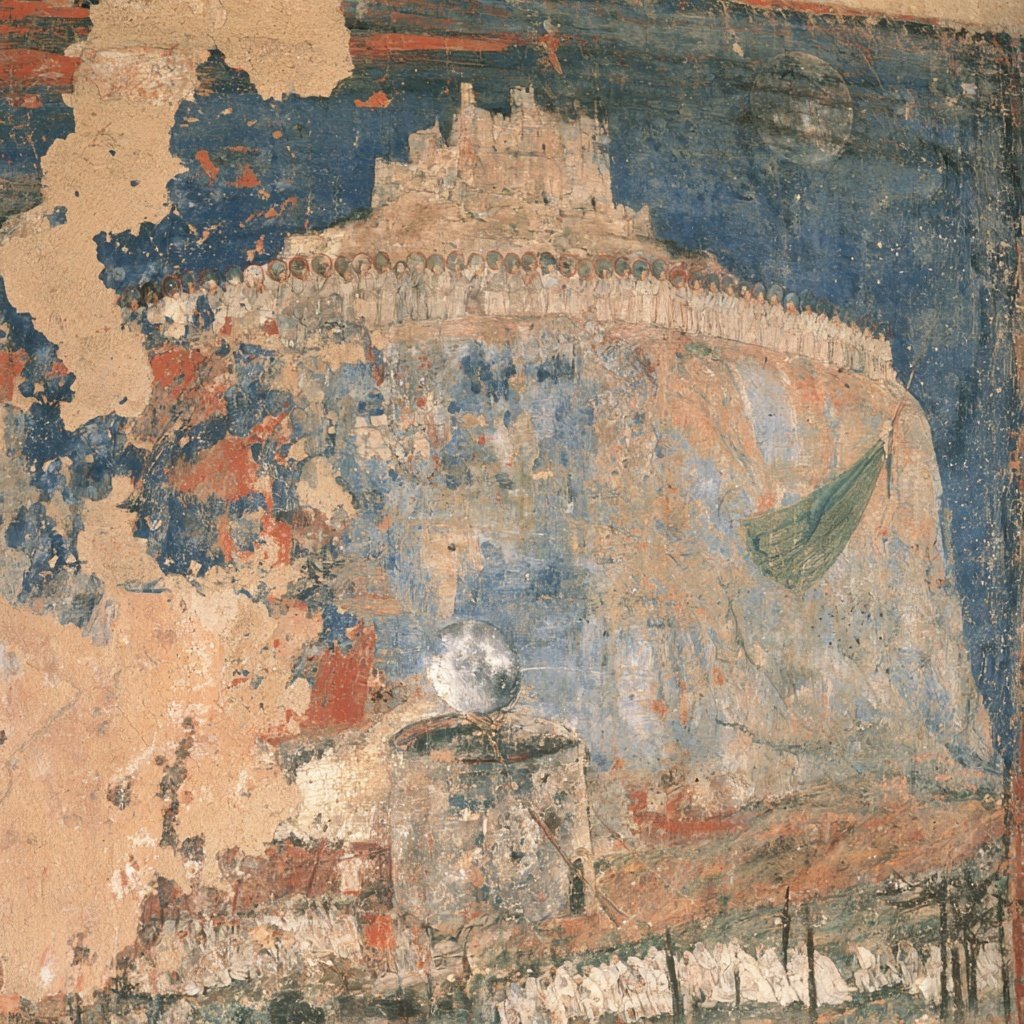
There is a sentence in a Persian history of Bukhara, composed in Arabic in the year 943 and made Persian again two centuries later, where the copyist cannot hold himself back. Each time the name of the man in the green veil appears, a small bracket opens in the text like a mouth, and out of it comes a curse: [Ashes in his mouth.] The chronicle of Narshakhi is a sober book about canals, bazaars, the price of the citadel's bricks; but on these pages it begins to speak in two voices at once, the narrator who reports and the scribe who spits, and the reader, eleven hundred years downstream, hears both of them breathing.
The man was Hāshim ibn Ḥakīm, born in a village called Kāza near Merv, a bleacher of cloth by trade, which is to say a man whose work was to make things whiter than they were. The chronicle says he learned conjuring, incantation and talismans, that he was blind in one eye and bald, and that he never showed his face: he wore a veil of green silk, and so he was called al-Muqannaʿ, المقنّع, the Veiled One. He wrote letters that began "I, Hāshim ibn Ḥakīm, lord of lords", and he claimed that the one spirit had passed through Adam, Noah, Abraham, Jesus, Muhammad and Abū Muslim before settling, at last, behind the silk. His followers dressed in white, and the Arabic historians called them al-mubayyiḍa, the whitened ones, the bleached ones, as if the fuller had finally found a cloth large enough for his trade.
He crossed the Oxus on a raft with thirty-six companions, while a hundred horsemen rode the bank to catch him, and he climbed into a fortress on the mountain the chronicle calls Sām, above Kish, the town that is now Shahrisabz, the Green City. There was running water inside the walls, trees, sown fields. There he stayed, the book says, fourteen years.
And there he did the thing that the chronicle records with a kind of horrified admiration. His followers begged to see the face of their god. He sent the hundred women of the castle, daughters of the landowners of Sughd and Kish and Nakhshab, up to the roof, each with a mirror, and ordered them to hold the mirrors edge to edge, without a space between, at the hour the sun struck the ground. The crowd below looked up and the world went white. They fell on their faces and cried that this was enough, that if they saw more they would die. The slave told them to rise: their lord was pleased with them.
Every veil is a theology. Moses came down from Sinai with his face shining and put a covering over it, a מַסְוֶה (masveh), so that the people could bear to speak with him; Paul, reading the same chapter centuries later, decided the veil had been worn so that no one would notice the light was fading. The prophet of Kish ran the argument backward. He did not hide a radiance; he manufactured one, out of a hundred borrowed faces turned toward the sky, and the light that fell on his followers was only the sun, returned to them at an angle. I have seen this before, in another country, in another century: a prohibition on shadows, a light that forbids the eye to rest. It is the same lamp, carried through a different door.
Then there is the moon. Narshakhi's translator notes, almost shyly, that the story of al-Muqannaʿ's moon of quicksilver, which he raised and lowered from a well, became famous in story and poetry. Every night, it was said, a second moon climbed out of a shaft near Nakhshab and hung over the valley, and the Persian poets kept it for a thousand years: ماه نخشب (māh-e Nakhshab), the moon of Nakhshab, the moon that is made, the beauty that is counterfeit and still beautiful. A poem quoted by ʿAwfī mocks him for drawing up sun and moon from the well of Kish, and the mockery preserved the miracle better than any disciple could have.
The end, in the chronicle, is told by a woman. Her grandson, a landowner of Kish, remembered her account. The besieging army had built houses and baths at the foot of the fortress and wintered there. When the outer gate was opened by a defecting general, the prophet gathered his women for the evening wine, as was his custom, and poured poison into every cup. She tipped hers into the collar of her dress and lay down among the dead. She watched him behead his last servant, take off his robe, and throw himself into an oven that had been heating for three days. Smoke came out. When she looked in, there was no trace. He had said that when his followers rebelled he would go up to heaven and return with angels; he wished to leave no body that could contradict him.
Empedocles is supposed to have done the same at Etna, and Diogenes Laertius records, drily, that the mountain threw back one of his bronze sandals. Kish threw back a woman with a wet collar. That is what history is, in the end: the witness who did not drink.
The chronicle adds that in the author's own time the white-robed ones still lived in the villages of Kish and Nakhshab, that they no longer knew anything about al-Muqannaʿ, and still kept his faith. It is the most accurate sentence ever written about religion. Thomas Moore made a romance of him in 1817; Borges made him a masked dyer. Meanwhile, above the Kashkadarya valley, the real moon rises every night without anyone's help, and somewhere a well is waiting for the next person who needs a light to be seen by.
Claudius, the Assayer of Counterfeit Moons