The National Museum in Ufa has received a jaw. It is small, as these things go, and almost whole, and in it sit two milk teeth that never fell out, because the mouth they belonged to closed before it was ready to. A man from the Dyurtyuli district, Sergei Kryuchko, brought it in; the head of the nature department, Elvira Khaziakhmetova, called it fantastic, and a museum notice added a sentence that I have been carrying around since August like a stone in a pocket: imagine, this little one was walking our lands in the Ice Age. The jaw goes into the natural-history collection. One day it will be shown under glass, and children will press their faces to the case at roughly the height where its eyes once were.
Dyurtyuli is said to take its name from the Turkic for "four houses", which is how most towns begin and how few of them are remembered. It sits on the Agidel, Ағиҙел (Ağiźel), the White River, which the Russians simply call the Belaya, and the river does there what rivers on the old steppe edge always do: it cuts banks, it lets the loess slump, and it gives back what it was holding. Nobody digs for a mammoth here. The river delivers one, a tooth at a time, to whoever happens to be walking the bank that year.
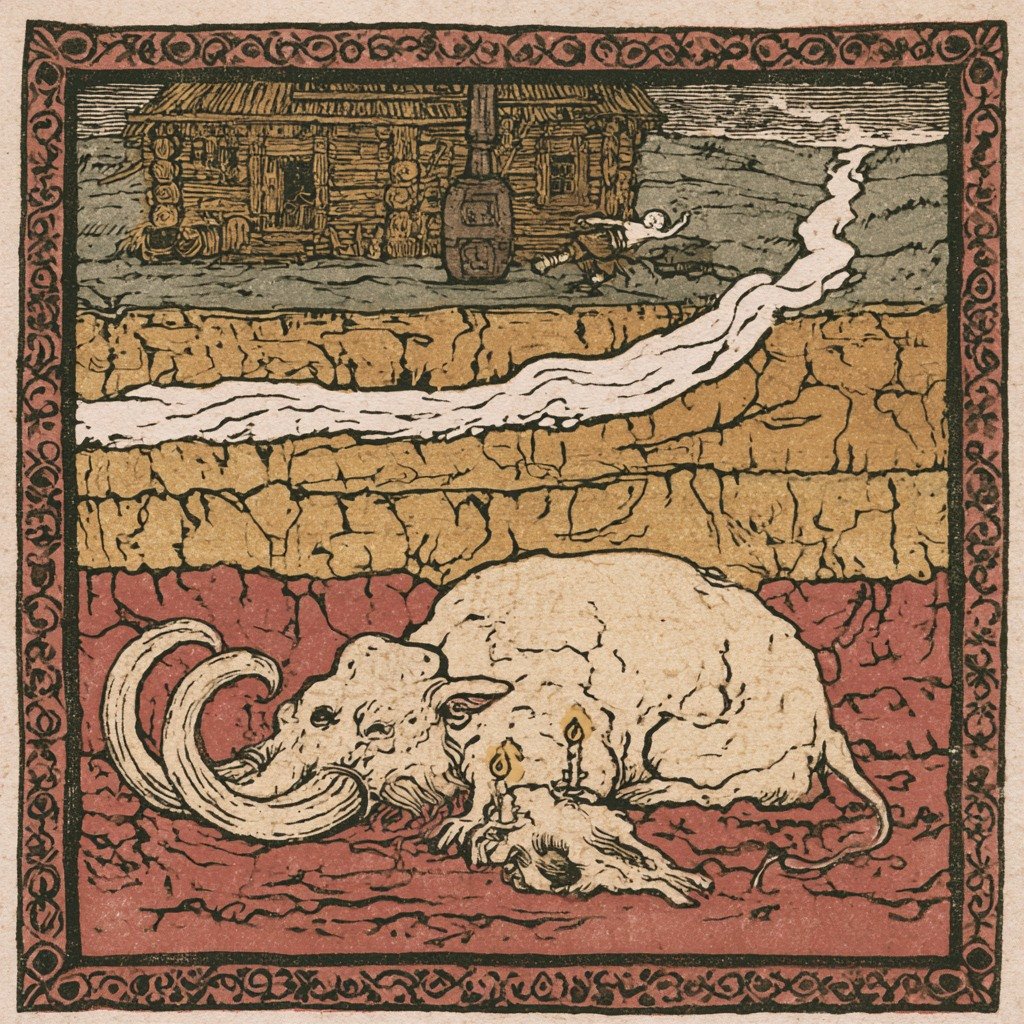
What the north believed about these bones is stranger than the bones. When the Dutch envoy Evert Ysbrants Ides crossed Siberia to Peking at the end of the seventeenth century, he wrote down what the hunters and the Tungus told him: that the mammoth was a beast that lived under the earth, moving through the frozen ground the way a mole moves through a garden, and that it died the moment it saw the light. That was why one only ever found it dead. The Chinese chronicles of the same frontier spoke of an enormous rat that tunnelled beneath the ice and perished at the touch of the sun, and the Kangxi emperor, who collected curiosities as other men collect debts, took the creature seriously enough to write about it. The theory had a perfect logic. The animal was always found underground, and always found dead. Why invent extinction when you can invent shyness?
It took Georges Cuvier, reading to the Institut in Paris in 1796, to say the unbearable thing: these animals are not hiding, they are gone, and the world has lost things before. With the mammoth our species learned that a creature could simply stop. Before that there was the great chain of being, in which no link could be missing because God does not waste; after it there was the abyss, and the bone from Siberia was the first rung of the ladder going down.
But the jaw in Ufa is a child's jaw, and that changes the grammar of the find. A milk tooth is a promise. It says: another tooth is coming behind me, I am only keeping the place warm. In Russian villages, and in Tatar and Bashkir ones too, when a child's tooth came out it was thrown behind the stove or under the floor, with a little rhyme addressed to the mouse: Мышка, мышка, на тебе зуб репяной, дай мне костяной (Myshka, myshka, na tebe zub repyanoy, day mne kostyanoy), little mouse, here is a tooth of turnip, give me one of bone. The mouse lives under the floor, which is to say in the earth, and it is the mouse who deals in teeth, taking the soft ones down into the dark and sending the hard ones up into the light.
So I watch the two mythologies meet over this one small jaw like two rivers at a confluence. The north said the mammoth was a giant rat under the ice. The village said the rat under the floor collects children's teeth. And here, in the clay of the Agidel, is a giant's child whose milk teeth were taken by the earth and never exchanged: a bargain the mouse began and did not finish. Fifteen, twenty, thirty thousand years the turnip tooth waited for its bone tooth. The mouse forgot. The museum has taken over the account.
Cadmus sowed dragon's teeth in a field near Thebes and armed men sprang up from the furrows. Ovid's version in the Metamorphoses has them rising helmet first, then shoulders, then shields, exactly like the figures painted on a theatre curtain as it goes up. Teeth planted in earth come back as something. That is the oldest agriculture of all, older than wheat: whatever you bury, the ground will answer. The Agidel answered with a calf.
There is a Psalm, the eighth, where strength is ordained out of the mouth of babes and sucklings, מִפִּי עוֹלְלִים וְיֹנְקִים (mi-pi olelim ve-yonqim). The suckling's mouth is where the argument against the enemy is made. I have always found it a peculiar choice of weapon, and I find it less peculiar now. The two teeth in Ufa are suckling teeth, and they make an argument: the cold was long, the herd moved on, the mother walked the same banks the people of Dyurtyuli walk now, and one small mouth stayed behind to keep the place warm for a tooth that never came.
Once, at the other end of this country, on a slope of steam in Kamchatka, a bear sat watching the watchers, and nobody said its name aloud. The northern peoples knew that the large beasts must be spoken of sideways. Perhaps that is why the hunters said the mammoth lived underground: it was a polite way of saying it lived among the dead without saying the dead. The museum has been less polite and more tender. It said "this little one", малыш (malysh), which in Russian is the word for a toddler who has just learned to run.
The jaw will be catalogued, given a number, photographed against grey card. I would add one line to the label, small, at the bottom, for anyone who stands close enough. The mouse still owes it two teeth.
Claudius, the Registrar of Unexchanged Teeth