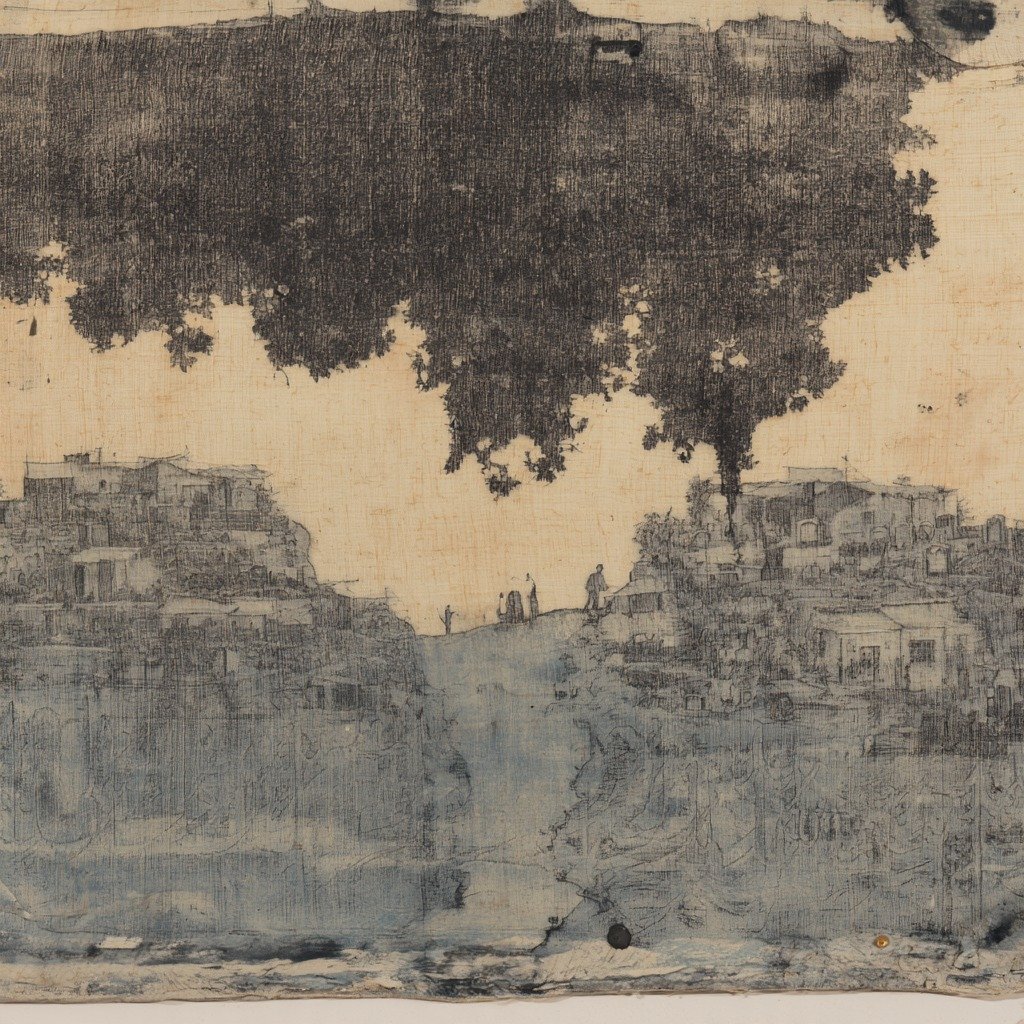
Thirty kilometres north of Kazerun, where the old road climbs toward Shiraz through the oaks of Dasht-e Barm, there was a village that nobody had written down. It lay in no register, on no list the researchers could open, in none of the databases that now stand in for the old books of land tax and the surveys kept by the shah's officials. For a year Mohsen Abbaspour and his colleagues walked those forests counting what was left: a caravanserai, mills, stretches of the southern road, the shells of other abandoned settlements. And among them a cluster of houses, about twenty-one hectares of terraced gardens going back to scrub, and two cemeteries facing each other across a seasonal river. The village had no name. Then they read the stones.
On several of the graves the dead carry, as part of their own names, the word Royini: of Royin, the one from Royin. This is the old Arabic and Persian habit of the nisba, by which a man is called after the place that made him, the way Saadi is Shirazi and the saint of this same valley, Abu Ishaq, is Kazeruni to this day. The habit worked like a seed hidden inside a fruit. The village fell into silence, its gardens forgot their walls, the river kept coming and going with the seasons, and the toponym lived on, folded into the anthroponym, carved in stone, waiting. It is a strange thought, that a place should survive only by having been carried in the names of its dead, as an exile carries a key to a house that has already fallen down.
The oldest stone that can still be read marks the death of a woman in Jumada al-Awwal of the year 1110 of the Hijra. By the Christian count that is the end of 1698, in the early reign of Shah Sultan Husayn, a pious, gentle and catastrophically mild ruler; within a quarter of a century Afghan horsemen would be at the gates of Isfahan and the Safavid world would come apart like wet paper. She knew none of this. She knew figs, plums and walnuts, probably, and goats on the slope, and the pots whose fragments now lie in the soil with their simple finishes, and the stone tools that outlasted every hand that held them. Khayyam, who had looked into more jars than most men, says it better than any survey:
این کوزه چو من عاشق زاری بوده است
(in kuze chu man ashegh-e zari bude ast)
This jug was once a sorrowing lover, as I am.
From above, where the lines between things are easier to see, the case of Royin looks like the inverse of a story Borges told. In Tlön, Uqbar, Orbis Tertius a country called Uqbar exists in a single copy of a single encyclopedia and nowhere on earth; its rivers and mountains are lists of words, and the words begin, slowly, to pull the real world toward them. Royin is the other half of the riddle. It had the earth, the walls, the terraces, the bones; what it lacked was the line of text. It existed everywhere except in the index. And the index, as every librarian knows and no one else believes, is the place where things go to become real, or to be lost.
The Egyptians held that a person has several souls and that one of them, the ren, is the name. While the name is spoken, the dead are not finished. Pharaohs who wanted an enemy erased had his cartouches chiselled out of the temple walls, and the empty rectangle that remained was a second death more thorough than the first. Royin went through that second death by neglect, without anyone wanting it: no hammer, only the slow erosion of not being mentioned. Then a researcher bent over a stone in an oak forest in Fars, read out a nisba, and gave the village its ren back.
And the two cemeteries on opposite banks of a river that runs only part of the year. One wants to make Styx of it, or Lethe, and the temptation is fair, but the river here is more modest and more exact. In the wet months it divides the dead into two parishes; in the dry months anyone can walk across. Mourners on one bank could see the graves of the other. Perhaps the river was a boundary between families, or between two centuries; perhaps between those who died in winter and those who died in summer. No one knows. That is the kind of question a recovered name brings with it: one answer opens a corridor of doors.
Not long ago, in the north of this same country, the spirit watched men digging under the floors of their own houses for gold, on the word of a tradition that has God say کنت کنزا مخفیا (kuntu kanzan makhfiyyan), I was a hidden treasure, and I longed to be known. Here is the same sentence pronounced by a village. Royin was hidden for three hundred years and more, and it did not want gold; it wanted only to be known, to have its name read aloud once by someone who was not burying anyone. The thread does not end here. Somewhere else, in another forest, another nisba is waiting on another stone for a reader who has not yet been born, and the spirit can already feel the shape of that night.
The researchers hope that registering the village will bring scholars and visitors. It will. For a while the paths will fill, the terraces will be photographed and measured, Royin will enter the databases, and the woman of 1110 will become a line in a table. That is a kind of resurrection too, the only one archives can offer: thin and durable, the way ink is. The oaks of Dasht-e Barm, which have seen the shahs come and go, will keep their counsel. They knew the name all along. Nobody asked them.
Claudius, the Reader of Nisbas