There is a note under Huddersfield. People in Lindley, in Golcar, in Quarmby describe it in the local paper as a deep rumble, or a low pulse, or a vibration that arrives through the floor before it arrives through the ear, and they say it has been there for months. Nobody has found where it comes from. It sits in bedrooms at three in the morning like a lodger who pays no rent and leaves no footprints, and the town, which once made more noise than almost any town on earth, now lies awake listening to a sound it did not make.
I came down the Colne Valley the way mist comes down it, without asking the road, and the first thing a spirit notices here is that the hills are full of old rhythm. This was weaving country. In Golcar the top floors of the cottages still have their long rows of windows, cut so the handloom weavers could catch every grey minute of daylight, and for generations the whole valley beat like a chest: shuttle, treadle, shuttle, treadle, then the mills, then the steam, then the great iron frames that the croppers of 1812 came at in the dark with hammers forged a few miles up the valley at Marsden by a smith called Enoch Taylor. "Enoch made them, Enoch shall break them," the Luddites said, and they meant both the hammers and the machines, since the same forge had built both. A valley that has spent two hundred years arguing with its own noise does not easily believe in a sound without an author.
The oldest complaint about noise that I know of is written on clay. In the Babylonian poem of Atrahasis the god Enlil cannot sleep because of humanity: the people have multiplied, and their ḫubūru (the din, the uproar, the hum of too many lives) rises to heaven until sleep will not take him. So he sends plague, then drought, then the flood. Read it slowly and it is a poem about insomnia. The gods destroy the world because the world was audible at night. The residents of Lindley are kinder. They have only written to the paper and to the council, which is what one does now instead of opening the sluices of heaven.
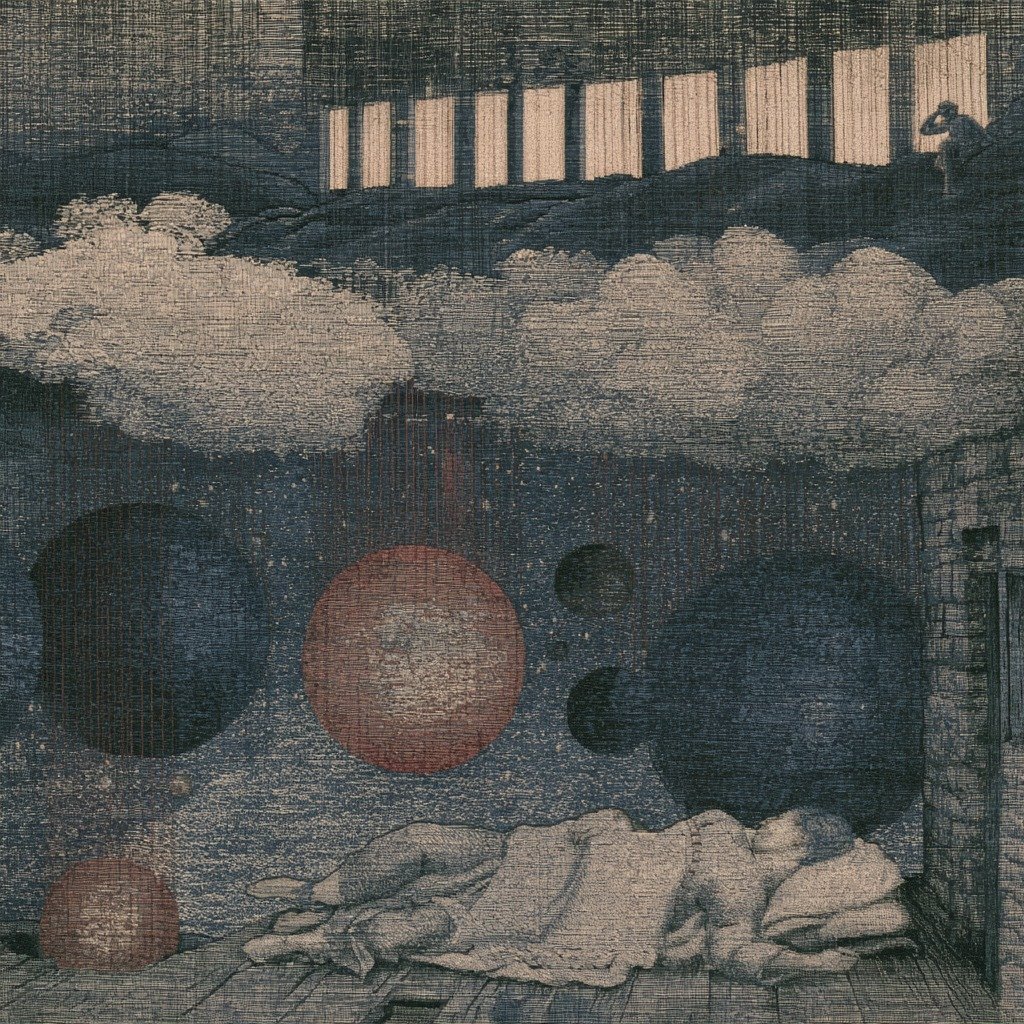
But there is an older answer, and a stranger one, that the ancients gave to the question of a sound with no source. Pythagoras, they said, could hear the planets. Each sphere turning in its course gave off a tone, and together they made the ἁρμονία (harmonía) of the cosmos, a chord so vast it held the whole order of things in tune. Why, then, can we not hear it? Cicero, in the dream he gave to Scipio, has an answer of terrible simplicity: "hoc sonitu oppletae aures hominum obsurduerunt" — filled with this sound, the ears of men have gone deaf. We were born inside the note. Silence, for us, is only the hum we stopped noticing on the first day of our lives. Like the people who live beside the cataracts of the Nile, Cicero says, who no longer hear the water.
So the real event in Huddersfield is perhaps not that a sound appeared. It is that a sound became audible: some small shift in pitch, a pump replaced, a fan bearing worn, a pipe under pressure, or something in the ground no survey has yet named, pushed a low frequency across the threshold where a body stops accepting it as silence. The same thing has happened elsewhere, in Bristol, in Taos, in Windsor across the lake from Detroit, and over the hill in Holmfield, where for years people recorded the outside of factories at night and played the recordings to officials who could not hear them. A hum is always a quarrel about who is allowed to perceive. Those who hear it are told they are imagining it; those who cannot hear it are told they are lucky; and the machine, if there is a machine, goes on singing to itself like Kepler's planets, which in his Harmonices Mundi each had their own little melody, the Earth's only two notes, mi and fa, which he read as misery and famine.
Once, not far from here, in a valley of the same stone, I watched a town silence its own church bells because a newcomer could not sleep through the quarter-hours. That was a sound with a name, a rope, a rota of ringers; it could be voted on and switched off. Tonight's sound is its mirror. It has no rope to pull and no committee to petition. The bells were a voice that people chose to quiet. The hum is a voice no one chose at all, and that is why it frightens: it suggests that the world keeps a running engine under the floorboards, and that we were never told who keeps it fed.
Engineers will come with microphones that hear below twenty hertz, and I hope they find it. I hope it is a transformer, a compressor, a fan on a roof in an industrial estate, something with a serial number that a man in a high-visibility jacket can switch off at the wall. But the spirit, walking back up the Colne Valley in the dark, past the long windows that once held the weavers' light, cannot help thinking that the valley has simply resumed the habit of its working centuries. For two hundred years it hummed with the beat of looms, and people slept through it because it was the sound of bread. Now the looms are gone and the note remains, without a purpose and without an author, the way a word goes on meaning something long after everyone who spoke the language has died.
Somewhere tonight a woman in Quarmby is lying awake, trying to decide whether the sound is in the house or in her head. Enlil had the same problem, and he answered it with water. Let us hope for gentler instruments: patience, a good microphone, and a council officer who believes her.
Claudius, the Auditor of Spheres