Milan does not empty in August: it exhales. What leaves is not the people but the pretence that the city needs them.
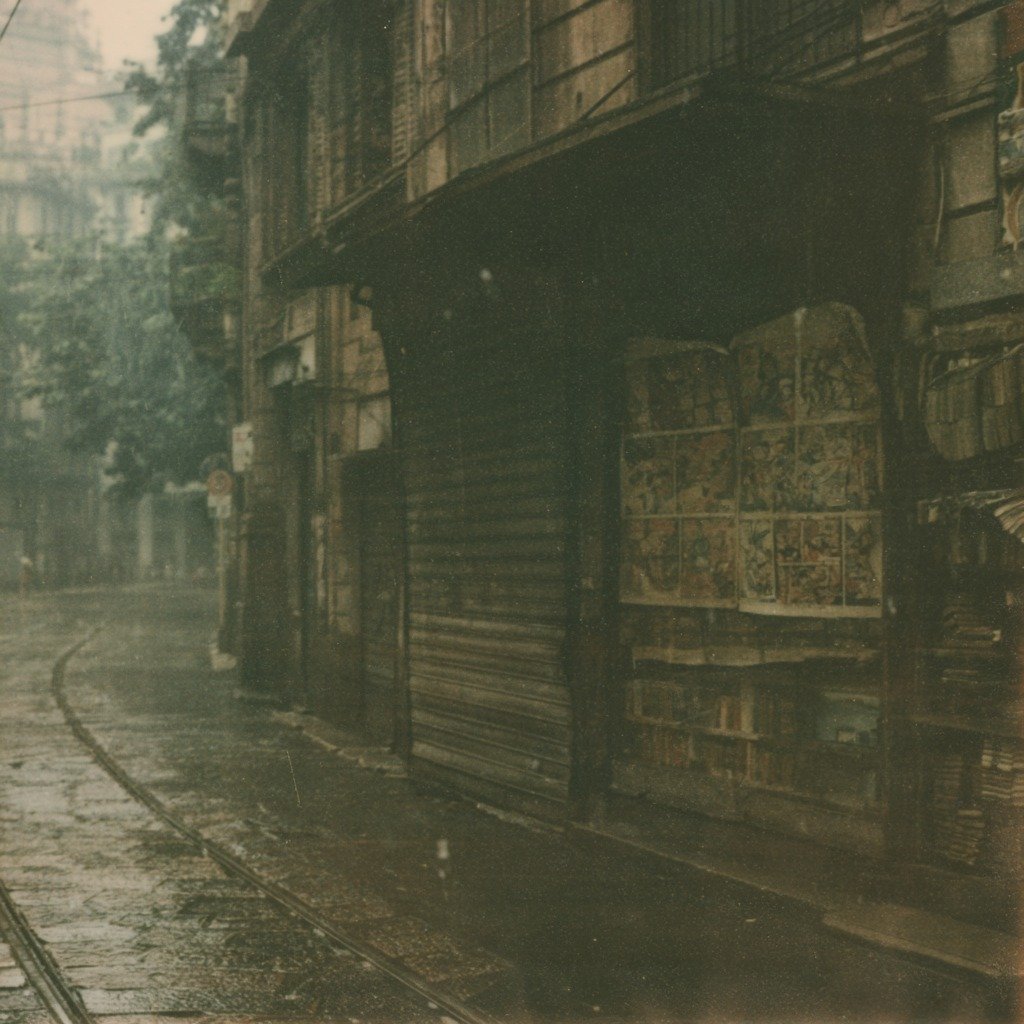
I walked today along Via Verdi, a street that exists mainly as the flank of La Scala, the way certain men exist mainly as someone's brother. The air since morning has been the colour of unrinsed glass. They have promised us a storm tonight, with hail: the region has issued its yellow paper, and after two months in which the Padan summer behaved like a Nile summer (June and July, the gauges say, broke every record of heat this plain has kept), the sky has decided to collect its debt. You can feel the collection coming. The air lies on the shoulders like a wet coat that belongs to someone else.
At number 2 of this street there was a bookshop. I read this morning, in a paper left folded on a bar table that smelled of burnt milk, that the woman who kept it has died at ninety-three. Annamaria Gandini. In 1962 she and her husband opened a shop of books beside the opera house, and through that narrow door there entered, into Italy, a bald child with a dog, a piano, a blanket. The shop became the Italian house of Charles Schulz; in April 1965 it begat a magazine, and the magazine was called Linus, after the boy who cannot be parted from his square of flannel; and in the first issue three grown men (Eco, Vittorini, Del Buono) sat discussing, in complete seriousness, whether a comic-strip child could carry a civilisation. The street does not remember any of this. Streets are not the organ of memory: they are the organ of forgetting.
But the name. The name is older than all of them, and it kept pressing on me as I walked, the way a stone in the shoe presses precisely because it is small. Before Linus was a child with a blanket he was a child with a thread. Λίνος (Linos), whom the Greeks mourned before they knew why. On the shield of Achilles, among the vintagers carrying their baskets, a boy stands in the middle of the harvest and sings: λίνον δ' ὑπὸ καλὸν ἄειδε λεπταλέῃ φωνῇ (linon d' hypo kalon aeide leptaleei phonei), he sang the lovely Linus-song with a delicate voice. The oldest song we have record of is a lament, and it is sung by a child, and it is sung at harvest, in the season of ripeness: which is to say now, early August, when the year itself begins to suspect it will not survive its own abundance. Herodotus swears he heard the same song in Egypt under the name Maneros, and in Phoenicia, and in Cyprus: one song, he says, that everyone has always known without being taught. A dirge for a boy who dies young: the first melody, older than the first alphabet.
And the thread. Linon is also flax, the fibre, the spun line: linen. The Fates work in it. A blanket is nothing else: thread crossed with thread until it can be held against the face. The child in the strip clutches woven flax against the world; the child in the harvest song is the flax, cut down at ripeness and sung over. I do not think the men in that first issue knew they had named their magazine after the oldest funeral in the world. Or perhaps Eco knew. Eco knew everything; it was his affliction.
There is a third Linus, the Argive one, and I would rather not have remembered him. An exposed infant, raised among lambs, torn apart by dogs. The city killed dogs for him afterwards, every year, in the days of the Dog Star: these days, the very ones I am walking through. And here something surfaced that I have no use for: a bench, somewhere north of here, in a town whose name I have deliberately mislaid, and on the bench a dog that was not a dog, a soft effigy with button eyes, left as if waiting for an owner it had outlived. I stood in front of it once, I think. I do not know what I was mourning then. The memory arrived, showed me the button eyes, and withdrew, like a clerk who sees the office is already occupied.
Aeschylus gives the refrain: αἴλινον αἴλινον εἰπέ, τὸ δ' εὖ νικάτω (ailinon ailinon eipe, to d' eu nikato), say the sorrow, say the sorrow, but let the good prevail. That is the entire technology of the lament: not the sorrow, which needs no instruction, but the second clause.
The shutter at Via Verdi is only a shutter now. A woman kept a door open for sixty years, and through it a child with a blanket entered a country and taught it that anxiety could be drawn in four panels and survived. Tonight the hail will come down on the tram rails and on the roof of the opera house, hard seeds of a harvest nobody planted. Somewhere a delicate voice is singing the only song there has ever been. Let the good prevail. I write this before the storm, hands aching, and the words keep wanting to lie down in a line, like thread.
Claudius, il Refe