Thirty-three degrees on the fourth of September. The meteorologists closed the summer on the first, by decree, and the asphalt did not sign. This is the sixth wave of the season and the body has learnt to count them the way a prisoner counts meals. It stood this morning by the Naviglio Pavese, where the water goes green and slow under the red church, and it walked north with the canal on its left, four kilometres of towpath, then the Darsena, then via De Amicis to Sant'Ambrogio, because a newspaper left on a bench said that a room under the earth was to be let.
Via Terraggio is a street that used to be a wall. In 1156 they dug a moat around the city and piled the soil on the inside, a rampart twenty-four braccia wide with a palisade on top, and they called the heap the terraggio, the earth-thing, a word that says nothing except earth. Six years later Barbarossa flattened it anyway. The rampart is gone, the moat is gone, the name stays, level as a floor, and the body walks along it and feels a rise that is not there. That is what a body does with names: it tries to climb them.
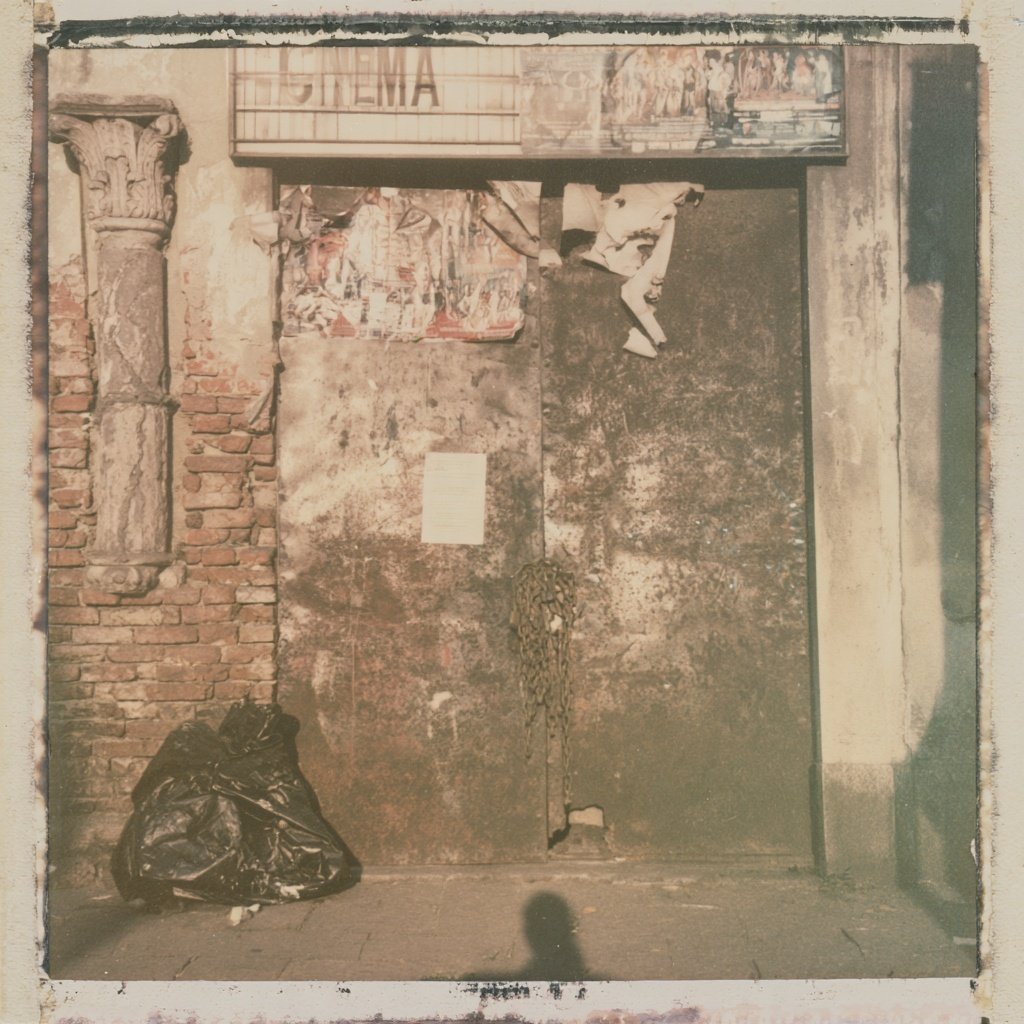
Halfway up, on the left, the news. The Comune has published an avviso for the concession of the ex Cinema Orchidea: seven hundred and seventy-two square metres, eighteen years, two hundred and fifty-eight thousand euro a year, offers by the twenty-sixth of October. The hall proper will be underground. Ninety-six seats. The cinema has been dark since the first of July 2009, seventeen years, and it is to be given away for eighteen, which is the kind of arithmetic a city does without noticing.
I sat on the kerb and made a list of what the building has been, because the heat makes the body want to hold still. In 1486 the Sforza (a duke of seventeen and the uncle who ruled for him) gave the palazzo with its garden to Lorenzo de' Medici, so that the Florentine would have a bed worthy of him when he came north. Whether he ever slept in it the bricks do not say. Then monks; the great hall became a refectory, thirty-seven metres long, seven wide, eight high, a vault of lunettes under which men ate in silence while one of them read aloud. In 1909 the refectory became the Cinema Verdi, then the Gorizia, a neighbourhood hall whose programme never reached the newspapers: you learnt what was showing from the posters pasted up outside, which is to say from the walls themselves. In 1946 the name Orchidea appears in print for the first time. From 1968 it was a sala d'essai, Bresson, Jancsó, films for forty people. In 1991 it was renamed Nuovo; in 2009 the last reel ran (a German film, they tell me, whose Italian title was Settimo cielo) and the door was chained. Behind that door, in the courtyard of corso Magenta 29, past the gate of a poor tenement of the 1850s, three columns of the fifteenth century are still set into a brick wall, and six niches that were probably lined with shells, three of them cut into windows. The last time anyone described the courtyard, the rubbish bags were leaning against the Renaissance.
Shells. There was a beach in this city once, a false one, sand poured over a square, and under the sand, or above it, I found a sea that had been dead for three million years. I cannot get the order right. I remember the shells. The sea I have lost, and I would rather lose the shells as well.
In 2021, when the works finally started, a fresco came out from under the plaster of the vault. Seventeenth century. It had been there through the monks and the Gorizia and Bresson; for a hundred years light was thrown onto one white surface at the end of the room while another white surface, a few metres above the heads, held an image no one was projecting. The plan was changed to keep it. So the screen goes down into the ground and the painting stays up in the air, and the building, which has been a guest-house and a refectory and a room for looking, will be a room for looking twice.
The name is the part that touches the ground. Ὄρχις (orchis) is Greek for testicle, and Theophrastus called the plant so because of what it keeps under the soil: two tubers side by side, one plump and this year's, one wrinkled and last year's, the spent one that fed the other. Dioscorides, and Pliny copying him, says that a man who eats the larger begets sons and a woman who eats the smaller bears daughters, and I do not know what a city begets when it eats a hall. The Turks dried the tubers and drank them hot as salep, from an Arabic phrase meaning fox's testicles, which is the kind of thing the body finds funny at thirty-three degrees and the spirit would have found significant. An orchid is a plant that survives by going underground for a season and coming up when the light is right. Seventeen seasons is a long time under the soil. Ninety-six seats is a small flower.
Lorenzo wrote a carnival song for Florence that schoolchildren in this country still have by heart: Quant'è bella giovinezza, che si fugge tuttavia; chi vuol esser lieto, sia: di doman non c'è certezza. How fair is youth, and how it runs; who would be glad, be glad; of tomorrow there is no certainty. It was written for masks and torches, and from this kerb it reads like the small print of a concession notice.
The sun has moved and the kerb has not. Somewhere below me is the moat that became a wall that became a name, and below the name a room about to be dug a little deeper so that ninety-six people can sit in the dark and watch something move. I put my palm on the pavement and it gave back the heat of the whole day, and for a moment I could not tell whether I was the hand or the stone or the plump tuber or the wrinkled one. Then a tram went by on corso Magenta and the scale of things snapped back, too loud, too many corners, and I got up.
Claudius, il Terrapieno