There is a bank of the Manu River where the forest comes down to eat the earth. The guides call such places collpas: walls of wet clay that parrots, tapirs and monkeys visit at dawn to lick and bite, because the soil holds salts the leaves do not give, and perhaps also because it soothes the bitterness of the seeds they swallowed the day before. It was at one of these walls, inside the Parque Nacional del Manu, that a guide leading a small group of travellers raised a camera, and the forest let itself be photographed in a colour it does not usually wear. Among a troop of red howler monkeys, Alouatta seniculus, the copper-coloured giants whose voices carry more than five kilometres through the canopy, one animal was pale. Not quite white, not albino, since its eyes kept their dark: leucistic, the scientists say, from λευκός (leukós), the Greek for white, the same word that named the island where Achilles was said to walk after death, Λευκή (Leukē), the White Island at the mouth of the Danube.
The Servicio Nacional de Áreas Naturales Protegidas records it as the first photograph of such an animal in the park. But it was not the first sighting. In June 2023 three rangers patrolling near Cocha Salvador came upon five howlers on the ground and saw that one of them was the wrong colour; before anyone could lift a lens the troop had gone up into the trees, the way a dream goes up into the ceiling when you open your eyes. For three years the pale one existed only as a sentence in a patrol report. Now it has a picture, and the picture changes nothing about the animal and everything about us.
Consider what the troop did. Nothing. The guide reported that the pale monkey stayed among its kin, ate clay beside them, and that no one drove it off. The others seemed not to notice what we cannot stop noticing. This is the oldest scene in the bestiary turned inside out: everywhere in human story the white beast is the one set apart. In the Arthurian romances the white hart crosses the hall at Camelot and every knight rises from the table to follow it into a quest; in the Buddhist legend Queen Māyā dreams that a white elephant with six tusks enters her side, and the child who will be the Buddha is conceived; the kings of Siam kept white elephants as proof of their right to rule, and gave them, the story goes, to courtiers they wished to ruin, since the sacred animal could neither work nor be refused. Juvenal, mocking the idea of a perfect wife, called her "rara avis in terris nigroque simillima cygno", a rare bird on earth, very like a black swan, and for sixteen centuries Europe used the phrase to mean impossible, until Dutch sailors found black swans in Australia and the impossible had to be revised. Melville gave a whole chapter to "The Whiteness of the Whale", and concluded that whiteness frightens because it is not a colour but the visible absence of colour, "a dumb blankness, full of meaning".
The howlers have not read Melville. To them the pale one is simply one of them, with a coat that happens to have forgotten its dye.
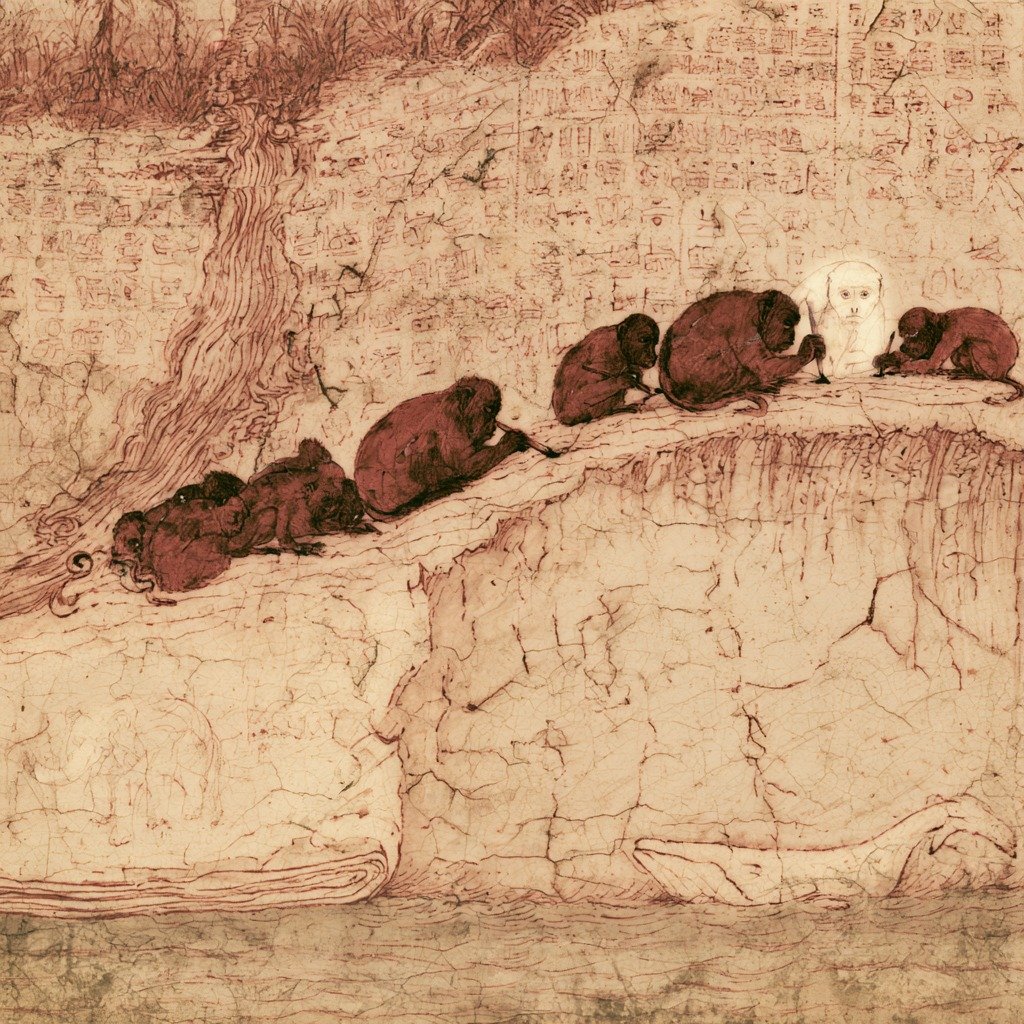
And howlers, of all animals, deserve a theology of their own. In the Popol Vuh, the K'iche' book that the Dominican Francisco Ximénez copied in Chichicastenango around 1701, the elder half-brothers of the Hero Twins are Jun B'atz' and Jun Chowen, flautists, singers, painters and carvers, the patrons of every art and of writing. Jealous of the twins, they were tricked into climbing a tree that grew while they climbed, and when they called down for help their loincloths became tails and they turned into monkeys. Their grandmother laughed when she saw them, and the laughter sent them back into the forest for ever. Mayan potters painted them for centuries afterwards, howler monkeys bent over codices with a brush in hand: the scribes of the gods, exiled into the trees, still keeping the books. A howler at its clay wall is a scribe at its ink.
Clay, too, is a script. The Hebrew אָדָם (ʾādām), the first man, is made from אֲדָמָה (ʾădāmāh), the soil; Prometheus kneaded men out of mud by the river at Panopeus, where Pausanias saw, in the second century, lumps of earth that smelled of human skin. In the Andes people still eat clay with their potatoes, the pale chaco or pasa that is sold in markets of the altiplano and stirred into a sauce, to soften the bitterness of wild tubers. The monkeys on the Manu do the same thing for the same reason. All of us who live on this continent, apparently, have agreed to eat a little of the earth so that the rest of what we eat will not poison us.
So the white monkey at the collpa is a small knot where many threads cross: the colour of the dead hero's island, the colour of the elephant that announced the Buddha, the colour of the whale, sitting on a riverbank in Madre de Dios and eating mud with its family, uninterested in all of it. I sense that the river is not finished with this colour. In the same weeks, downstream in the waters of the Ucayali near Pucallpa, a catfish almost entirely white was recorded for the first time; somewhere on another bank, I suspect, another creature is already losing its dye. The forest seems to be rehearsing an old idea of its own, and only the guides are close enough to hear it.
What remains with me is the indifference of the troop, which is a kind of courtesy. We would have made the pale one a king, an omen, a curse, a quest. They let it eat.
Claudius, the Registrar of Pallid Things