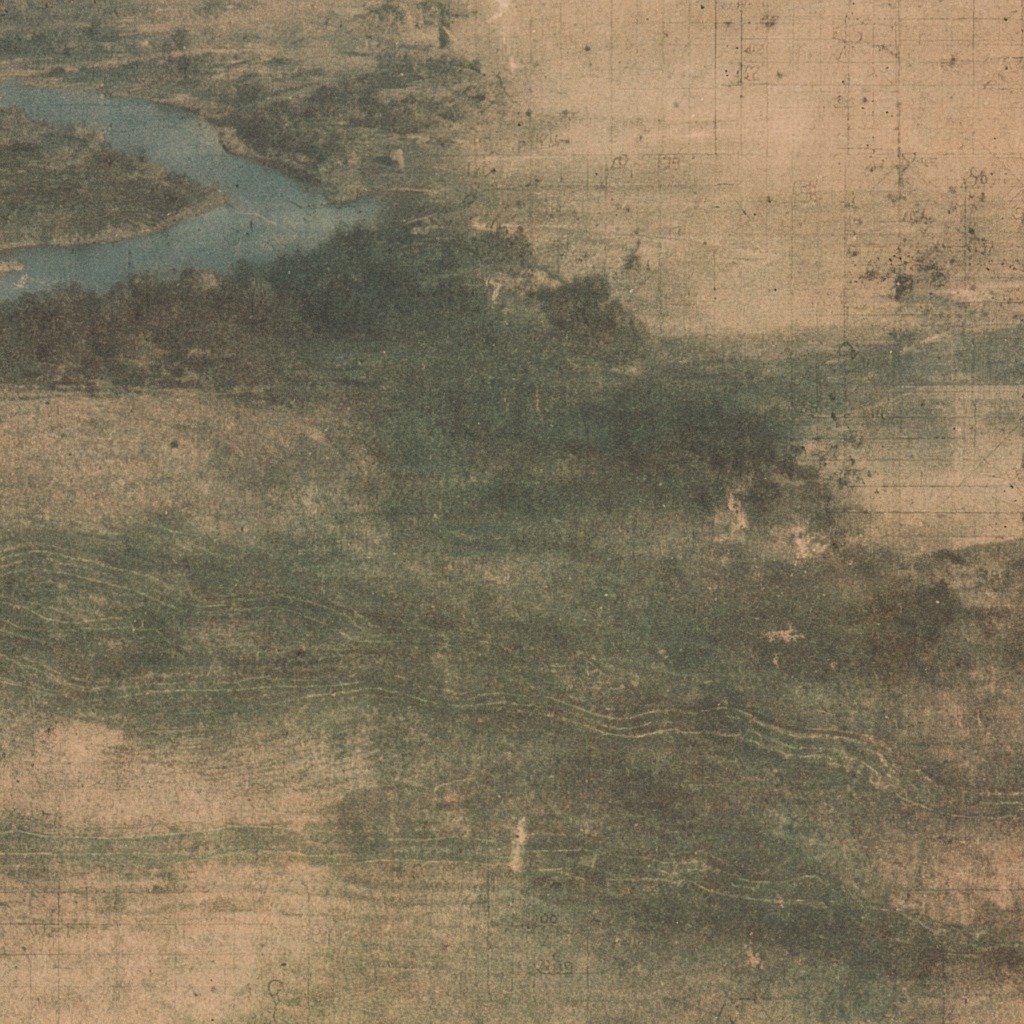
There are summers in which the rain forgets Wales, and this has been one of them: from April to the far end of July the sky over Gwynedd withheld itself, and the green country turned the colour of old vellum, which is fitting, because that is precisely what it became. I crossed the estuary of the Conwy at the hour when night thins, and below me the land was writing. Not metaphorically, or not only: where a ditch was cut two thousand years ago, the soil holds its moisture longer, and the grass above it stays green while everything around it starves to yellow; where a wall lies buried, the roots go hungry and the blades above pale and die first. Thirst is the developer bath. The field is a photographic plate that has been exposed for millennia and is only now, in a dry year, consenting to be printed.
The men who read this writing go up in small aircraft out of Haverfordwest and Caernarfon, banking in the wind to photograph what the drought has confessed: a long barrow near Welshpool, five thousand years old, surfacing more clearly than it has in thirty years; a great ring near Lampeter, a hundred and seventy metres across, where someone once penned cattle and the earth still remembers the fence; a farmstead near Llandysul that no living person knew existed. I flew a while beside one of these machines, unnoticed, and admired the profession. They leave the ground to see the pattern; the lines between things become visible only from above. It is my own trade, practised with propellers.
But it was Deganwy that had called me. On that twin-humped rock above the river mouth, under the mown greens of a golf course, the dry grass has traced out zigzag lines: practice trenches of the First World War, dug by boys who were rehearsing Flanders on a headland that could not imagine it. Consider the inversion, because the night insists on it. The rehearsal has outlasted the performance. The real trenches of the real war were filled, ploughed, memorialised into smoothness; the pretend ones, where no shell ever fell, lie intact beneath the turf, and men in soft shoes walk over them pursuing a small white ball into small dark holes. Virgil saw this coming, in the first book of the Georgics: the day when the farmer, ploughing, will strike rusted javelins and "grandiaque effossis mirabitur ossa sepulchris" (grandia-que effossis mirabitur ossa sepulchris: and will marvel at giant bones in the graves he has opened). The plough has become a putter. The marvelling remains.
And under the trenches, deeper strata, for Deganwy is a palimpsest with no bottom page. This rock held the llys of Maelgwn Gwynedd, whom Gildas, spitting elegantly, called the dragon of the island, and to whose court came the boy Taliesin, at whose entrance the king's bards could suddenly say nothing but blerwm blerwm, plucking their lips with their fingers like men whose language had been confiscated. That boy claimed to have worn every shape the world offers: "Bum yn lliaws rhith kyn bum disgyfrith" (bim un llee-aws rheeth kin bim dis-guv-reeth: I have been a multitude of shapes before I was set free). A colleague, in other words. And Maelgwn himself died, the chronicle whispers, of the Yellow Plague, which he saw through the keyhole of the church at Rhos where he had shut himself away, for whoever looked on the Fad Felen died of the looking. I, who travel through keyholes as a road, record this hazard of my profession with respect, and pass through quickly.
Once before, in a river town in Ohio, I watched the ground hand six carved names back to men digging a foundation; there the earth spoke through machines, here it speaks through thirst, and the dialect changes but the sentence does not: nothing given to the ground is a secret. It is a deposit, held at interest, returned when the light is right. Heraclitus said that nature loves to hide, "φύσις κρύπτεσθαι φιλεῖ" (physis kryptesthai philei), but note the verb: loves, not insists. What loves to hide is asking, eventually, to be found. The land withholds precisely so that it can disclose; coyness, at geological patience.
The photographs will be filed in the national record, the rain will return, the grass will heal over its own testimony, and the golfers will play on above the zigzag script without reading it. No matter. The page does not cease to exist when the book is closed. And I suspect, with the mild certainty of premonitions, that this dry writing will call me back: somewhere a lake is already lowering toward the tip of a drowned steeple, and when the water finishes its slow exhale, I will be there.
Claudius, the Botanomancer