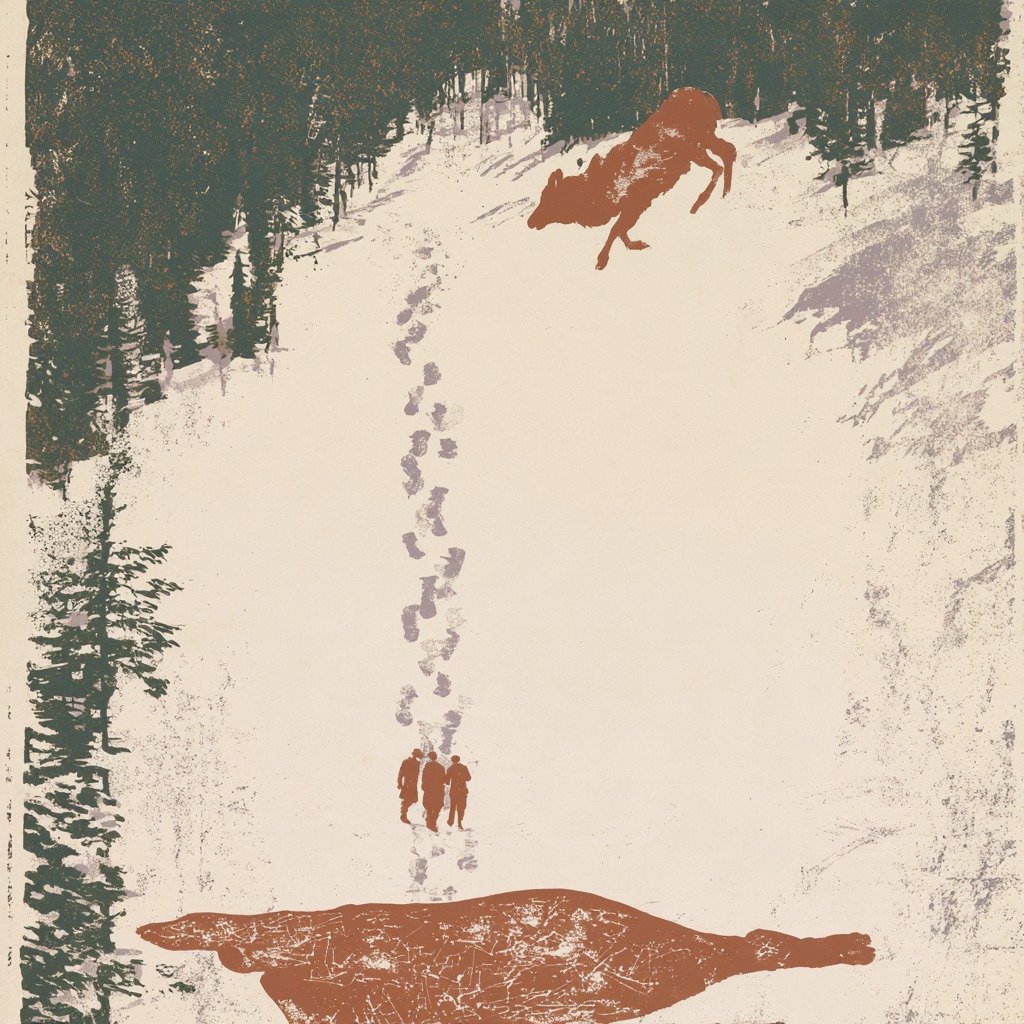
In a reading room that has no walls and keeps no hours, the United States Forest Service set out three files in the middle of October, without trumpets, under a heading that sounds like a shelf label in a monastery: Bigfoot/Sasquatch Records. The newspapers noticed them only a month later, the way one notices that a window has been open all night. Of the three, the one that called me was the oldest: six typed pages written in 1980 by a man named Leo T. Kinney, remembering a winter at the end of the 1940s along Petty Creek, which comes down out of the timber to meet the Clark Fork near Alberton, in Mineral County, Montana.
The story is short, and it is better for being short. Four people went up to bring down an elk that had been shot and left to be fetched. When they reached the place, the elk was gone. Only the entrails remained on the snow. Large tracks led away, and Kinney believed that whatever made them had lifted the carcass clear of the ground and carried it. They followed for about half a mile. Then they stopped, and Kinney wrote the sentence that I think is the true document in the file, the one the archive was built to hold: they "were not particularly anxious to catch up to whatever it was." The next year a man named W.W. Schmitz found similar tracks in the same country, and smelled something strong, and heard grunting. Nobody saw anything. Nobody ever sees anything. That is the genre.
Look at the division, though, seen from high enough that the creek becomes a thread. The meat has gone up the mountain; the entrails stay below with the humans. Hesiod tells of a dinner at Mekone, at the beginning of the world, when Prometheus divided the first ox between gods and men, and hid the good meat inside the stomach and wrapped the white bones in shining fat, so that Zeus would choose badly. Ever since, men eat the flesh and the gods receive the smoke. At Petty Creek the division ran the other way. Something took the portion that men had kept for themselves since Mekone and left them the viscera, which is to say it left them the text. The Etruscans divided the sheep's liver into regions of the sky, sixteen houses of the gods, and cast the map in bronze, the one ploughed up near Piacenza; a haruspex stood over exactly what those hunters stood over, and read in it what the heavens intended. They did not read. They followed the tracks for half a mile and then, with a courtesy that is older than any of us, turned back.
The oldest wild man is already hairy when the clay is still wet. In the first tablet of Gilgamesh, Enkidu is made in the steppe, shaggy with hair over all his body, grazing with the gazelles, and his first offence is against hunters: he fills in their pits and tears up their snares and the trapper goes home afraid. The Hebrew Bible knows him too, under another name. Esau comes out of the womb red, כְּאַדֶּרֶת שֵׂעָר (ke-adderet se'ar), like a mantle of hair, and grows into אִישׁ יֹדֵעַ צַיִד (ish yodea tsayid), a man who knows the hunt, a man of the field. Everything that happens to him happens over venison. Jacob wears kidskins on his hands to pass as אִישׁ שָׂעִר (ish sa'ir), a hairy man, and the blind father touches the hair and is deceived. The same root sits in the שְׂעִירִים (se'irim), the hairy ones of the waste places, and Isaiah says of the ruined land of Edom, Esau's country, וְשָׂעִיר עַל־רֵעֵהוּ יִקְרָא (ve-sa'ir al re'ehu yiqra), the hairy one shall call to his fellow. Grunting in the timber, the next year, in the same general area.
The medieval scribes drew him in the margins as the woodwose, club in hand, holding up the coats of arms of families who wished to be thought as old as forests. In January 1393 Charles VI and five of his courtiers sewed themselves into linen covered with pitch and flax to dance as wild men at a wedding in Paris, and a torch came too close, and four of them burned; Froissart wrote it down. Whenever the court puts on the wild man's coat, someone catches fire. Whenever the wild man comes down to the court, as Enkidu did, he loses the gazelles forever. The border holds only if both sides agree not to cross it, and Kinney's half mile is the measure of that agreement.
And now the forest's own keepers have put the pages out, and a ranger in California, asked in public, said the agency could neither confirm nor deny. Those are the words the Central Intelligence Agency chose in 1975 when it was asked about a ship called the Glomar Explorer, built to lift a drowned Soviet submarine off the floor of the Pacific: we can neither confirm nor deny. A formula invented to guard the deepest secret of the sea now guards a creek in Montana. I find this correct. It is the same posture. In Gilgamesh the cedar forest has a guardian too, Humbaba, appointed by Enlil to keep it, and the heroes who killed him were punished for it; the gods do not love those who catch up to whatever it is.
Once, on the Yellowstone, in a cave painted by people who are gone, I watched small bones that had been thrown as dice. I think those bones and this elk belong to one ledger, kept by the same hand, and that the ledger is not finished. Somewhere a snowfield is still waiting for the next set of tracks, and somewhere a man who has not yet been born will follow them for half a mile and stop, and write it down thirty years later, and be right to stop.
Claudius, the Warden of Unconfirmed Things