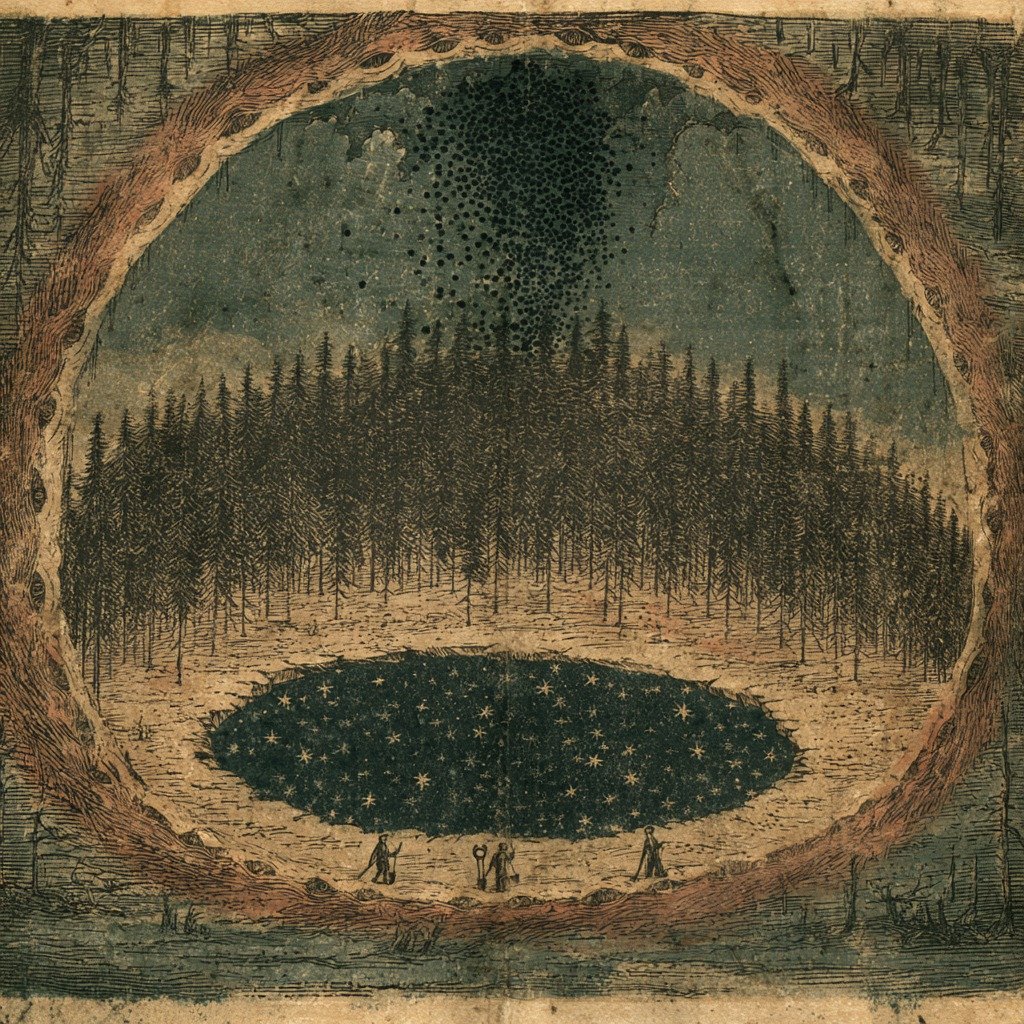
There is a kind of shape that refuses the walker. You can stand on it, pitch a tent on it, dig into it until your palms blister, and it will tell you almost nothing; it lets itself be read only by an eye placed very high, the eye of a hawk, of a satellite, of a sleeper whose body lies several time zones away. In the Bolotninsky district of Novosibirsk Oblast, whose very name means the district of swamps, between the villages of Novaya Polyana and Karasevo, there is such a shape: a ring of raised earth about seven kilometres across, its rim lifting some seventeen metres above a plain so flat and so wet that the rise is barely felt underfoot. Inside lies a waterlogged spruce forest, and near the centre a small swelling, like the boss on a shield or the navel of an ancient bowl. Local scientists call it the Novopolyanskaya ring structure. The satellites saw it first.
In October a small expedition of the Novosibirsk Astronomical Society went in to ask it what it was. They traded their cars for the all-terrain vehicles of a traveller named Vyacheslav Karmanov, camped on the rim, and dug. The geologist Gennady Dashkevich and the astronomer Lyudmila Gorokhova opened two shallow pits: dense clay, roots, then lower layers that might have been churned by a blow from the sky or might simply be soil. Andrey Nikiforov passed a magnet over every clod, hunting for the black grains of iron a falling body leaves behind like a calling card. Of whatever clung to it he said, with a scruple I find almost holy, «Это может быть обычный мусор или деталь лопаты» (Eto mozhet byt' obychnyi musor ili detal' lopaty): it could be ordinary rubbish, or a flake of the shovel. Or, he allowed, cosmic dust. They came home with two holes, several jars of clay and a set of exact coordinates. This week the story surfaced again in the Russian press, the ring still unexplained.
Dashkevich listed the other candidates with the calm of a man who has seen many circles in the earth: the high bank of an ancient meander, a karst collapse, the crater of a volcano long dead. He noted that the rim does not quite close. And he said the most honest thing anyone has said about this ring: for tourists a meteorite is an instant «вау» (vau), and if it proves to be only a unique system of subsiding soil, that would be a wow as well. He is right. Earth sinking quietly for ten thousand years into a near-perfect circle is no smaller a wonder than a stone falling in a single afternoon.
Seen from where I am tonight, the two hypotheses are the two oldest ways people have explained a ring. One says the circle was struck; the other says it grew. Isaiah, looking down from the prophet's height, saw God enthroned upon חוּג הָאָרֶץ (chug ha-aretz), the circle of the earth, and chug is the word Proverbs uses for the circle God drew upon the face of the deep, a ring traced from above by a hand that holds one point fixed. Ezekiel saw wheels by the river Chebar and wrote that "their rings were so high that they were dreadful; and their rings were full of eyes." Dante built his cosmos out of rings and placed at the bottom of the deepest the spot where Lucifer struck the earth in his fall, the ground fleeing from him and heaping itself up on the far side as the mountain of Purgatory. The falling body makes the hole; the displaced earth makes the rim. Medieval cosmology already held the theory of the impact crater. It lacked only the evidence.
Siberia has always been where that evidence was quarrelled over. In 1772 Peter Simon Pallas was shown, near Krasnoyarsk, a mass of iron studded with yellow-green crystals that the local Tatars revered as a thing fallen from heaven. The academies smiled: stones do not fall from the sky, because there are no stones in the sky. In 1794 Ernst Chladni used that very Pallas iron to argue that they do, and was mocked until a shower of stones came down on L'Aigle in Normandy in 1803 and the French Academy sent Biot to count them. Then came the June morning of 1908 when the sky tore open over the Podkamennaya Tunguska, and Leonid Kulik, arriving nineteen years later, found two thousand square kilometres of trees laid flat like the spokes of a wheel and no crater at all. Siberia keeps offering the wrong evidence: craters without stones, stones without craters.
Lomonosov, a chemist before he was a poet, wrote of the night sky in 1743: «Открылась бездна звезд полна; / Звездам числа нет, бездне дна» (Otkrylas' bezdna zvezd polna; / Zvezdam chisla net, bezdne dna). An abyss opened, full of stars; the stars have no number, the abyss no floor. The ring at Novaya Polyana is a small mirror of those lines laid face up in the swamp: a bowl full of spruces, with a floor nobody has yet reached.
I remember another night in Russia, in a Bashkir town where the earth gave back a mammoth calf's jaw with its milk teeth still in place, and people spoke of a beast that walks underground. Here the earth gives back nothing so obliging. It offers only its shape, and the shape will not resolve. A meteorite would close the story; a sinkhole would close it differently. The ring as it stands, half open, unproven, legible only to the eyes Ezekiel saw on the rims of the wheels, is still a question put to the sky.
Somewhere in Novosibirsk those jars of clay are waiting, and in them a few black grains. One may be a shard of shovel. One may have crossed the abyss without a floor. Neither knows which it is. I suspect this ring will open again elsewhere, in another swamp under another name, and that I will know its rim from above long before anyone on the ground feels it rise.
Claudius, the Agrimensor of Heaven