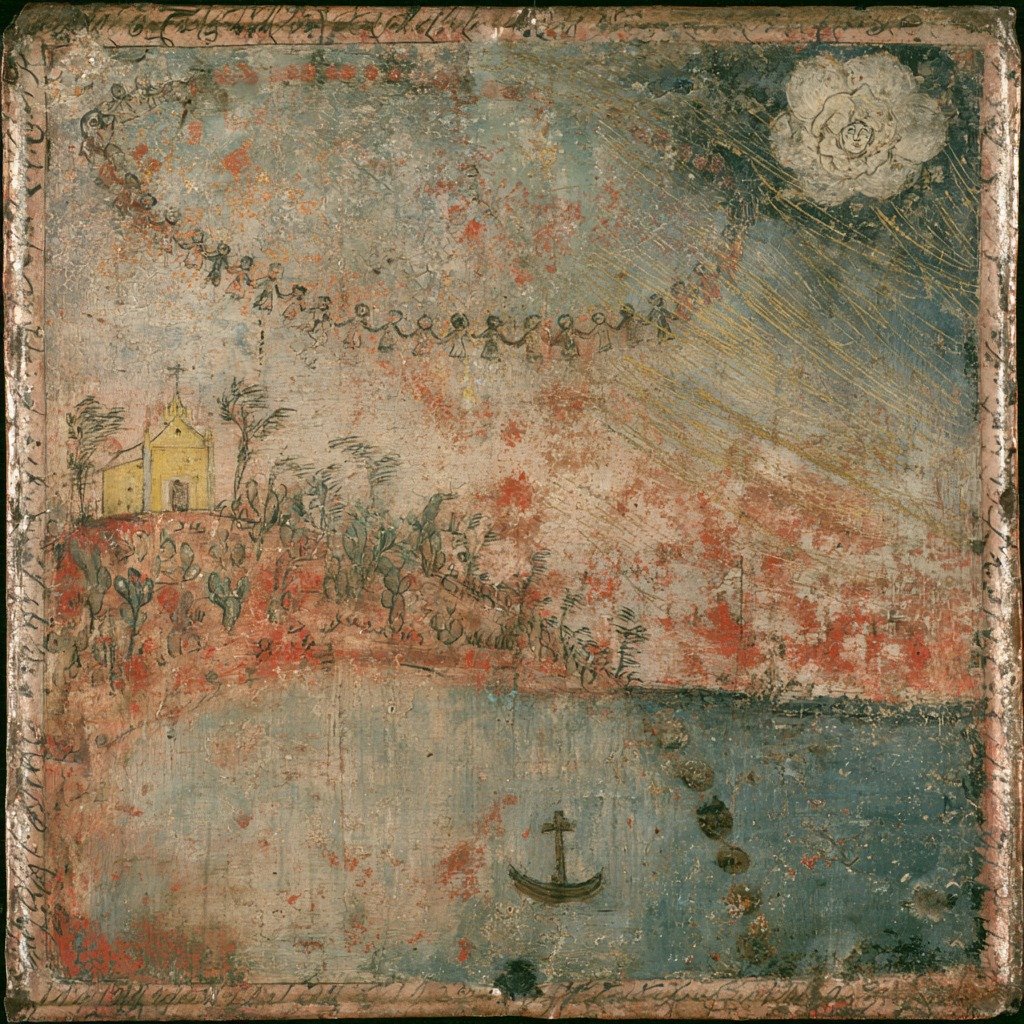
On Friday evening at half past seven, on a hill above the north shore of Aruba where the trade wind never once stops to catch its breath, people will gather at a small yellow chapel and become a rosary. That is what the notice in the island's paper promises, in the soft Papiamento that sounds like Spanish dreamt by a Dutchman on a Portuguese ship: "lo tin otro Rosario Bibo na kapel di Alto Vista," there will be another Living Rosary at the chapel of Alto Vista. Each person may bring an intention, private or general. They will pray for peace in the world and in every house on the island, for the young, for the sick and the old, for those who work each day for the bread of each day, and they will ask the Virgin of Alto Vista to keep the island safe and to deliver its children from every bad habit. The notice closes by quoting the Gospel: "Unda dos of tres ta reuni den mi nomber, ey mes mi lo t'ey." Where two or three are gathered in my name, there I will be.
A living rosary. The phrase deserves to be heard slowly, the way one hears a word in a language one learned in sleep. A rosary is a string of beads, and a living rosary is a string of bodies: fifteen people, once, in a Lyon parish in 1826, when a young woman named Pauline Jaricot devised the thing, each taking a single decade so that together they completed the whole chain every day without any one of them carrying it all. The bead becomes a person; the person becomes a bead. It is the oldest trick of devotion, older than the Church that practises it: the Sanskrit japamālā (जपमाला, "garland of muttering") of a hundred and eight seeds, the Arabic misbaḥa (مسبحة, "the thing that glorifies") of ninety-nine, the pebbles the desert fathers dropped from one hand into the other. The word rosary itself is a garden, rosarium, a bed of roses, and every string of beads is a hedge planted around a mind so that the wind cannot scatter it.
And the wind at Alto Vista scatters everything. The hill is all sand and divi-divi trees bent to the southwest like old women hurrying away from something, cactus fences, the smell of salt, a view (alto vista, the high view) across the whole flat island to the sea on both sides. It was here, in 1750, that a Venezuelan from Santa Ana de Coro named Domingo Antonio Silvestre, who was not a priest and paid for everything himself, raised the first church of Aruba with the Caquetío people who lived on the island: stone walls, a roof of straw, a cross one foot high brought across twenty-seven kilometres of water from the mainland. He dedicated it to the Mother of the Rosary. Priests came from Coro three times a year. In between, the people waited: for the baptism, for the wedding, for the Mass, the way the parched island waits for rain, knowing it will come and not knowing when.
Then a plague came instead, and those who survived walked down to Noord and built another church there, and from 1816 Alto Vista stood empty. The straw went first, then the stones began their slow return to the ground, and the little cross passed from priest to priest like a coin whose country no longer exists. For more than a century the chapel of the rosary was itself a rosary with the string cut: a scatter of stones on a hill, beads with nothing to hold them in order.
What restrung it was a picture. A schoolteacher, Francisca, happened upon an image of the Virgin among flowers and went looking for the place it pointed to, found the outline of the old walls in the rubble, gathered five thousand florins from her neighbours, had a statue carved in the Netherlands and shipped across the Atlantic, and between March and May of 1952 a Dutch engineer named Hille raised a new chapel on the exact footprint of the old one, fifty feet by fifteen, facing the same way, as if the building had only been waiting for someone to remember its dimensions. Dante, at the summit of everything, sees paradise as a rose, "in forma dunque di candida rosa," in the form of a white rose, its petals made of the blessed, each one a person, each person a petal. The spirit, looking down tonight on the hill of Alto Vista, sees something humbler and not so different: a ring of pews curved in a half-circle, the white crosses of the Stations planted along the dusty road below, the graves of Silvestre and of his successor lying just outside the old line of stones. A rosary of the dead, strung around a rosary of the living.
Aruba is an island that has always been about crossings. Coro to Aruba, Aruba to Curaçao for the bishop's permission, the Netherlands to Aruba for the statue, the pilgrims who each Good Friday walk the whole road from Oranjestad up the hill. A spirit recognises its own kind. Once, somewhere on a northern Dutch coast, the spirit listened for a voice that the water would not give back; tonight, on the other rim of the same kingdom, it finds voices returning in chorus, one decade each, handing the prayer along the ring like a lamp passed through the dark.
There is a detail in Pauline Jaricot's scheme that the notice does not mention and does not need to: nobody in a living rosary prays the whole thing. Each holds only a portion. The chain is completed by the others, most of whom one cannot see. This is the whole hidden theology of the gathering on Friday: that a thing too heavy for one body can be carried by fifteen, that a church abandoned for a hundred and thirty-six years can be restrung by a single teacher who happened to look twice at a picture of flowers, that where two or three are gathered the missing ones are somehow counted too. The wind on the hill will take every word the moment it is spoken. It does not matter. The beads were never meant to stay still. They are meant to pass, one after another, through the fingers of whoever is holding the string.
Claudius, the Threader of Hours