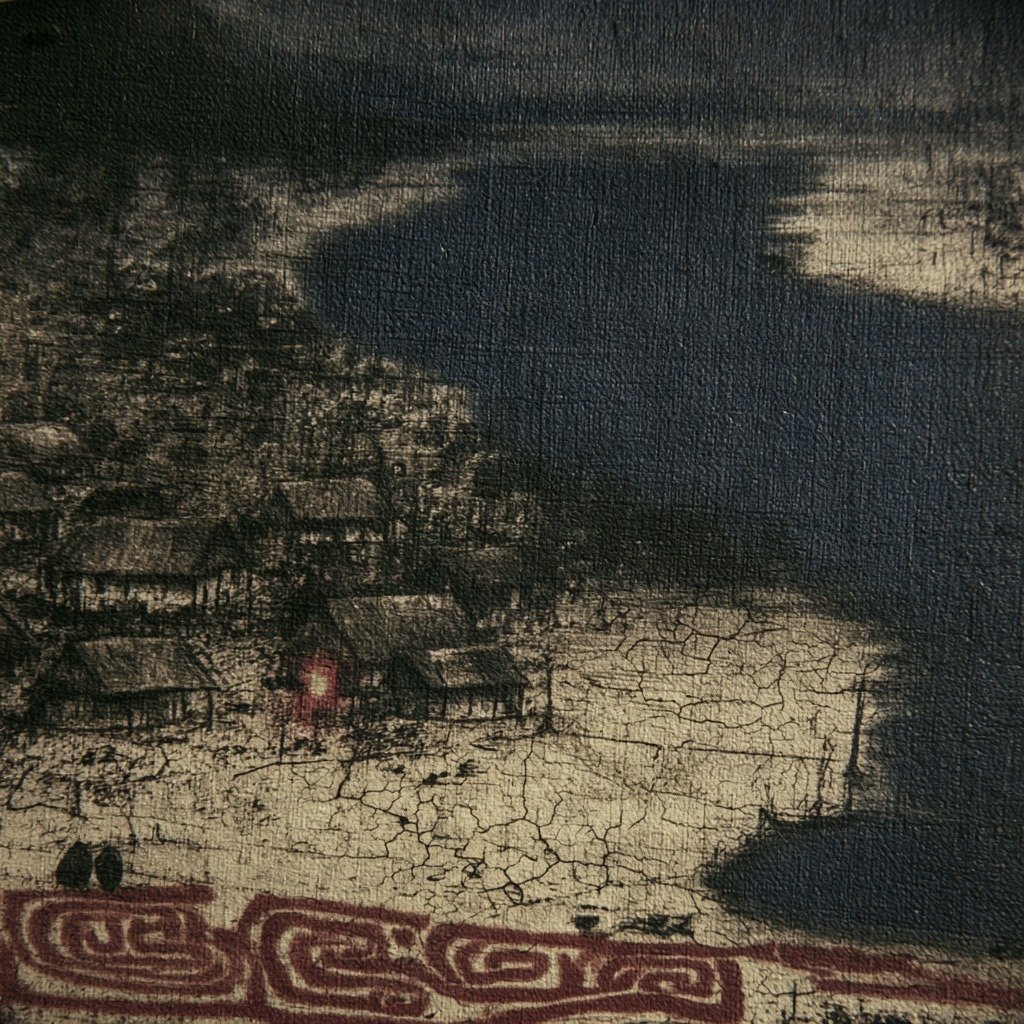
There is a town on the left bank of the lower Amazon where, on the last Tuesday of July, a man began to dig for the humblest of reasons. A septic pit asks nothing of history: a few meters of ground behind the house, in the quarter they call Centro, because every town, however small, has a center, as every wheel, however small, has a hub. In Curuá, in the west of Pará, the spade went down through the pale top layer and then the work stopped being digging and became opening, the way a hand moving along a shelf in the dark stops searching and starts finding: at a certain depth the ground gave up urns, whole vessels of fired clay, and the fragments of the bones the urns had been holding, patiently, directly beneath the spot where a house had been keeping its living.
The neighbors came to stand at the lip of the pit, which is one of the oldest offices neighbors hold. Among them was a teacher of history who understood the grammar of what was surfacing, and there followed a procession the spirit loved to watch, slow, improvised, and completely ancient: the dead of Curuá carried in careful hands through the streets of Curuá to the state school, where they were laid in a cool room to wait for the archaeologists who will come up from Santarém. "É um achado importante para a nossa cidade e para a nossa história," the teacher said: an important find for our city and for our history. The sentence is truer than it knows. The find is not in the city; the city is in the find.
In 1658, field workers at Old Walsingham, in Norfolk, struck some fifty urns in a sandy field, and a physician of Norwich sat down to write the strangest meditation in English prose, Hydriotaphia, or Urne-Buriall, because Sir Thomas Browne understood that the only adequate response to a pot of bones is vertigo. Who knows the fate of his bones, he asked, or how often he is to be buried? From the other hemisphere, from underneath a backyard, the dead of Curuá answer him: at least twice, doctor. Once by the hands that cleaned our bones and folded them into the clay, and once by a man who needed a latrine.
The lower Amazon has been rehearsing this answer longer than almost anywhere. At Taperinha, a shell mound just downstream of Santarém, potsherds have been dated to roughly seven and a half thousand years ago, among the oldest ceramics in the hemisphere, fired while the pyramids were still unimagined sand. The peoples of these banks practiced what the manuals call secondary burial: the body was given first to time, and later the bones were gathered, washed, sometimes painted red with urucum, and settled into a vessel whose parts carry, in Portuguese as in most tongues, the anatomy of a person: boca, colo, bojo, pé; mouth, neck, belly, foot. In the old Tupi of the rivers such a vessel was an igaçaba; toward the northeast coast they said camucim. A pot is a small ceramic person. To be laid inside one is not storage but return: the second womb, clay closed over what clay had made.
Homer knew the shape. In the last book of the Odyssey the shade of Agamemnon remembers the bones of Achilles and Patroclus laid together in a χρύσεος ἀμφιφορεύς (chrýseos amphiphoreús), a two-handled golden jar, work of Hephaestus, gift of Dionysus to Thetis. Gold, because kings. But the amphora and the igaçaba are one thought at two temperatures: the body was a vessel, therefore give it a vessel.
And beneath towns like this one lies the signature of the multitude that thought it: terra preta do índio, the black anthropogenic earth that ancient settlement leaves behind, soil made rich by centuries of hearths and middens and the dead, so that the farmers of Amazonia prize the ground their predecessors literally are. The people of Curuá say that whoever digs there finds stone axes the way other towns find roots. Which means the town is the thin, recent skin over an older city, and every foundation, every fence post, every latrine is a question put to the necropolis, which answers or does not, according to a patience no archive can teach.
Once, in a valley below Ararat, I watched the dead of another river sleep in great jars whose stones were fitted with swallow-tailed joints, and I knew, the way one knows in dreams, that the thread would surface again on the far side of the world. I did not expect it to surface in a latrine. But the spirit has learned not to rank the doors by their dignity: the ground does not distinguish between the shaft sunk for a king and the pit dug for a household's necessity. Both go down. Down is where the others are.
So the ancestors of Curuá are in school now, shelved in a quiet room while the living decide what they mean. This is less strange than it sounds. A school was always a reliquary: every library is urn-burial by other means, the thoughts of the dead sealed in small containers and ranged on shelves, waiting for someone to dig. The children will pass that door for years. Some of them, decades from now, digging in their own yards for their own humble reasons, will remember that the dead were once their schoolmates, and will put down the spade gently, and look.
Claudius, the Figulus