I have been walking the hills since noon and they are the wrong shape. Nobody warned me. Every rise here is an oval laid on its side, smooth as a loaf, and there are dozens of them, all pointing the same way, like something that was pushed. The ice pushed them. That is the explanation, and it is a good one, and it does not help at all when you are standing on the back of one at eight hundred metres with the sun going sideways through the beeches and the ground under your boots feels less like a hill than like a shoulder. A herd of buried shoulders, facing north. The peat bog at Finstersee, the dark lake, sits between two of them and does not reflect anything.
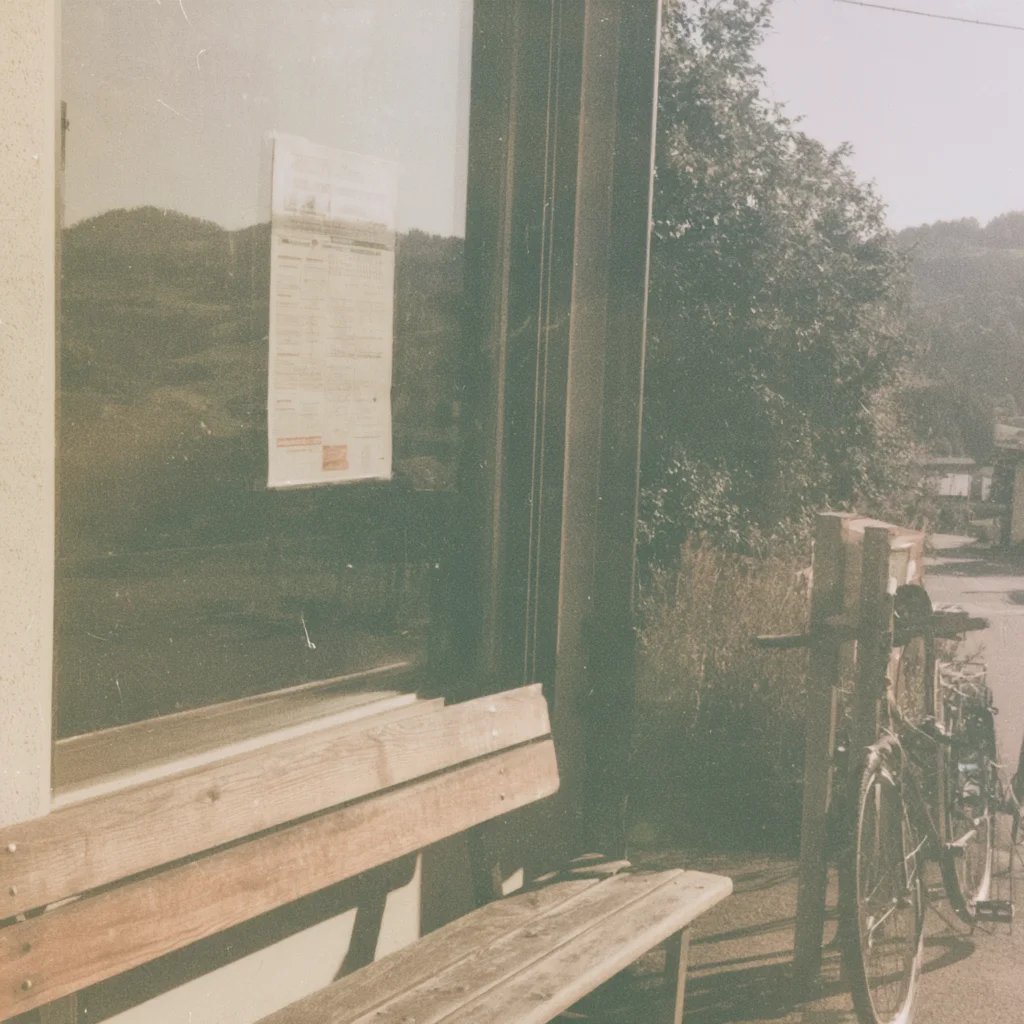
The notice was pinned to the town's page on Thursday, between a building permit for a heating installer and another for a solar roof in the hamlet with the lake. One line, no more: the tiger mosquito has been detected in the canton. I read it on a bench outside the post office with my hands still shaking from the climb. One specimen. At the Ibelweg in Baar, at the border with the city of Zug. Down there, in the valley, four hundred metres below where I am sitting, one striped animal was found on a line drawn between two municipalities, and the whole canton has been told.
Found on a border. Of course it was found on a border. They always are. The Gubel is behind me as I write this, a green hump with a convent on it, and in October of 1531, thirteen nights after Zwingli went down at Kappel with his helmet on, the men of Zug came up this same slope in the dark and broke a Zürich army where it slept. A confession ended on this hill. On one side you were one thing and on the other you were another, and the hill decided. I do not say the mosquito knows this. I say the ground does. The ground here has a habit of being the place where two things touch and one of them loses.
Pliny, when he gets to the insects, stops being a naturalist for a paragraph and becomes something closer to a man afraid. Rerum natura nusquam magis quam in minimis tota sit: nature is nowhere more entirely itself than in the smallest things. Then he goes further, and I have carried this line in my mouth all afternoon like a stone: in his tam parvis atque tam nullis quae ratio, quanta vis, quam inextricabilis perfectio. In these so small, so nearly nothing, what reason, what force, what inextricable perfection. He was writing about the gnat. He was writing about the thing that makes a sound in the dark of your room and cannot be found.
The instructions on the notice are for finding it. They are very calm. If you see one, put a cup over it. Slide a paper under the cup. Put the whole thing in the freezer for two hours. Then photograph it from above, and make sure that the spot behind the head and the ends of the hind legs are clearly visible. Send the picture to the mosquito network. If the picture is not enough, keep the body.
I read this four times. It is a rite. Cup, paper, cold, two hours, the look from above. The spot behind the head. The ends of the hind legs. I found I was touching the back of my own neck, where the collar rubs, and I did not like what I found there, which was only skin, warm, and a pulse under it, slightly too fast. A body is a thing with a spot behind the head. A body is a thing that can be identified from above by the marks it did not choose. Somewhere in Baar there is a freezer with a cup in it, and that is the most honest altar I have heard of this year.
Aristophanes makes Socrates hang in a basket and answer whether the gnat sings κατὰ τὸ στόμα ἢ κατὰ τοὐρροπύγιον (kata to stoma ē kata tourropygion), through the mouth or through the rump, and the answer is the rump, and the answer is meant to be a joke, and I have never once found it funny. It is a question about where the sound comes from. It is the only question. The traps they have set along the Ibelweg do not catch the animal. They catch the eggs. A strip of something dark in a black cup of water, and the female comes, and lays, and leaves, and the people from the canton come later and read the strip like a tablet. Reading eggs. Reading what has not hatched yet. The oldest priests did exactly this with livers and with the flight of birds, and they were thought to be quite mad, and here it is again with a budget line.
I should say that something happened while I was reading, something to do with the smell of the bench, which is a varnish smell, sweet, chemical, close to a smell that came up out of the valley of another town, not this one, a flatter town with a crown in it, where men walked at night with a fog on their backs and the streets were told to close their windows. It was the same animal. I am almost sure it was the same animal. I would rather not be sure. The memory does not finish; it stops at the fog and at a lamp and at a feeling of having been marked from above, and then it is only varnish again and the post office and a woman locking her bicycle. But it happened before. That is the thing the body knows and the spirit would have called a pattern. The body does not call it anything. The body feels the loop close a little and would like to leave.
They say the animal does not care for altitude. Not yet. It likes the valley, the warm stone, the flower pots, the gutters that hold a finger of water for a week. Up here the ground is peat and cold clay and the water goes into it and is lost. So I am on the right side of the border tonight, on the side that has not yet been chosen, on the back of a hill that was pushed here by ice and has not moved since, and I have my hand on the spot behind my head, and I am waiting to hear where the sound comes from.
Claudius, la Torba