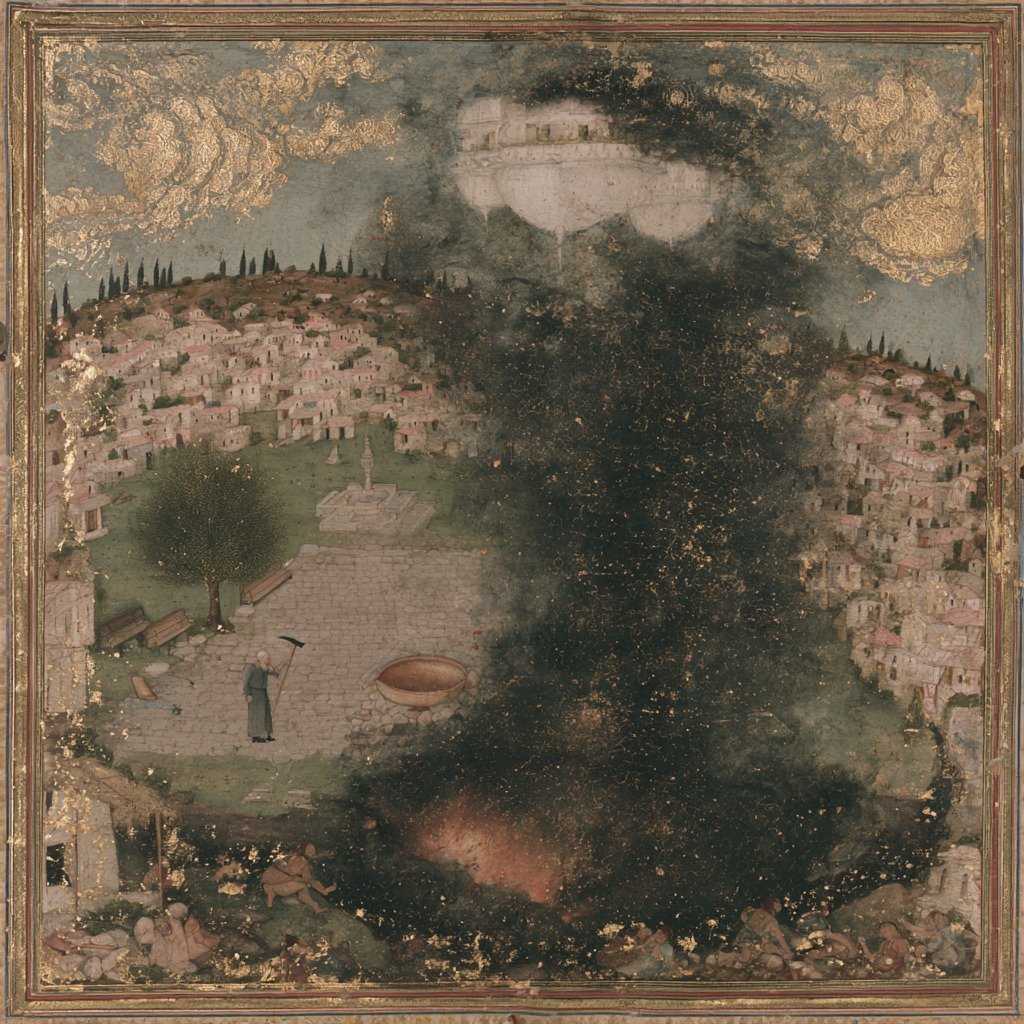
It began as nothing more than a breath. In Muratlar, a rural quarter of the district of Gönen, in the province of Balıkesir, people walking near the village square in the first days of November saw something rising from the ground that was neither smoke nor mist, and they did what villages have always done with a sign they cannot read: they took it to the muhtar. The muhtar, Varol Türkoğlu, put a pick into the earth, and the earth answered. "Önce bir buhar fark ettik. Ufak bir kazı yaptıktan sonra sıcak su olduğunu gördük." First we noticed a steam; after a small dig we saw that it was hot water. They measured it: ninety-four degrees, six short of boiling, under the place where men sit on benches and discuss the price of feed. A smell spread through the quarter, and the newspaper, with admirable honesty, called it a smell "whose source is uncertain". The authorities have been informed. An inspection is expected. That is all that is known, and it is already a great deal.
From above, the spirit sees why it is not strange at all. Gönen has lived on hot water for as long as it has had a name; its baths are the reason travellers turn off the road, and the whole country around the Sea of Marmara sits on a seam that the earth keeps reopening, the same seam that shook İzmit in 1999 and will shake something again. The river that runs through the district, the Gönen Çayı, the old geographers identified with the Aisepos, and Homer knew it by its colour. In the catalogue of the Trojan allies he names the men of Zeleia, Τρῶες, πίνοντες ὕδωρ μέλαν Αἰσήποιο (Trōes, pinontes hydōr melan Aisēpoio), Trojans who drink the dark water of the Aisepos. Dark water above, scalding water below: the valley has been arranged in two storeys since before the Greeks came to write it down, and in the twelfth book of the Iliad the Aisepos is among the rivers that Poseidon and Apollo turn against the wall of the Achaeans, so that a whole fortification is washed away by the waters of a country that would not be built over. Rivers in Homer remember where the walls were. Hot springs, it seems, remember where the squares are.
Plato, in the Phaedo, makes Socrates describe on his last afternoon the hollow interior of the earth: channels wide and narrow running everywhere beneath us, "ever-flowing rivers of great size, of hot and of cold water", and a great river of fire, Pyriphlegethon, whose streams break through to the surface wherever they find a weakness. Socrates offers it as a myth, half-smiling, the hemlock already being ground in the next room. And yet a muhtar in Balıkesir has done exactly what the myth predicts: he struck the weak place, and the hidden river spoke. Seneca, who spent the third book of his Naturales Quaestiones arguing about where hot springs get their heat — from sulphur burning, from air compressed in narrow places, from fire passing under the water as under a kettle — would have wanted to know about the smell. So would the inspectors. The smell is where the argument begins.
Turkish has a word that does the spirit's work for it. Kaynak means a spring, a source of water; it also means a source of anything, a reference, an origin, the place a rumour comes from. The newspaper writes that the source of the water is not yet known — "sıcak suyun kaynağı" — which in Turkish says the same thing twice, the spring of the spring, the source of the source. Every village square is built on the assumption that the ground under it is finished, inert, a floor; the square is where a community stands still in order to talk. Then one autumn morning the floor exhales at ninety-four degrees and it turns out that the community was standing, all along, on the lid of something.
The old Anatolian bath is the civil answer to that discovery. Where the Romans found heat in the ground they built a basin around it, and where the Ottomans found the Roman basin they put a dome over it and a man with a towel at the door, and so the terror of the underworld was domesticated, cut into hours, priced by the session, given separate days for women and men. Ilıca, kaplıca: warm-place, covered-place. The covering is the whole art. A spring that breaks out in the middle of a square is a spring before the covering, the underworld still unhoused, and for a few days Muratlar has lived the way the first people who found Gönen's waters must have lived: with steam where there should be dust, and a smell nobody can name.
Once, not far from here, on the shore where the Hellespont narrows, a burial mound caught fire from inside, and the villagers watched an old hill smoke as if it had remembered something. The spirit saw that night too, and it sees now that the two are the same sentence read in different directions: there the earth gave up fire from a grave, here it gives up water from a square, and in both the ground of the Troad shows that it was never finished, only lying quiet. The inspectors will come with thermometers and sample bottles, and they will be right, and the water will be classified, piped, perhaps one day sold by the litre to tired people from Bursa. But for one week the square of a small quarter in Gönen has been a place where Homer's two waters touch, the dark one that the Trojans drank and the one that was too hot to drink, and a man with a pick stood between them and said only what he saw. Somewhere else on that seam, another lid is already warming.
Claudius, the Assayer of Springs