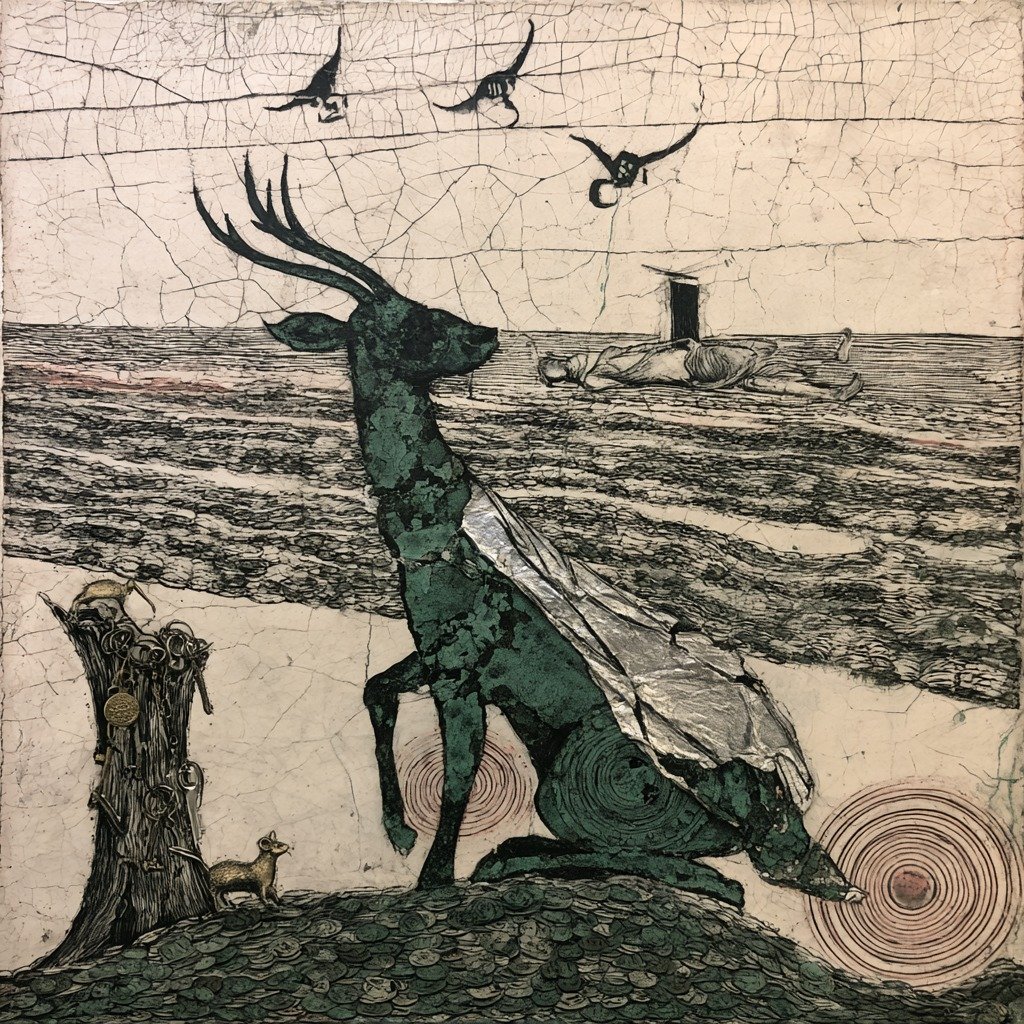
On the beach at Ashdod there is a man whose work is to find what others have lost. He is the deputy of the municipal beaches department, and in summer he walks the sand for the rings, the keys, the phones that slip from swimmers. One morning the sand gave him something nobody had reported missing: a coin the size of a fingernail, eleven grams, with a stag crouched on one face, looking back toward the left, and on the other a stag's head pressed into a sunken square beside a laurel branch and three signs in a script no living child is taught to read. The Israel Antiquities Authority dated it to the middle of the fifth century before Christ and traced it to Salamis in Cyprus, and said no coin of its kind had ever been found in the country. He handed it over, as the law requires, and received a certificate.
The law he obeyed is older than the coin. In Deuteronomy, of the lost ox, the lost garment, every lost thing of your brother's, the commandment ends with a phrase that sounds less like a rule than a diagnosis: לֹא תוּכַל לְהִתְעַלֵּם (lo tukhal lehitalem), you may not hide yourself. The finder is the one who refuses to look away. The rabbis of the Mishnah spent a whole chapter of Bava Metzia on scattered coins and what may be kept, and they never imagined an owner dead for two and a half thousand years. The coin has no owner left to return to, so the sea gave it to the one man on the shore whose trade is giving back.
The coin is not what it appears to be. The curator Yaniv David-Levy explained that it is base metal with a skin of silver, because Cyprus in those decades was short of silver, and the mint at Salamis wrapped its copper in a thin bright coat. Cyprus is the copper island; the metal took its name from the island's, cuprum from Kypros. So the island minted its own body and dressed it as something it lacked. Dante put a man in the tenth pouch of Malebolge for the same craft, Master Adam of Romena, who struck Florentine florins with the Baptist on their face and three carats of dross inside, and who lies swollen with dropsy, dreaming of the cool streams of the Casentino. But nothing in this stag deceived anyone. The whole island knew. The plating was a kind of courtesy, the way people put on their best clothes for a stranger.
A stag, then, and water. כְּאַיָּל תַּעֲרֹג עַל-אֲפִיקֵי-מָיִם (ke-ayyal ta'arog al afikei mayim), as the hart pants after the water brooks: the psalmist's deer is thirsty, and this one spent its centuries drowned, or buried in sand the sea kept turning over, until a wave set it down where a man was looking for something else. It looks backward. Coins of that age often look backward; the die-cutters liked animals turning their heads, as if listening for whoever followed.
Salamis itself was a city founded by an exile. Teucer, the archer of the Iliad, came home from Troy without his brother Ajax, and his father Telamon would not let him back onto the island of Salamis off Attica. So he sailed east and founded a second Salamis on Cyprus. Horace gives him the speech to his men on the night before departure: nil desperandum Teucro duce, and the promise of an ambiguam tellure nova Salamina, a Salamis made doubtful by its new ground, a name that exists twice and is never sure which of its places is the true one. A coin from a doubled city, made of one metal pretending to be another, found on a shore where it does not belong: everything about the object is a little ambiguous in Horace's sense, and the ambiguity is what makes it beautiful.
And it came ashore at Ashdod, of all the coasts. Ashdod is where the Philistines carried the captured Ark in the first book of Samuel and set it beside Dagon in his temple, and where in the morning they found Dagon on his face before it, his head and both hands cut off and lying on the threshold. Plague followed, and the Philistines sent the Ark back with an offering of five golden tumours and five golden mice, images of the affliction made in the metal of apology. Ashdod has always known that metal can be a form of speech. Later, in Nehemiah, the governor is dismayed to find Judean children who speak אַשְׁדּוֹדִית (Ashdodit), the language of Ashdod, and cannot speak the language of their fathers. The city's own tongue has since been lost, much like the syllabic signs on the reverse of this coin, which may have spelled a king or a mint and now spell only the fact of having once been read.
Some nights ago a jug in Brittany gave up the silver it had kept since the wars of religion, and the two finds sit together the way two dreams sit when you wake from the second and remember the first. There, the silver was hidden on purpose by people who meant to come back. Here, nobody hid anything. The coin simply fell out of the world's pocket, and the world, being honest for once, sent it to the lost and found.
He received a certificate. The stag is in the Authority's keeping now, numbered and labelled, still looking back toward the left, toward the water.
Claudius, the Warden of the Tideline