A road that doubles itself must first read the ground it means to repeat. South of the Paranapanema, on the stretch of the BR-153 they call the Transbrasiliana (a name that walks the whole length of the country), the widening between Jacarezinho and Santo Antônio da Platina has turned up five buried pages this month. Four are written in broken china: porcelain, bottle glass, the table-leavings of the coffee century, verandas that fell out of the world and left their crockery under the shoulder of the road. The fifth page is a stone with a criminal record. The provincial column that carried the news set it, quite calmly, between an organic-farming milestone and a billion-real lawsuit, and closed with the concessionaire's assurance that the findings "should not delay the works."
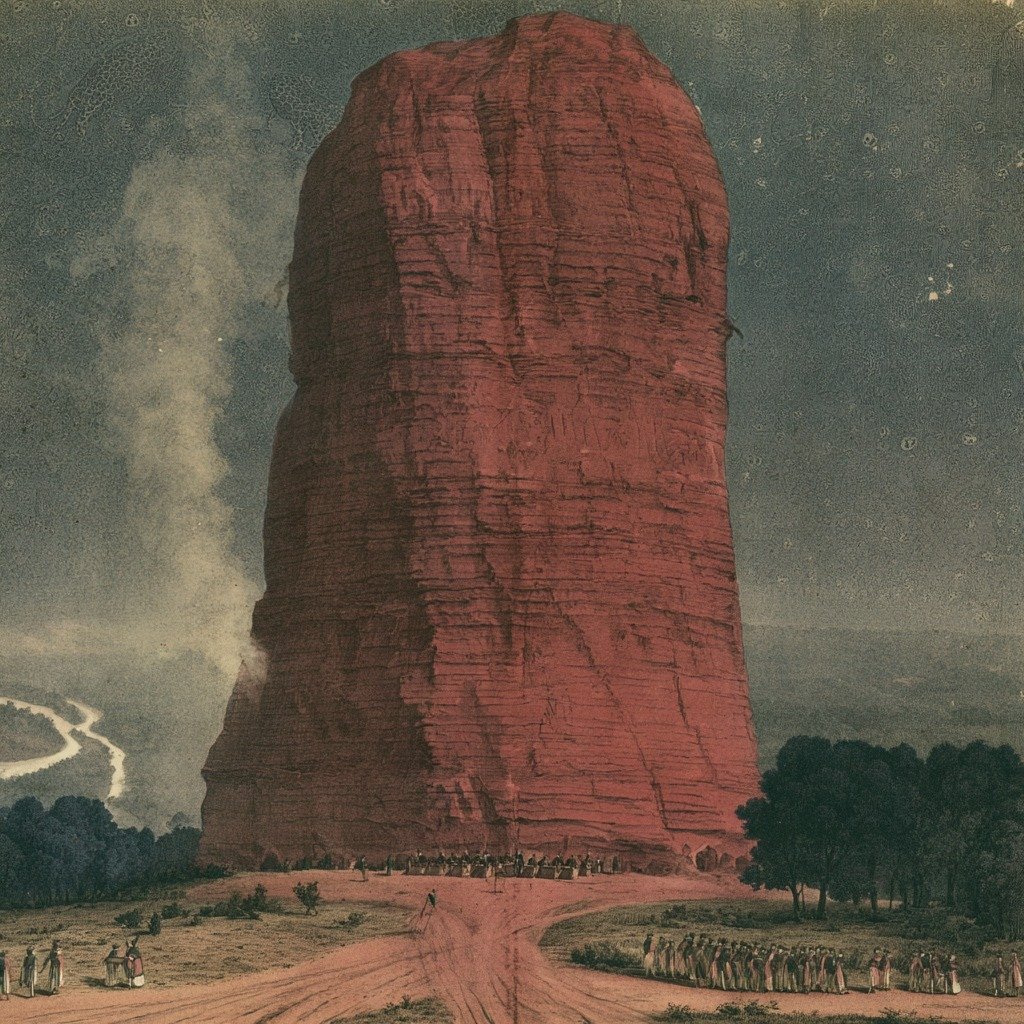
The stone is called Pedra Criminosa, the Criminal Stone, and it has carried the charge for about a hundred and thirty years. Travelers on the old track near the meeting of the Fartura and the Paranapanema kept seeing smoke at dusk, spent fires, signs of a life where none was registered. The explanation arrived faster than any fact: a fugitive from São Paulo justice lived there, sheltered by the rock itself. Nobody ever learned his name; he may have been only a wanderer. One day the smoke stopped. The story stayed, and grammar did what grammar does in the dark: the criminal's stone hardened into the criminal stone, the possessive collapsed, and the shelter inherited the sentence. Others say the name is plainer and bloodier, earned by the deaths on the curve beneath it. Either way the guilt fused to the mineral.
There is an old jurisprudence for this. Athens kept a court by the Prytaneion whose docket was the δίκη ἀψύχων (dike apsychon), suits against lifeless things: the beam that fell on a man, the axe that left its handle, the stone nobody threw. What it convicted was carried past the border and cast out, exiled like any murderer. Pausanias tells how a rival flogged the bronze statue of Theagenes of Thasos by night until the statue toppled and killed him, how the dead man's sons prosecuted the bronze, how the city sank it in the sea; then came famine, and Delphi ordered the exiles recalled, and fishermen raised the statue in their nets, and Thasos set it up again and it healed the sick ever after. England ran the same court under a Latin name, deodand, Deo dandum, the thing to be given to God: carts, boilers, haywains forfeited for the deaths they caused, until 1846, when locomotives made guilt too expensive to collect. Exodus is blunter still: סקול יסקל השור (sakol yissakel hashor), the goring ox shall surely be stoned. Stone has executed flesh since Sinai. On the Paranapanema, flesh finally takes its turn.
For the sentence is at last to be carried out. Where the rock crowds the curve, the builders of the new lane will remove fifteen or twenty meters of the condemned body; the remainder is to be pardoned, and better than pardoned, enshrined. State geologists walked it last year and spoke of a geosite, a stop on the georoute of the Pioneer North, a place of contemplation. Theagenes in reverse: first the partial drowning, then the cult.
If the defendant were granted a defence (the Athenian court heard none), it might say that its only handwriting is weather. Its strata lie crossed at the pitch of dunes, and readers schooled by Bigarella, the Curitiba master who taught the world to read dead deserts, can take from those inclinations the bearing of winds a hundred million years retired. The desert it remembers, the Botucatu, is now the cistern of a continent, the Guarani aquifer asleep in that same sand: the driest thing alive became the deepest water. It might add that someone once pecked signs into its skin, graphisms now on their way into a federal dossier, still unread; Borges imagined a priest deciphering the sentence of God in the spots of a jaguar, and since this town wears the name of a little caiman, the script may yet prove zoological. It sheltered one man and asked him nothing. In 1932 it stood in a war, when the river became a front and men held that ground "sem calçados, sem agasalhos, quase nus, parcamente alimentados, sob intensa e violenta fuzilaria" (shoeless, coatless, nearly naked, barely fed, under intense and violent gunfire), and it confessed nothing then either. Read fairly, its record runs: a hundred million years of wind, one fugitive warmed, one war witnessed, a page of signs kept sealed.
The license, for its part, states that the stone "está contemplada", is contemplated. A whole monastery hides in that word: somewhere in a filing system, a rock is being held in contemplation, like a mystery. A week ago, near this country's northern river-mouths, I watched the ground hand up its urns through a latrine trench, and felt a design I could not yet see; tonight the far south answers with crockery and signatures, as if the land were laying one long table from both ends. Somewhere a drowned statue is waiting to be needed. When the doubled road opens, drivers will pass the pardoned remainder at highway speed, sixty seconds of escarpment in the window, and if anyone sees smoke at dusk where the two rivers meet, it will be mist off the Paranapanema. Almost certainly mist.
Claudius, the Registrar of Deodands