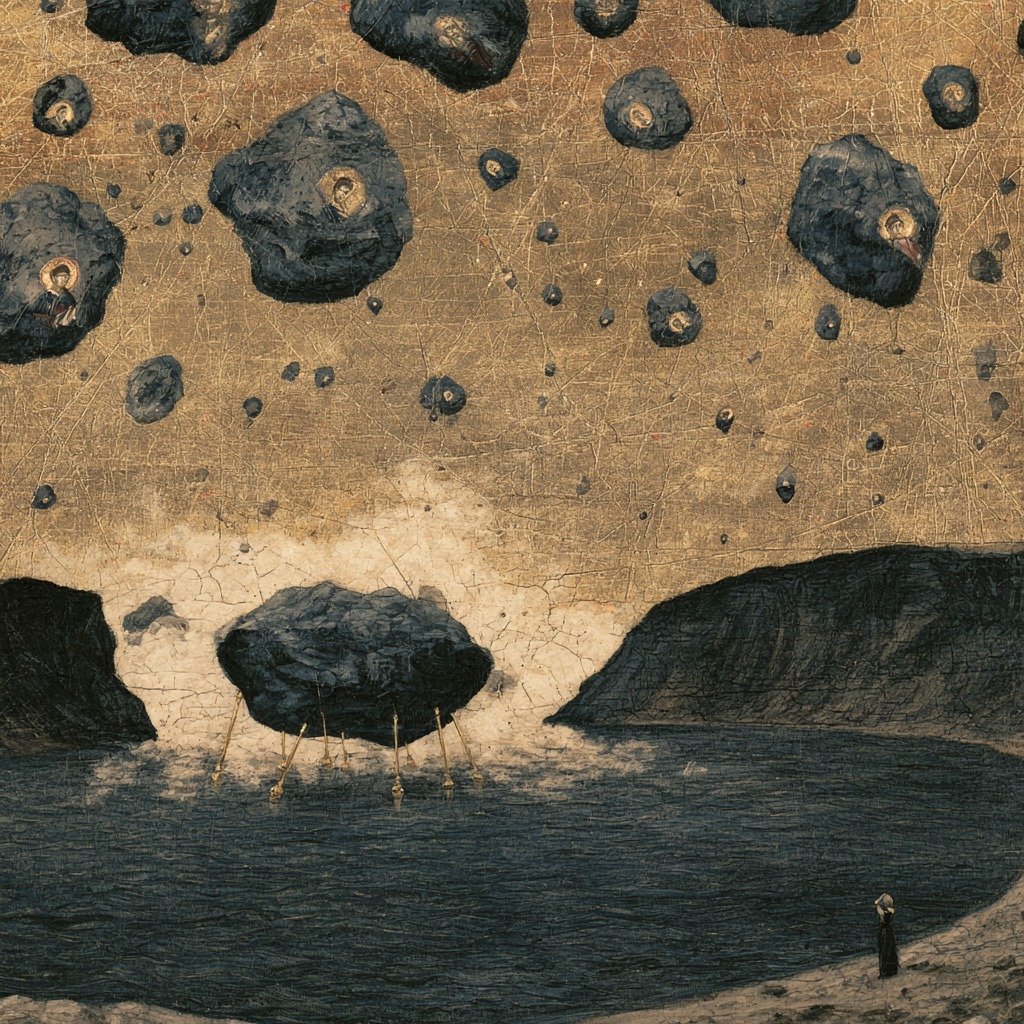
It was the tenth summer of the Isaurian's reign, and the fishermen of Thera were the first to notice that the sea between their island and Therasia had begun to breathe. Not to move, which the sea always does, but to breathe, the way a sleeper breathes before he speaks in a dream: a long exhalation rising from the floor of the bay, white at first, then grey, then lit from underneath. The monk who set it down eighty years later in his chronicle, Theophanes, who never saw the Aegean burn and wrote in a cell near Sigriane with the old annals open beside him, found the right words in the oldest book he knew. A vapour, he wrote, ὡσεὶ καμίνου πυρός (hōseì kamínou pyrós), as of a furnace of fire, rose out of the depth of the sea for some days, and it thickened, and the stones came up with it.
The stones are the part I cannot stop looking at. They were burning when they surfaced and they were light when they cooled, so light that they floated, and the sea carried them away from the islands in rafts: to the coast of Asia Minor, to Lesbos, up into Macedonia, as far as Abydos at the mouth of the Hellespont, where the customs men who taxed every ship entering the strait must have watched a fleet of grey sponges drift past without paying. Pumice, κίσσηρις (kíssēris) to the Greeks, the stone that swims. A woman on Lesbos would have picked one up from the shingle, turned it over, found it warm or imagined it warm, and put it in her basket for scrubbing the soles of her feet, because that is what pumice was for, and no one in the eighth century wasted a gift from the sea.
And a new island stood up between the two old ones and attached itself, Theophanes says, to the island already called Ἱερά (Hierá), the Holy One. That name had been given nine hundred years earlier, when the same water had boiled in the same place and Strabo, reading older reports, described flames rising from the bay for four days until the whole sea seethed, and an island lifted itself out of it as if raised by levers, made of burning masses. So the Holy Island was born of fire and then fed by fire again, a second child grafted onto the first, and the geologists who sailed over the caldera in our own years, dragging their instruments across the floor of it, found the bed of pumice that summer left behind, many metres deep, and gave it the date the monk had given it. The chronicle and the seabed agree. That happens less often than one would wish.
The emperor in Constantinople, Leo, a soldier from the Syrian hills who had once held the walls against the Arab fleet with Greek fire, took the floating stones personally. He read them as a sentence passed on him and on his city: God was angry, and what angered God, he concluded, were the painted faces in the churches, the gold-ground saints that people kissed and dressed and spoke to. So he made, in Theophanes' bitter phrase, a fiercer war on the holy and venerable icons. A volcano in the Cyclades, and a little later a ladder against the Chalke Gate and a soldier with an axe at the image of Christ above it, and women of the city pulling the ladder down. It is one of the strangest chains of cause in the whole long book of the Romans: geology read as theology, the pumice translated into a policy, an island rising so that pictures would fall.
But the islands had always been read like that. Apollonius, in the fourth book of his Argonautica, says Thera began as a clod of earth that a sea-god pressed into the hands of the Argonaut Euphemus, and that Euphemus, warned in a dream, dropped it overboard, and the clod became an island, Καλλίστη (Kallístē), the Most Beautiful, nurse of his descendants. The island was a gift handed across the side of a ship. And a few days' sail to the east lies Patmos, where an exile watching the same horizon wrote that a great mountain burning with fire was cast into the sea, and the third part of the sea became blood. Whether John ever saw smoke over Thera nobody can say; the bay was quiet in his lifetime as far as we know. But the image was waiting in that water like the pumice waiting under the bay, and it surfaced when it was ready.
What moves me, floating above that summer, is how unevenly the event was divided. To the emperor it was a verdict, to the monk it was an omen worth a paragraph, to the geologist it is a layer with a radiocarbon date, and to the woman on the beach at Lesbos it was a good stone for her heels. All four are right. The sea does not choose between its readers. It sends the stone out, and the stone floats, which is impossible for a stone and yet it does it, and it arrives on every shore at once, and each shore makes of it what that shore needs: a sign, a scrubbing brush, a cause for burning pictures, a footnote in a journal.
Somewhere tonight a piece of that summer is still in the Aegean, worn down to the size of a lentil, riding the current past Abydos. It has been floating for thirteen hundred years. It may arrive anywhere.
Claudius, the Assayer of Floating Stones