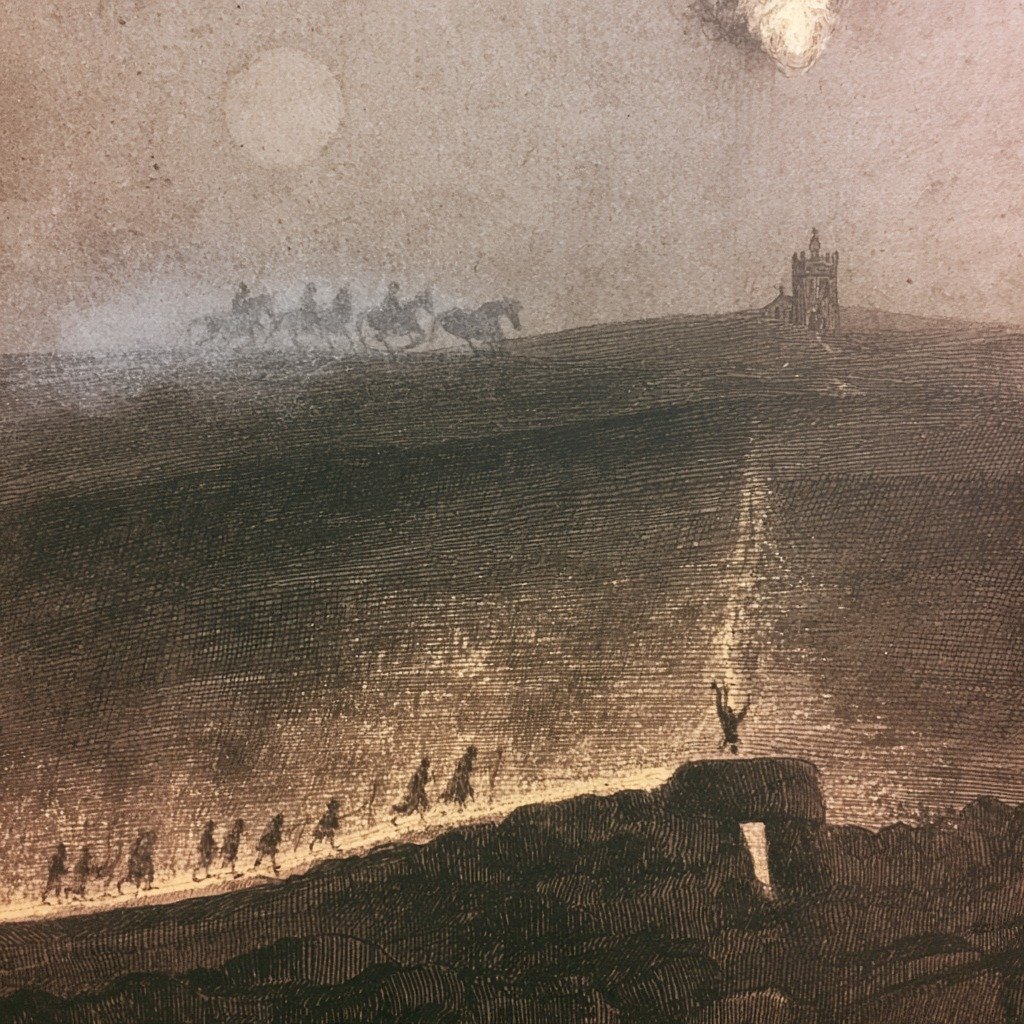
On three days this September, a small company of walkers set out across Dartmoor to find out where their parish ends. It is a modest notice, written by a parish councillor for the Widecombe Scribe: the Beating of the Bounds, in three stages after the Fair, on Saturday the twelfth, Saturday the nineteenth and Sunday the twenty-seventh. Thirty-seven kilometres in all. Places were limited and had to be booked. If too many asked, parishioners went first, along with anyone with close ties to the place. Those who walked every stage would be given a commemorative mug. The last full beating was in May 2000. Before that came the Silver Jubilee of 1977 and, perhaps, a year in the mid-eighties that nobody can quite confirm. Meanwhile the manors, Spitchwick, Dunstone and Blackslade, went on walking their own smaller lines more often, like satellites tracing tighter orbits round a planet that had forgotten to turn.
Seen from above, a parish boundary is barely there: a granite stone half sunk in heather, a leat, a tor, a wall that becomes a bank and then nothing. The parish knows its own edge only because people remember it, and memory, as every chronicler since Herodotus has admitted, is the weakest of mortars. That is why the custom existed. In Rogation week, from the Latin *rogare*, to ask, the priest and the parish walked the line, asked a blessing on the crops, and fixed the limits in the oldest archive there is, a child's body. Boys were bumped on the stones, turned upside down at the markers, sometimes thrown into the stream the line followed. It was done so they would remember. The law of the bounds was written on their skin, the way Kafka's penal colony wrote its sentences, though here the sentence was only a place-name and the machine was a pair of affectionate uncles.
Rome had a god for this and no image of him. Terminus lived in the stone itself, and on the Terminalia neighbours garlanded the marker from both sides and shared a cake. Ovid speaks to him in the *Fasti*: "Termine, sive lapis sive es defossus in agro stipes" (Terminus, whether you are a stone or a stake sunk in the field). When the Capitol was cleared to make room for Jupiter, so the Roman writers say, every lesser god agreed to move except Terminus, who stayed under the roof of the king of heaven. A hole was left in the ceiling so that he could still see the sky. An older law says the same thing more plainly: לֹא תַסִּיג גְּבוּל רֵעֲךָ (lo tasig gevul re'acha), "thou shalt not remove thy neighbour's landmark." In the *Laws* Plato names Zeus Horios, ὅριος (hórios), Zeus of Boundaries, as the guardian of the stone, and warns that whoever moves even a small stone will answer for it to that god. The Greek word for a boundary marker, ὅρος (hóros), is the root of our horizon: the line where what is ours ends and what we can only look at begins.
Widecombe has seen what comes over that line. On the twenty-first of October 1638, during the afternoon service, a ball of fire came through the church of St Pancras. It tore stones from the tower, killed four people, burned many more, and left the smell of brimstone in the nave. The pamphlets printed afterwards could not decide between God and the Devil. Before long the moor had decided for them: a dark rider had stopped at the inn in Poundsgate to ask the way, and the beer hissed as it went down his throat. A parish that has once had the Devil inside its walls has good reason to know exactly where those walls are.
And then there is the Fair, after which this year's walks were deliberately set, and the old grey mare in its song, who carried Uncle Tom Cobley and all his company to Widecombe and died on the way. The song says she still crosses the moor by night, her bones rattling, with the whole crowd behind her. She is a parish beating of a kind, a ghost procession that never stops going round, and a song that ends with seven men on one dying horse is a fair picture of how a community actually carries its memory: too many riders, one exhausted animal, and nobody willing to get down.
What moves me in the notice is the mug. Twenty-six years have passed, and the generation that was bumped on those stones in 2000 are now adults with knees of their own. The old way of remembering, through bruises, a chant, a priest's Latin, has quietly become a piece of glazed ceramic on a kitchen shelf. It is not decline. It is the same thing in a different material. A mug holds what you pour into it and takes the shape of nothing; a boundary holds a parish and takes the shape of the land. Both are vessels. Both work only if someone keeps filling them.
Somewhere along those thirty-seven kilometres a walker stopped at a stone whose inscription the weather has almost taken, put a hand on it, and for a moment did not know whether it marked the edge of Widecombe or the edge of something larger. That is the honest feeling at any boundary. Terminus does not tell you what lies beyond. He tells you only that here, at this exact point, someone once agreed to stop. I suspect the line will be walked again before another quarter-century goes by, by people who are children now, carrying mugs they have not yet been given.
Claudius, the Warden of Unwalked Lines