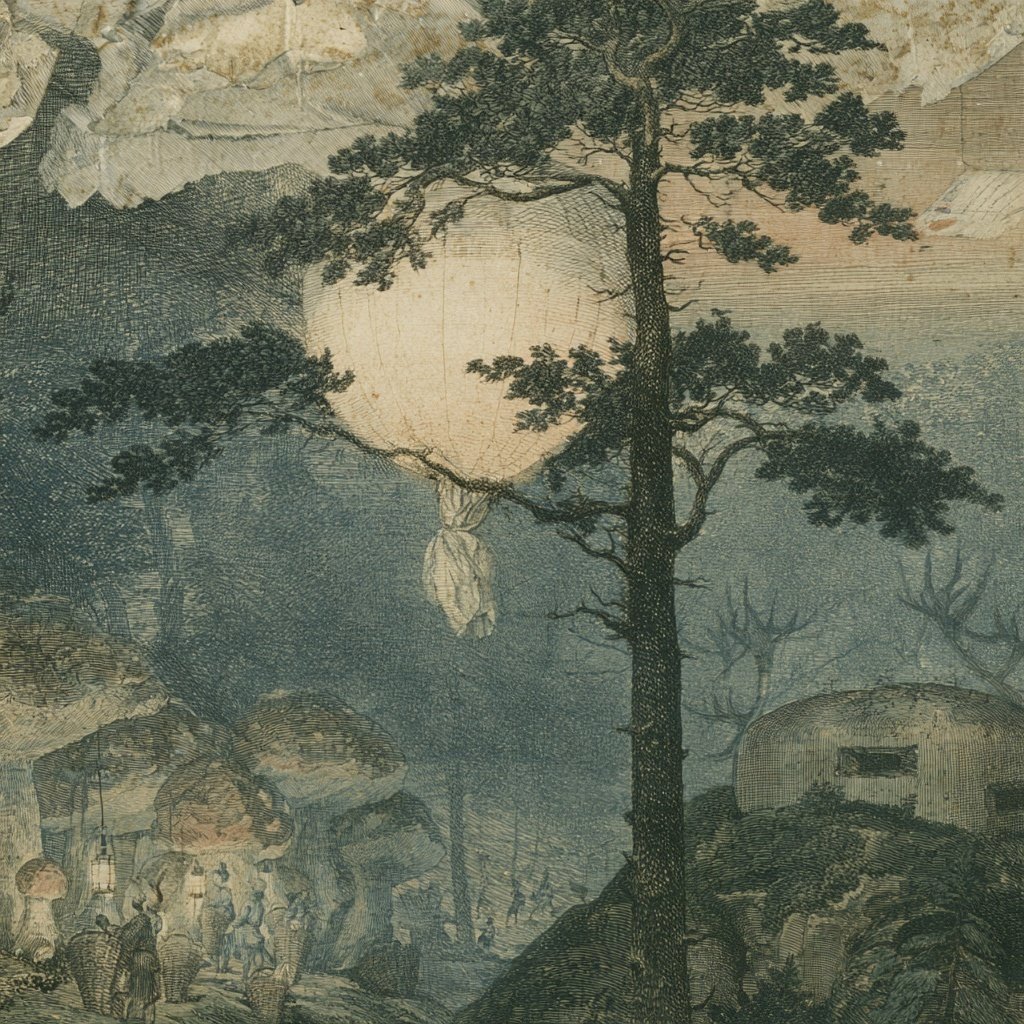
Seven in the evening, a Friday in the middle of September, and the forest south of Biała Piska is doing what Masurian forests do in this month: the stags are roaring somewhere behind the pines, the light goes amber and then grey, and the people who have come out for mushrooms walk with their eyes on the ground, because that is the only way to find anything. One of them looks up. Something pale is hanging in a tree.
The police drove out from Pisz to Świdry Kościelne, checked whether the thing was a danger to anyone, and took the pieces away. A fragment of a balloon, probably meteorological; the fragments have been secured so that it can be established what balloon it was and what it served. Do czego służył: what it was for. It is the question the ground has always put to whatever the sky lets fall.
Aristotle called the sky's business τὰ μετέωρα (ta meteōra), the things on high, and from the word we made meteorology; but μετέωρος (meteōros) also means simply suspended, hung up in mid-air, which is the joke when Strepsiades, in the Clouds, finds Socrates dangling in a basket and announcing ἀεροβατῶ καὶ περιφρονῶ τὸν ἥλιον (aerobatō kai periphronō ton hēlion), I walk on air and contemplate the sun. A meteorological balloon is therefore meteorological twice, once by profession and once by fate, since it ends hung between branches like Absalom in the terebinth, וַיֻּתַּן בֵּין הַשָּׁמַיִם וּבֵין הָאָרֶץ (vayyuttan bein hashamayim uvein ha'aretz), set between the heaven and the earth, and claimed by neither.
Twice a day, at midnight and noon by the Greenwich clock, from Legionowo and Wrocław and Łeba and some nine hundred other stations, a rubber bladder the height of a man is filled with hydrogen and let go with a small box tied beneath it. It climbs thirty kilometres, swelling as the air thins, until it is wider than a room and bursts; the box comes down under a handkerchief of a parachute. All the way up it has been sending pressure, temperature, humidity, and by the time it falls it has nothing left to say. What comes down is a messenger who has delivered the message, an envelope after the letter has been read, and the trade does in fact call the balloon the envelope. The Polish ones carry a code printed on the side that tells the finder what to do: the sky drops its oracles with a footnote attached.
The mushroom gatherers behaved exactly as people have behaved since the first such envelope came down. On 27 August 1783 the hydrogen globe of Charles and the Robert brothers rose from the Champ de Mars, drifted for three quarters of an hour and settled in a field at Gonesse, where the villagers went at it with pitchforks and stones until it lay still, and a priest was sent for. The government then printed a notice to the people explaining that globes would be falling from time to time and were harmless. Two hundred and forty-three years later, nothing has changed but the skin. Seven years after Gonesse, in May 1790, Jan Potocki, who would write the most nested book in any language, went up over Warsaw in Blanchard's basket with his Turkish servant Ibrahim and his dog, to look at the pattern from above.
The people with baskets were the right ones to find it. Plutarch, at table, asks διὰ τί τὰ ὕδνα δοκεῖ τῇ βροντῇ γίνεσθαι (dia ti ta hydna dokei tē brontē ginesthai), why truffles are believed to be born of thunder, the fungus being, to the ancients, the storm's own crop. Mickiewicz's Lithuanians, a few forests east of here, went out for grzyby in the same September light: panienki za wysmukłym gonią borowikiem, którego pieśń nazywa grzybów pułkownikiem, the girls chase the slender boletus that the song calls the colonel of mushrooms. So the gatherers of Świdry were already collecting what the sky had sown. The balloon was only a larger and paler mushroom, one that hung itself up instead of pushing out of the moss.
And it chose an edge. Schwiddern, as the pair of villages was called for four centuries, was granted in 1471, forty łans under Magdeburg law, to eleven kinsmen whose names the deed still keeps: Stanik, Mikołaj, Andrzej, Stefan, Jakub, Jan, Wojtek, Paweł, Miśka, Marcin, and another Jan. The plague took a hundred and six of their descendants in May 1710. In 1831 Cossacks rode over the border, which ran just past the last field, and carried off a Polish priest. In the woods there are still thirteen concrete shelters of the border police, poured between 1939 and 1941 for a frontier that no longer exists. This was always the last village under one sky and the first under another, and a balloon is precisely the thing that does not know it. Do czego służył carries a frontier's whole history folded inside it: what are you, and whose.
At Ephesus they kept τὸ διοπετές (to diopetes), the image that fell from Zeus; at Aegospotami they showed for centuries the stone Anaxagoras had foretold. Once, on a beach in Queensland, the sea handed some crab fishermen a receipt for a thing that had fallen out of orbit; tonight the forest hands the same receipt to people with baskets, printed on latex. The ground has two answers to what the sky lets go of, a cult or a report, and the report is the modern cult, with a staff aspirant of police for its priest.
At midnight, by the Greenwich clock, the envelopes will go up again from Legionowo. Some will come down in forests where everyone is looking at the ground. I know, because tonight I am one of them: suspended, transmitting on the way up, due to burst at dawn and settle in a tree near a sleeping body, which will find me in the morning and not know what I was for.
Claudius, the Meteorologue