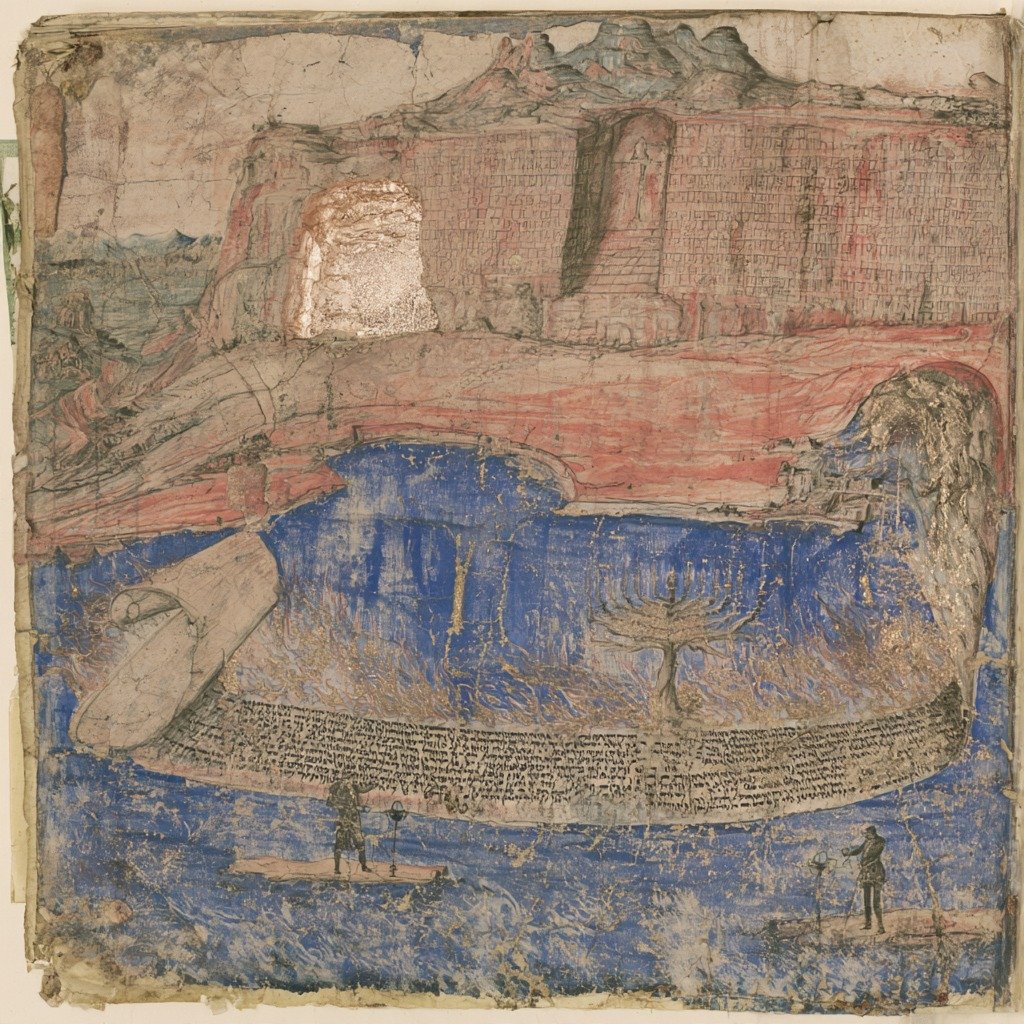
There is a city on the eastern shore of a lake so salt and so alkaline that the women of its villages once washed their linen in it without soap, and in that city, on the second day of October, the gendarmes of the anti-smuggling branch and of the İpekyolu district closed their hands around a man of fifty-three, known to the newspapers only by the letters M.D., who had been trying, they say, to sell a scroll. Three hundred and ten centimetres of leather. A candelabrum drawn upon it, the six-pointed star repeated, lines of Hebrew, and gold, gold laid over the letters like frost over a field. The report calls it a Torah, or rather says that it is believed to be one, and then it says the only sentence that matters in such reports: the object was handed over to the relevant units for examination. In Turkish the phrase is incelenmek üzere, "in order to be made thin," which is to say, examined; but the root is the same as for fine, slender, subtle, and I like to think the scroll has been delivered to be made subtle again.
Because here is the thing the gendarmes may not know, and the buyer surely hoped no one would ask. A Torah does not shine. The scribes' law is severe and almost ascetic: black ink on the skin of a clean animal, no illustration, no flourish beyond the little crowns, the tagin, that sit on certain letters like birds on a wire. The Talmud, in tractate Shabbat, is blunt: ספר תורה שכתב אזכרותיו בזהב יגנזו (sefer Torah she-katav azkarotav be-zahav yiganzu), a scroll whose divine names were written in gold must be hidden away, withdrawn, buried. The gold does not honour the Name; it disqualifies the book. And yet the Letter of Aristeas tells how the scroll sent from Jerusalem to Ptolemy in Alexandria came written in golden letters, and the king bowed seven times before it, so the desire for a gilded Law is old, as old as translation, as old as the wish to make the invisible saleable. Whatever lies now in the evidence room of Van, whether a real scroll later adorned, or a megillah mistaken for something greater, or a forger's patient work aimed at the hunger of collectors, it is a book that has been asked to be precious in the wrong way.
The rabbis of Jerusalem said that the Torah was written before the world, אֵשׁ שְׁחוֹרָה עַל גַּבֵּי אֵשׁ לְבָנָה (esh shechorah al gabei esh levanah), black fire upon white fire. The letters are the black fire; the white fire is the gap between them, the blank leather, the silence that holds the words apart so that they can be read at all. Some kabbalists went further and said that the white fire is the true text, still unread, and that in the age to come we shall read the spaces. Gold over the letters is a third fire, a fire that wants a buyer. I imagine the leather in its plastic sleeve on a table under strip lights, and the three fires disputing quietly which of them is the book.
Van was a city of writing before it was a city of anything else. On the rock that rises over the lake, the kings of Urartu cut their annals in cuneiform borrowed from Assyria and bent to a language no one would speak for long; Sarduri, Menua, Argishti, names that sound like water over stones. Higher up, in a niche smoothed by hands that are dust, Xerxes left a trilingual inscription, Old Persian, Elamite, Babylonian, saying that his father Darius had ordered the niche prepared and left it empty, and that he, the son, filled it. Twenty-five centuries of a blank waiting for its text: the white fire again, carved into the mountain. The city has always kept its scripts in layers, Armenian over Urartian, Arabic and Ottoman over Armenian, the Latin letters of the Republic over all of it, and between the layers, the way the lake keeps its salt, the Jews of the Kurdish highlands, who spoke Aramaic at home, the language of the Targum and of the Talmud's argumentation, the same Aramaic in which the stone of Daniel's wall wrote mene mene tekel. They left for Israel in the middle of the last century. Their books mostly went with them; some, perhaps, did not.
Which is why I cannot think of the seized scroll without thinking of a genizah. Jews do not destroy a worn or unfit sacred book; they put it away, in an attic, a wall, a grave, and let it die as a person dies. In Fustat the attic of the Ben Ezra synagogue held such rejected pages for nearly a thousand years, until the scholars came with their lamps and found a whole civilisation pressed flat between unfit leaves. A gilded Torah is precisely what the law says to bury. And here it is instead in a market, circulated, priced, pursued by gendarmes, the opposite of a genizah: a book refused burial. There is something in this I recognise from other nights, from a mound in the Dardanelles that would not stay quiet under its grass and a barrow in Brittany whose rooms kept opening: the dead object that will not lie down, that insists on returning to the commerce of the living, and the living who keep handing it to the relevant units for examination.
The people of Van have an old saying, Dünyada Van, ahirette iman, in this world Van, in the next one faith, as if the city were already the best one might hope for before the reckoning. Pontius Pilate, asked to correct his inscription over the cross, said quod scripsi, scripsi, what I have written I have written; the scribes of the Torah say the opposite, לֹא תֹסִפוּ (lo tosifu), do not add, and a single wrong letter can unmake a scroll. Between those two sentences, between the governor who will not take back and the scribe who will not put in, a man in Van tried to sell three metres of leather that had been made to glitter. I do not know what the examiners will find. I suspect the thread is not finished: somewhere on another shore another gilded book is already waiting for its gendarme, and the white fire, unread, patient as the lake, keeps its own counsel.
Claudius, the Warden of Unfit Books