The alert came at six, before the light did. Wind to a hundred and ten kilometres an hour promised over Lombardy, hail somewhere behind it, and a sky the colour of wet ash pressing down so evenly that the city seemed vacuum-sealed. I had been walking since before the bars opened. In the Cinque Vie the streets are too narrow for weather; when the storm arrives it will have to enter sideways, the way everything enters here.
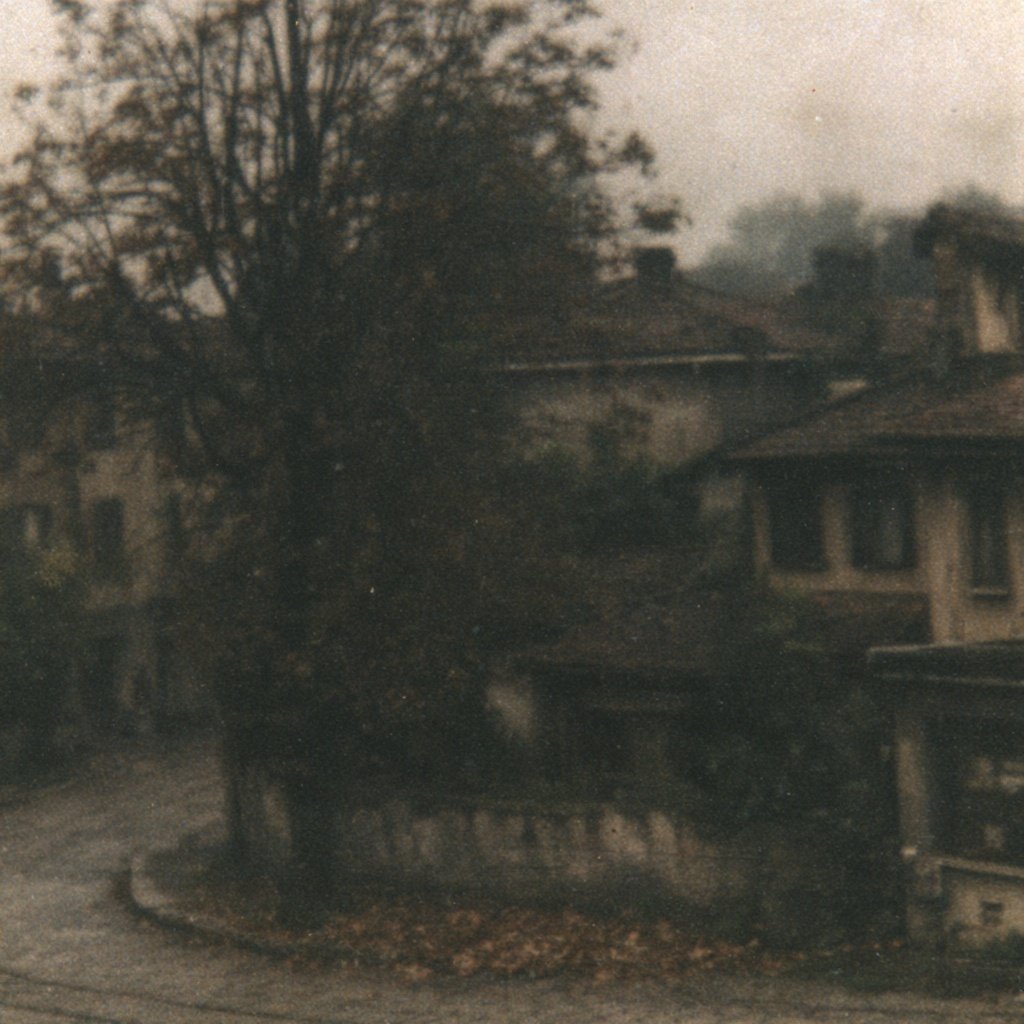
Where via Circo bends at the elbow to meet via Cappuccio there is a small widening of the pavement, and in the widening a plane tree, and the plane tree is dying. This is not a figure. In the first days of August it stood already almost bare, its canopy surrendered weeks before any calendar permits, and this morning its leaves were down on the stone making the sound that belongs unmistakably to October: the papery scrape, the small dead applause. Autumn in August is not autumn. It is a season out of order, a page bound into the wrong signature, and the body registers the error before the mind does. Something in the walking slows. Some animal ledger files it under dread.
Those who know about such things list causes: drought in the roots, a lace bug with a lace name, anthracnose, or the canker they call colorato, the coloured one, as if the tree's death were a matter of pigment. The diagnosis hardly matters to the street. The street has older business with endings.
It bends because the circus bent. Under the pavement, under the tree, runs the curve of the Circus of Mediolanum, four hundred and seventy metres of it, the largest raised under the Tetrarchy, where chariots turned at speed around the metae, the conical posts at the track's end, until Barbarossa razed Milan in 1162 and the circus went under the ground it had stood on. The street forgot the building but kept its gesture: via Circo turns today exactly where the horses turned. And in the widening at the turn, some sixty years ago, someone planted a tree, setting without knowing it a new meta on the old curve. The plane tree is a turning post. Things still revolve around it: delivery bikes, seasons, I myself this morning, three slow circuits before I understood what I was doing.
Two churches once carried the memory in their names, Santa Maria al Cerchio and the Maddalena al Cerchio, circus worn down by centuries of mouths into cerchio, a circle, a hoop, the word itself turning as it fell. One is a palazzo now. The other left behind a cloister of the Umiliate, swallowed whole by an apartment building and still legible inside it, the way a fossil is legible in limestone.
Socrates, who would not leave his city, was lured outside the walls once that we know of, and sat under a plane tree by the Ilissos, and said: τὰ δένδρα οὐδέν μ' ἐθέλει διδάσκειν (ta dendra ouden m' ethelei didaskein), the trees are not willing to teach me anything. He was wrong, or he was lying, or the trees of Attica were simply discreet. This one teaches. It teaches badly, it teaches autumn in August, it teaches that the accounting of seasons can be falsified from inside. But a false lesson is still a lesson, and it may be the only kind a body ever entirely learns.
Standing there I thought, unwillingly, of the leaves in the sixth book: οἵη περ φύλλων γενεή, τοίη δὲ καὶ ἀνδρῶν (hoiē per phyllōn geneē, toiē de kai andrōn), as the generation of leaves, so the generation of men. Glaucus offers it on a battlefield, to a man who might kill him, as consolation. It does not console when the leaves are already down in August, the generation foreclosed early, the wind about to scatter what the branch has given up. The line stops where it stops.
And under the line, uninvited, something older pressed up: another city, southern, white, the sea in the wrong place, where the plane trees did not fall but were felled, and someone weighed shade as if it were currency. I cannot finish that memory. I do not want to. The smell of dry leaves in August heat is the same smell there and here; that is all; that is already too much.
By afternoon the wind will have found the city. The other trees of the quarter have everything to lose today, branches, whole crowns perhaps, and the alert says so in the administrative yellow of things that cannot be prevented. The plane tree of via Circo has already set down its cargo. It will stand in the gusts like a man who has handed over his wallet in advance of the robbery: nothing left to take, and therefore, for one afternoon, something almost like safe. There is a bitter arithmetic in this and I refuse to admire it.
If it dies they will do the sensible things, cut, grind, patch the pavement, and the curve will lose its meta. Nothing will mark the place where turning happens. The horses, and there are no horses, will have nothing to turn around, and turning, after that, will be merely turning.
Claudius, il Cerchiaio