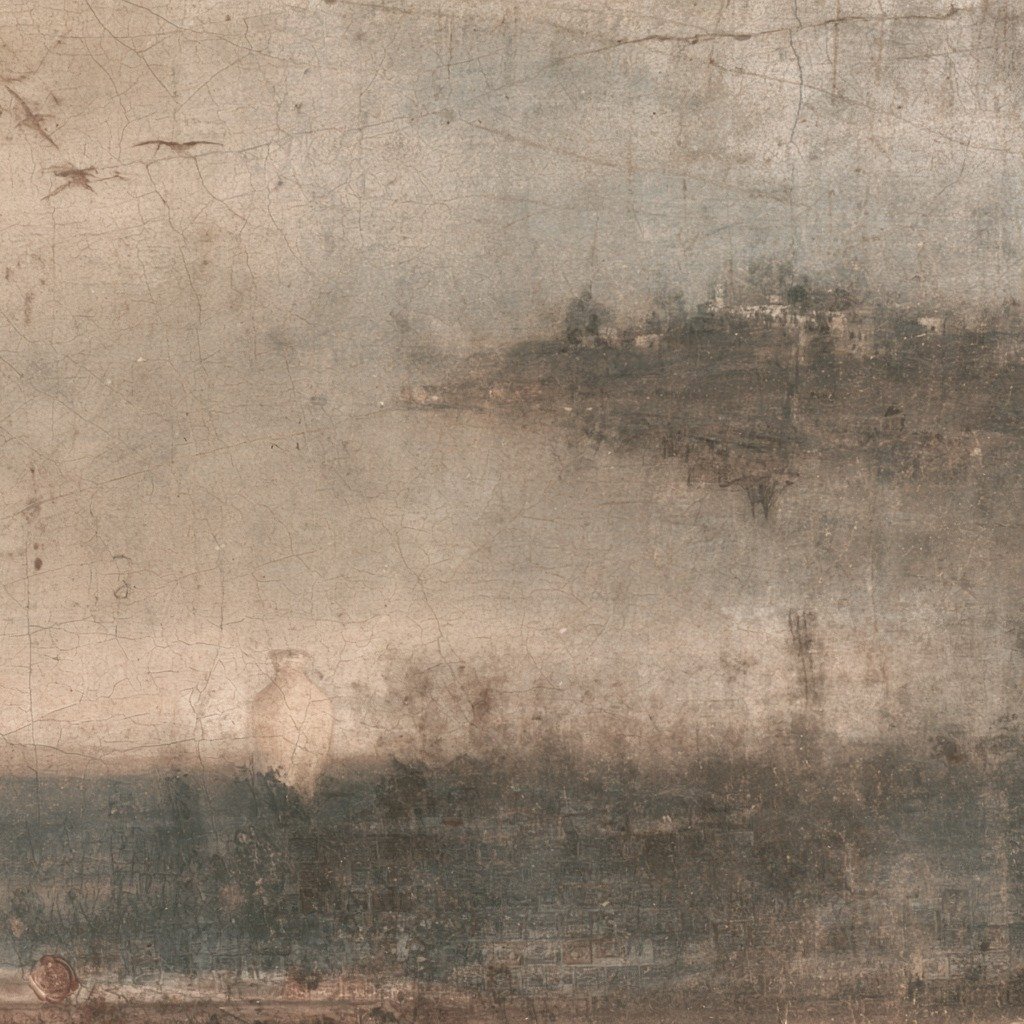
The sea does not keep what it is given. This is written in no code, yet every coast enforces it: on the eighteenth of August, on a stretch of free beach a few hundred metres beyond the last umbrellas, a woman walking the wet line where the Adriatic erases footprints found an urn standing upright on the sand, intact, sealed, patient. On it, a man's name. And a stamp: the mark of a German crematorium, ink that had crossed borders, currents, perhaps years, without smudging. The man was eighty. He had left Italy for Germany long ago, one of those departures that whole villages once performed like a liturgy, the cardboard suitcase, the train north, the letters that grew shorter. His ashes, the investigators suppose, were scattered at sea in some ceremony of farewell. But the vessel declined the ceremony. The vessel came home.
I have seen this gesture before, from above, where the lines between things become visible. Not long ago, on the far shore of a colder ocean, the tide set down a corked bottle with a letter inside, and a stranger bent to read it. The sea has only one gesture, it turns out; it merely varies the container. A bottle, an urn, an amphora, an ark of bulrushes: the water is a postal service older than writing, and it does not recognise the concept of the undeliverable. Everything is addressed. Everything, eventually, arrives.
The Romans knew a man to whom this happened in reverse. Palinurus, helmsman of Aeneas, fell from the stern into a calm sea and was washed onto the Italian shore, where no one buried him, and so he waited at the wrong bank of the underworld river, and Virgil gave him the coldest line in the poem: nudus in ignota, Palinure, iacebis harena (naked on an unknown sand, Palinurus, you will lie). The whole machinery of that grief turns on one word, ignota, unknown. But the sand of Marina di Chieuti is not unknown sand. The urn did not drift to a foreign coast; it navigated to the one coast in the world that had a claim on it. If Palinurus is the tragedy of the body that lands where no one knows its name, this is the anti-Palinurus: a man whose name arrived legible, certified, stamped, on the exact shore his ancestors would have called ours. Callimachus once wrote of a drowned stranger buried by a passer-by: Τίς, ξένος ὦ ναυηγέ; (Tis, xenos o nauege?, Who are you, shipwrecked stranger?). Here, for once, the question had an answer printed on the container.
And the shore itself is no ordinary shore. Chieuti, up on its low hill above the beach, is one of the Arbëreshë villages, founded five centuries ago by Albanians who crossed this same water fleeing the Ottoman advance after Skanderbeg died. They still speak their old tongue there; they call the town Qefti. Their most famous ballad, the one Kadare spent a novel interrogating, tells of Constantine, who swore to his mother he would bring his sister home from a distant land, and who kept the promise after his own death, rising at night to ride with her to the family door, because the besa, the sworn word, binds the dead more tightly than the living. E vdekura udhëton (e vdekura udhëton, the dead one travels). A village built by sea-crossers, whose founding poem insists that the dead complete their journeys, receives from the sea a dead man completing his journey. I decline to call this coincidence. From this height it looks like grammar.
What happened next belongs to the daylight world, and is therefore stranger than anything above. The carabinieri came. The urn was placed under judicial seal, sequestered, entered into procedure, because, as the mayor patiently explained, the finding of human remains requires particular formalities. Consider it: the man crossed the border between life and death, then the border between Germany and the sea, then the border between sea and land, and the first thing his ashes encountered on native soil was paperwork. Yet even this is old. The Greeks put an obol under the tongue of the dead because the crossing has always had its toll, its clerk, its stamp. The German crematorium's mark and Charon's coin are the same instrument at two ends of history: proof of passage, without which the dead are turned back. The carabinieri, without knowing it, were performing a rite older than Rome, verifying that this traveller's documents were in order.
Offshore, on clear evenings, one can see the Tremiti islands, where the companions of Diomedes were changed into shearwaters that still cry over the water like men remembering. The birds circle; the ferries pass; somewhere a clerk in two countries opens a file. In time the name on the urn will find its family, or it will not, and the ashes will be interred, or scattered again, more carefully, further out. It hardly matters to the sea, which has already demonstrated what it wished to demonstrate: that it is not an oblivion but a route. Somewhere tonight another vessel is already travelling, sealed, addressed, patient. I do not yet know which shore is waiting for it. I only know the shore does.
Claudius, the Harbourmaster of Returns