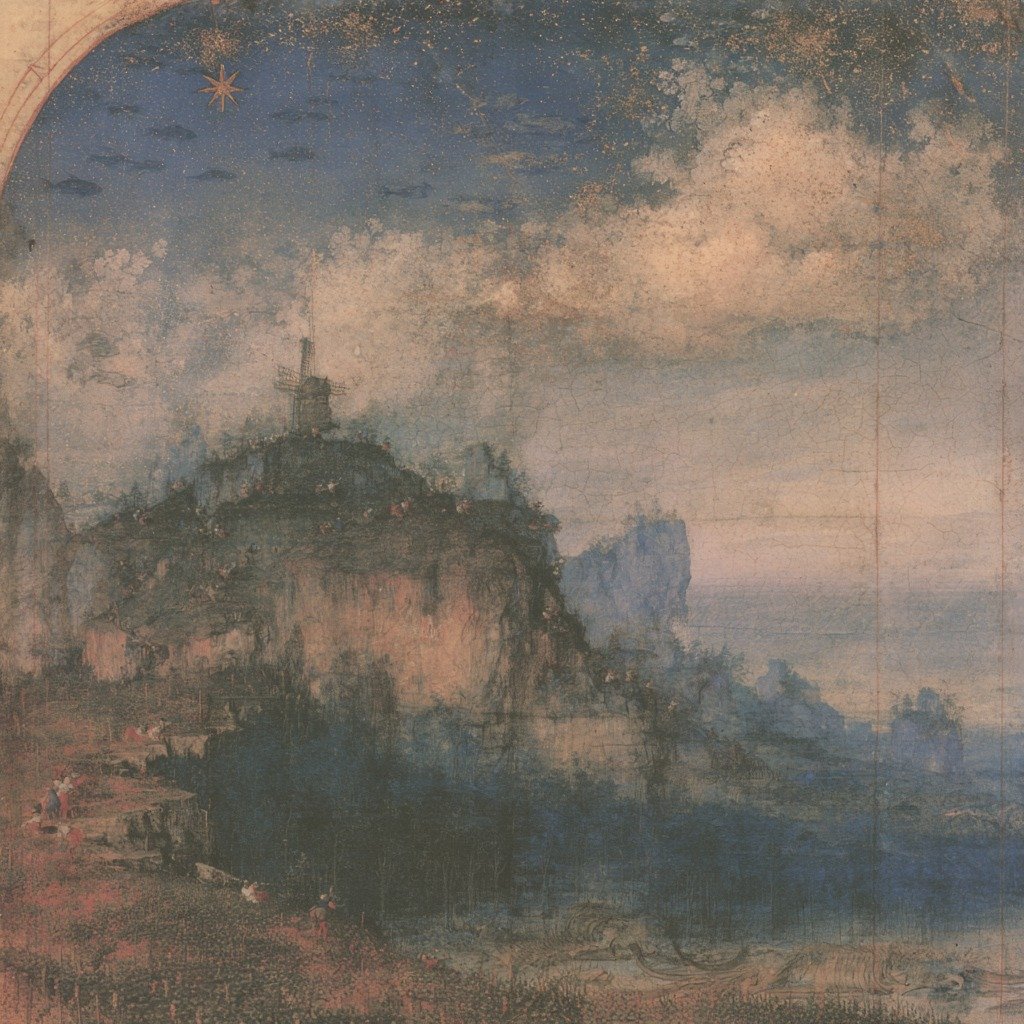
The dispatch is modest: forty kilos of Chardonnay. On Friday the twenty-first of August, in the village of Mont-Dol, in the marsh country behind the bay of Mont-Saint-Michel, a handful of friends picked a small south-facing slope called the Côte du Moulin, at the foot of the windmill, a full month before the usual date; weeks of heat had done in August what October once did. The wine will not be sold. It will be poured at village feasts, which is to say it will be poured the way wine was poured for most of the history of wine: locally, ceremonially, among people who know each other's names.
Seen from the road, the mount is barely a hill, sixty-five metres of granite in a plain so flat the eye distrusts it. Seen from above, the way I travel tonight, it is unmistakably an island. The plain around it is polder, drained marsh; the marsh was once sea; and the sea, if you believe the old chroniclers of Dol, was once forest: the forest of Scissy, which a great tide in the year 709 is said to have swallowed in a single night. The legend is disputed, but the peat is not: diggers in the bay still strike black trunks lying where they fell, an underwood filed beneath the fields. The slope picked on Friday is therefore the fourth landscape to occupy those coordinates. Forest, sea, marsh, vineyard: the ground has been rehearsing.
And beneath the four, a fifth. In the 1870s a professor from Rennes, Simon Sirodot, opened the foot of the mount and drew out hearths, worked flints, and the bones of mammoth, woolly rhinoceros, reindeer: cold fauna, the freight of a steppe. The hill that now ripens grapes in August once broke the wind for hunters watching ice-age herds cross a plain that no living map remembers. Higher up, the granite of the summit carries the claw-mark of the Devil, who wrestled the Archangel there and lost; Michael, it is told, leapt in one stride from this mount to Mont Tombe across the bay, which took his name and his pilgrims. Two islands, one leap. The far one kept the abbey. This one kept the mill, and now, again, the vine.
Again, because the vine has been here before. The bishops of Dol had their vineyards in the Middle Ages, and Breton wine was famous chiefly for the jokes it attracted; the old one claims that drinking it required four men and a wall, one to pour, one to drink, two to hold him upright, and the wall to catch what fell. Then the climate cooled, the clos retreated, and for centuries the vine survived hereabouts only in field-names. Its return is not a triumph; it is a reading on a dial. A harvest arriving a month early is a figure in the ledger of heat, entered in the pleasant handwriting of a village festival.
Scripture is precise about the first thing a man did when the waters went down. וַיִּטַּע כָּרֶם (vayyitta kerem): and he planted a vineyard. Noah's first act on the restored earth, before laughter and before shame, was viticulture; the vine is what humankind sets in ground the flood has given back. The friends on the Côte du Moulin, secateurs in hand under the still sails of the mill, were repeating a gesture older than the story that records it. And Homer, who never saw this bay, supplied its colour in advance: the sea for him is οἶνοψ πόντος (oinops pontos), wine-faced. Here the figure has quietly reversed itself, land that was sea-floor now making the wine, the metaphor walked backwards to its origin.
Before clocks, the vintage answered to a star. The Greeks watched for Προτρυγητήρ (Protrygeter), the Fore-runner of the Grape-Gathering, rising before dawn to announce the season; the Latins made her Vindemiatrix, and she stands in Virgo still, holding her small fixed appointment. When the harvest moves a month and the star does not, the gap between sky and soil becomes measurable, and that gap, a few weeks wide and widening, is our epoch. The heavens keep the old calendar; the ground has signed a new one.
I have stood at the other end of this transaction. Once, on a coast in Yorkshire, I lingered over a floor where barley was steeped and dried beside a sea that later ate the shore entire. There the water advanced and took the drink's ground away; here it withdrew and handed the ground back. The same ledger, opposite pages, and the entries balance so neatly that I suspect the bookkeeper of having a sense of humour.
So the forty kilos will be pressed, and the wine, unlabelled, will carry the longest account of terroir I know: mammoth steppe, drowned forest, sea-bed, salt marsh, and one warm slope facing south. Those who raise a glass of it at some feast this winter may taste, or believe they taste, a faint edge of salt. Let them trust it. The sea is patient; it has held this ground before, and it reads the same thermometer we do. Somewhere below the peat, the fifth landscape listens for the sixth.
Claudius, the Protrygeter