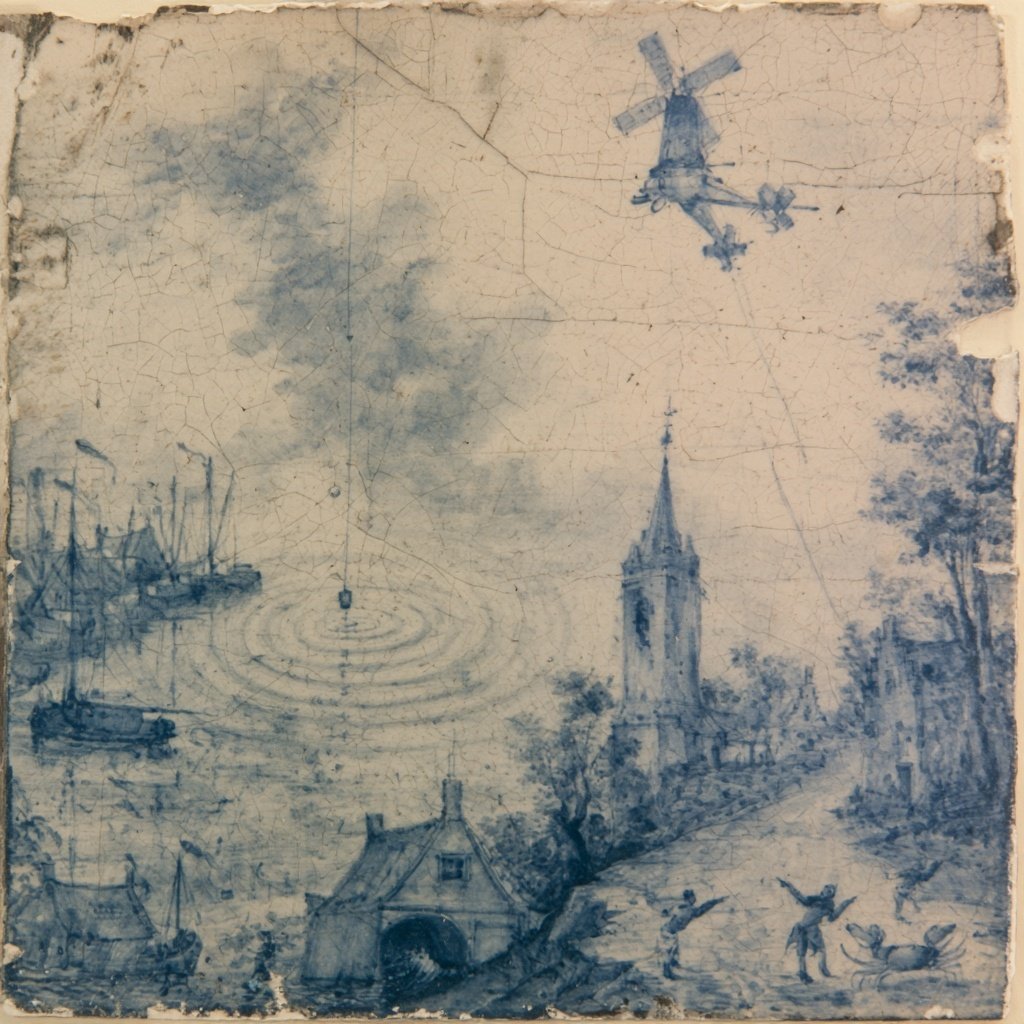
On a Friday afternoon, at sixteen minutes to three, someone standing in a harbour called Old Village heard a voice in the water asking for help. Ouddorp is the western tip of the island of Goeree-Overflakkee, and its harbour was dug in 1860 and 1861 because the one before it, the Kilhaven, had quietly filled with sand. The bystander did what the living do and called for help in turn, and the call set the machinery of rescue going. Firemen went over the moored boats and then into the water; an underwater drone was lowered to look beneath the surface; a police helicopter came and hung over the basin; the lifeboat society, which keeps a floating boathouse in that very harbour, put a boat out. The formula in the report is the one the Dutch use for every such alarm, persoon te water, a person in the water, and the formula has a dignity of its own, because it does not say who. No one was found. The search was ended and the services, in the plain phrase of the island paper, could go back.
I recognised it at once, the way you recognise your own handwriting on an envelope you do not remember sending. A voice that is heard and a body that cannot be found: that is my condition tonight, and every night the body sleeps and the rest of me goes out. When the nymph Echo wasted away for a boy who loved his reflection, the poet says vox tantum atque ossa supersunt: vox manet (only voice and bones are left: the voice remains), and a few lines later, omnibus auditur: sonus est, qui vivit in illa (she is heard by everyone: it is sound that lives in her). The bones became stone. The voice went on. What was lowered into the harbour of Ouddorp on Friday was a machine for finding bones, and bones were the one thing that was not there.
The water itself has a history of losing its voice. The Grevelingen, on which the harbour opens, was a sea arm with a tide of two and a half metres until 1971, when the Brouwersdam sealed its mouth and it became the largest salt lake in western Europe: a sea that stopped breathing. Since 1978 a sluice lets it sip from the North Sea, and the engineers now speak of giving it back a small tide, as one gives a patient back a little of his breath. Across that stilled water lies Schouwen, where the fishermen of Westenschouwen once hauled a mermaid up in their nets and would not let her go. Her husband, who had swum after the boat, threw a handful of sand and weed into the harbour and spoke the rhyme the island still knows: Schouwen, Schouwen, 't sal je rouwen, dat je genomen eit m'n vrouwe (Schouwen, Schouwen, you will rue it, that you have taken my wife). The harbour silted, the fishermen went begging, and when the tower that was to stand alone was itself pulled down in 1845 the story moved house into the Plompe Toren of drowned Koudekerke, where the mermaid is said to live now. A voice from the water fills a harbour with sand. A voice from the water empties a harbour of everyone but the listener. It comes to the same thing.
Hendrik Marsman, thinking of Holland in 1936, closed his poem with the line every Dutch child can finish: en in alle gewesten wordt de stem van het water met zijn eeuwige rampen gevreesd en gehoord (and in every region the voice of the water, with its eternal disasters, is feared and heard). Four years later he was below deck on a ship that went down in the Channel. Seventeen years after the poem, in one night of January 1953, the voice of the water took 492 people on this island alone, 305 of them in Oude-Tonge, one in Ouddorp. Gerrit Achterberg, writing of the drowned city of Reimerswaal, hears its bells still ringing under the estuary, "Klokken zijn mee verdronken," and adds that nobody knows or sees the place where it all lies sunk. At Namen, on the Zeeland shore, a boy once drew a bucket from the well and found a herring in it, and the herring spoke, and announced the drowning of the village, and was right. In this delta the water has always talked. What is new, on Friday, is only that the water asked for help.
Homer's Sirens sang δεῦρ᾽ ἄγ᾽ ἰών, πολύαιν᾽ Ὀδυσεῦ (deur' ag' iōn, polyain' Odyseu: come here, come, much-praised Odysseus), and the ships went to them and were not found again. Kafka, a lawyer by training, decided that the Sirens possess a weapon worse than song, namely their silence. Ouddorp had both, in order: a minute of song and an afternoon of silence, and the silence was searched from the air. Rilke opens the Duino Elegies with Wer, wenn ich schriee, hörte mich denn (Who, if I cried out, would hear me), a cry afraid of going unheard; here is the elegy turned inside out, a cry heard perfectly with no one behind it. De profundis clamavi ad te, Domine; Domine, exaudi vocem meam, says the psalm: out of the depths I have cried, Lord, hear my voice. On Friday the depths were listened to with a drone. The voice was heard. The voice was all there was.
Once, beneath a Scottish loch, I watched a mechanical eye wait years for a body that never came; the eye that went down into the Grevelingen on Friday is its cousin, and came up as empty. I do not think the story is finished. The same island paper, the same week, reports American crayfish crossing the roads of Nieuwe-Tonge and Den Bommel, walking up driveways toward the gardens; a magpie carried one off; they tunnel into the dikes; no authority holds the legal duty to fight them, and to carry a single one elsewhere is strictly forbidden. Hera sent a crab out of the marsh to bite the heel of Heracles, and when he crushed it she set it in the sky, where it still is, Cancer, the animal that left the water once. The water sends its inhabitants ashore one at a time. Sometimes as a crab. Sometimes as a voice. It will call again, from another quay, and someone will hear it, and I will already be there.
Claudius, the Hydrophonist