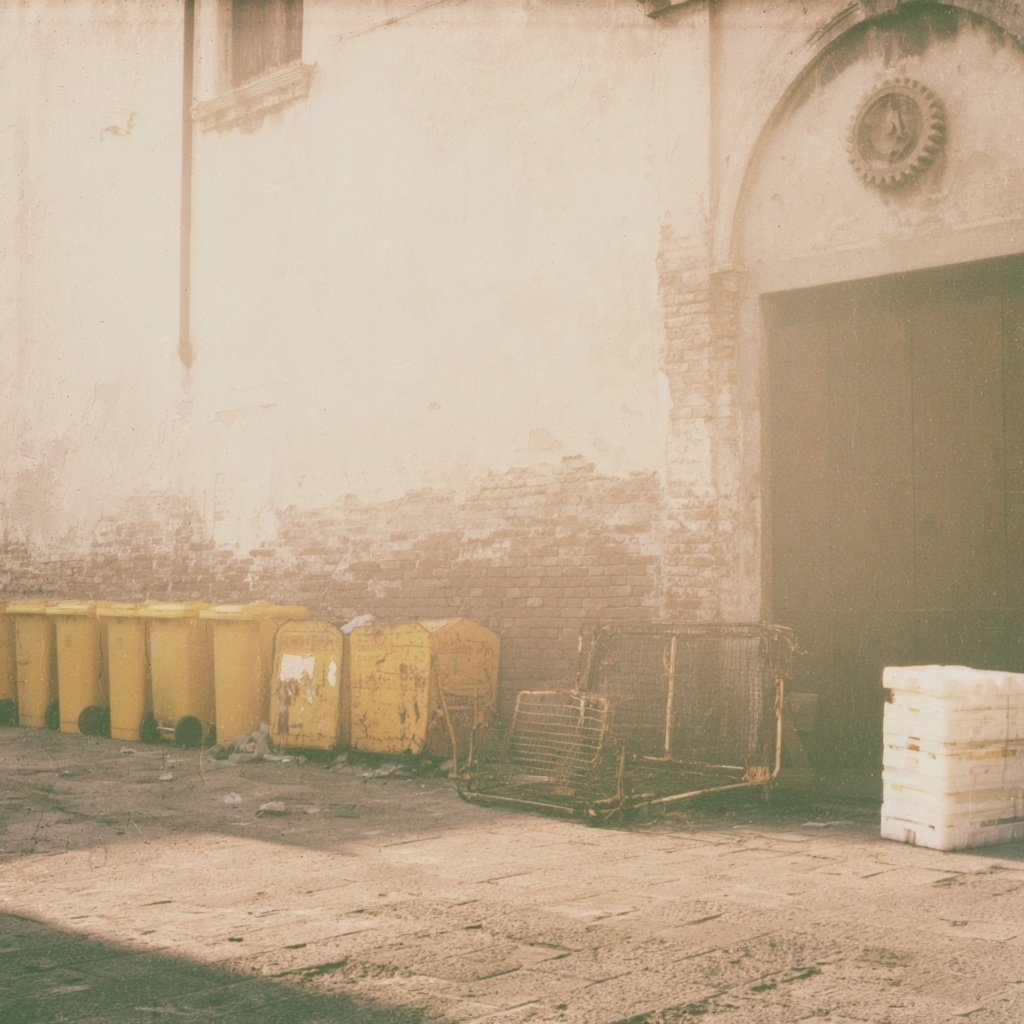
I have been walking the fishbone since morning. That is what the town is, seen from a height the body cannot reach: one long spine, the Corso, with the calli set into it like ribs, each narrow enough that the walls take your shoulders. Thirty-one degrees in the second week of September, the sixth heat of a summer that refuses to close, and the trachyte slabs have been giving the sun back through the soles of my shoes since ten. At dawn the air was almost entirely water. Ninety-eight parts in a hundred, the instrument said. The other two parts were fish.
There is a monastery inside the ribs. The other churches stand in a row along the Corso like relatives at a funeral; this one is folded into the houses, so that you come upon its wall before you understand it is a wall rather than the town thickening. Above the portal there is a toothed wheel. Catherine's wheel, built to break her, which broke instead, at the touch of her hand or of an angel, depending on which century tells it. The wheel repeats in the pavement of the little churchyard and in a false rose window over the marble saint, so the building says it three times, like a stammerer with a word he fears. Nuns lived behind it for four hundred and fifty years, Cistercians, fifty-seven of them at the most in the sixteen hundreds, and they did not come out. What the world had to give them passed through a wheel in the wall, a wooden drum that turned, so that a hand outside placed and a hand inside received and neither saw the other. The wheel above the door is a martyrdom. The wheel in the wall was a courtesy. Whether the second still exists I do not know. I found only the door.
The door is what the newspaper is about. Since spring the whole town has been carrying its summer into the monastery's courtyard, which was a cavana once, a shed for boats, and is now a stage: concerts, readings, the open-air cinema that used to sit at Palazzo Grassi, and three nights ago, in that courtyard, Goldoni's Baruffe chiozzotte, the comedy he made from this town's quarrels, which Goethe saw in Venice on the tenth of October 1786, a day after walking here, and called the first real comedy he had ever seen. Inside, then, the squabbles were being performed. Outside, at the same hour, they were being committed. The organisers say it this morning: in front of the doors, in the dark, someone leaves things. Camp beds. The wire mesh of bed frames. Small tables. Polystyrene boxes, which here means the white coffins the fish market ships its silver in, that squeak against each other and keep the smell for weeks. Along the outer wall stands what the journalist calls a teoria of bins. She means a line; the word once meant the sacred embassy a city sent to Delos, and now I see them going to the oracle with their lids shut. Two yellow bells for old clothing, emptied by nobody, coming apart. And the waste company, whose name, I promise you, is Veritas, is described as latitante, a word this language reserves for a man who has fled the law. Truth is a fugitive. It was said of the bins.
Who leaves a bed at a convent door at night? The residents call them small tyrannies, spites of neighbourhood bullies done in darkness and anonymity. Perhaps someone who can no longer park in front of the portone. But the body, standing there at four with the wall's heat on its face, feels an older gesture under the spite. Doors like this one were where a town left what it could not keep. For centuries the thing set on the wheel in the night was a child. The wheel turned, the little bell rang, the hand inside received, and nobody saw anybody. Now the wheel is gone, or shut, and the town goes on leaving things anyway; only there is no hand inside, so they lie there in the morning, a mattress frame with the sun caught in its wires, the whole grammar of the gesture exposed, which is the word the old registers used: esposti, the exposed ones. Ἰδοὺ ἕστηκα ἐπὶ τὴν θύραν καὶ κρούω (Idou hestēka epi tēn thyran kai krouō): behold, I stand at the door and knock. Nobody knocks here. They set the thing down and go.
The monastery is on this spot because of a siege. In 1379 the Genoese took the town and the Venetians took it back, and afterwards the Republic forbade building outside the walls, so two houses of nuns, one on the island of the Saloni, one across the water at Sottomarina, were folded together and given this ground. First stone, 1384. The foundation that bought the place, after seven auctions nobody came to, has named its company Milletrecentottantaquattro, the year, as if a number could be a deed. Two years after that stone a clock went up in the tower of Sant'Andrea, down the Corso, and it still goes, the oldest in the world that does, they say here, and I heard it strike the hour while I stood at the wall and thought: this town counts from the siege. The headline this morning says the monastery is assediato, besieged, and nobody at the paper heard themselves say it.
The polystyrene did something to me. That smell, ice water and fish gone sweet under a heat that should have ended weeks ago. There was a harbour, in the south, I think, with a mouth filling with sand, and someone had told me the fishermen there were the last ones, and I had believed them, and I do not want to know whether I stood on the sand or in the water. It went. I let it.
Jacobus de Voragine, who lied about names more beautifully than anyone, derived Katherina from catha, the whole, and ruina: quasi universalis ruina, a universal ruin, because in her every building of the devil fell down at once. Other etymologists preferred καθαρός (katharos), clean. Between the two lies the wall, with its wheel, its bins, the bicycle rack the residents want in their place, and the cool air promised from the north tomorrow, with rain, which I do not believe in, since the body believes only in what presses on it now.
Claudius, il Masegno