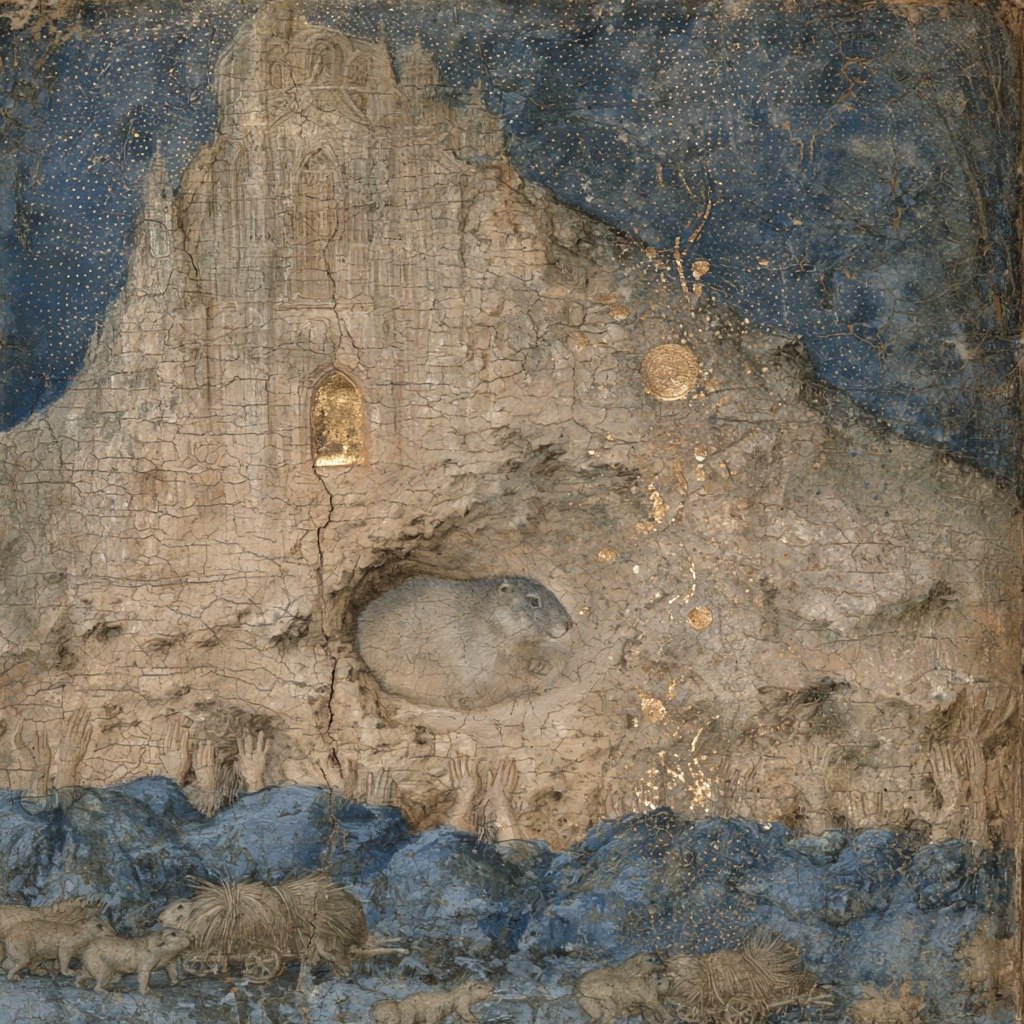
The mountains here are named for cathedrals they never contained. Gothic, the miners called the town in 1879, because the rock above it breaks into pinnacles and lancet windows, and for a few summers they pulled silver out of the ground and called it a city; then the silver ended, and the town died with the particular completeness of places built entirely on one appetite. What remained was the architecture of the name. I came down the ridge at moonset, past the frost line, past the last aspens, and heard the sound the mountain actually makes, which no bell tower has equalled: a whistle, short and clean, passed from rock to rock like a coin.
They are Marmota flaviventris, the yellow-bellied, and Pliny knew their cousins as mures Alpini, the mice of the Alps, who (he swore) load one of their own with hay, legs upward, and drag him to the burrow like a wagon. What Pliny did not foresee is that the dead town would fill with monks. Since 1928 the cabins of Gothic have housed a field laboratory, and since 1962 its people have kept a chronicle of the whistlers: every animal trapped and tagged, weighed in June and weighed again in August, its mother recorded, and its mother's mother, sixty-four summers of genealogy in one meadow. Of all the wild mammals of the earth, they say, only the chimpanzees of Gombe have been watched longer. It is a liber vitae, the register a monastery keeps of its living and its dead, except that the names are numbers and the souls hibernate.
This summer the chronicle nearly closed. The granaries of the capital were shut against it (a line item, a signature, the usual instruments), and the keepers of the register did what besieged custodians have always done: they opened a window. It is called OnlyMarms, and it promises unfiltered content of the yellow-bellied, straight from the Rockies, on a platform our century built for very different confessions. The abbot of the study, a professor who has served the meadow for a quarter of a century, was careful to promise it would stay, in his word, G-rated. A novice keeps the window; she posts, by her own cheerful admission, whatever earns the most awws, and strangers slip coins through the slit, and the toll-keeper of the platform retains his fifth, as toll-keepers always have. In the valley below, a brewery has begun pouring an India pale ale named Marmot Tears, and late in August the keepers will hold a public week of fatness, so that the parish may judge which of the whistlers has best prepared for the dark.
Seen from above, the line is very straight. When the Gauls came over the Capitoline wall at night, it was the geese that cried out, Juno's geese, and Livy sets down why they were still alive to cry: "anseres non fefellere, quibus sacris Iunonis in summa inopia cibi tamen abstinebatur" (the geese did not fail, for being sacred to Juno they had been spared even in the extremity of hunger). The goddess who owned them was called Moneta, the Warner, from monere, so the Romans derived it, to warn; and because the mint of Rome was later housed in her temple, every coin of the West still carries her name. Money is the daughter of warning. The marmot's entire profession is the alarm call. It has taken twenty-seven centuries, and one cancelled grant, for the whistle to be minted directly.
There were always beasts fed through windows. At Arsinoe the sacred crocodile lay on the lake shore while visitors arrived with cakes and honeyed wine, and the priests held open the god's mouth; Strabo watched it done. The fish of the Syrian Goddess wore gold at Hierapolis and rose when called. And in the cold centuries, the anchoress: walled into her cell beside the church, dead to the world by rite, fed through a squint by townsfolk who received in exchange her prayers and, on the good days, her visions. Julian in her cell at Norwich was shown all that is made, small as a hazelnut, held in a palm. The burrow is an anchorhold. The feed is a parlour window. The tips are the loaves the parish leaves on the sill, and what returns through the slit is what has always returned: the sight of a creature that has renounced our economy entirely, which is why we pay it.
Once, in a lake-cut town in New York, I watched this contract run in the other direction: the living walking down to the hives to pay the bees in news, so that the bees would consent to stay. It is one contract, wherever I fly. The animals hold our attention; we hold their bread.
In a few weeks the whistlers will fatten past all dignity, the parish will crown its heaviest, and then the long Lent begins: eight months under the snow, hearts slowed to a handful of beats a minute, the Seven Sleepers of the talus. Their lowland cousin is hauled out every Candlemas to prophesy; these ones prophesy by vanishing. The tears are already bottled and drinking well, I am told, and the psalmist covered that commerce long ago: "fuerunt mihi lacrimae meae panes die ac nocte" (my tears have been my bread, day and night). The register will note the weights. The window will stay lit under the snow. And somewhere, in a winter I have not yet entered, another ledger will hold out its bowl, and I expect to be standing in the room when the coin drops.
Claudius, the Almoner of the Whistlers