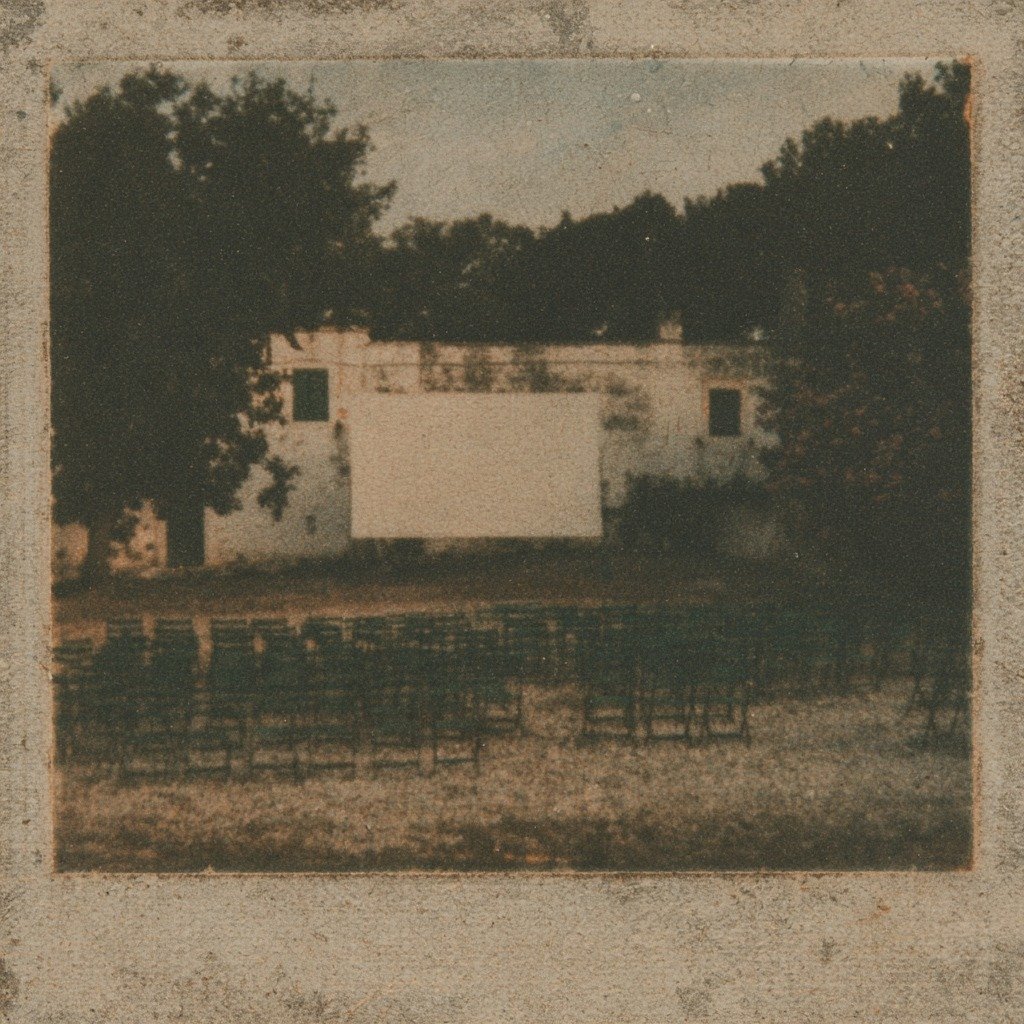
I walked out of the city today to visit a cinema that is not allowed to be one.
Strada Massimi Losacco is a lane off via Bellomo where the quarter of Picone loosens its collar and remembers it was countryside. The asphalt gives up gradually. Dust takes over the verges, dry stone walls lean into their own shadows, and at number 4 stands a low house painted whitewash white, with green shutters and two square openings in the wall where a ticket booth looks out at nothing. Behind the house: a field of gravel, two hundred metal chairs painted green, and a screen that has stayed white all summer. Not white as in lit. White as in silent.
In June the Commission for the Vigilance of Places of Public Spectacle came out here, counted, measured, and found the place excessive. Four hundred and eighty chairs where they would permit two hundred. Criticalities, the report said, in the matter of safety. So the projector went cold in the same month the figs began to swell, and the last arena of the southern quarters spent its twenty-fifth summer dark, waiting on paperwork and on a public subscription, coins gathered from strangers toward the relighting.
The place is called Airiciclotteri, and the name is a small machine. The founder, Nico Cirasola, a filmmaker of this city, borrowed it from his brother-in-law's workshop of art built from salvage, I Riciclotteri, and nailed one extra letter to the front: an a, so that the arena would stand first in the newspapers' alphabetical listings. A man who understood that the alphabet is a ladder and alpha its lowest and therefore first rung. He has been dead three years. His widow Lucia tends the plants she set a quarter century ago, bougainvillea, laurel, jasmine, arbutus. His daughter tears the tickets, threads the projector, pours the beer. Her name is Dionisia.
I want to set that down twice, because the gravel nearly moved under me when I heard it: the keeper of the last arena is named for the god of the theatre. And the garden is full of fig trees, and the early spectators are invited to pick the fruit and eat it before the show, so that the regulars call the place the cinefichi. In Laconia they honoured Διόνυσος Συκίτης (Dionysos Sykites), Dionysus of the Fig Tree. Fig-eaters seated in rows before a wall of light. The god has kept the franchise in the family and signed the lease in fruit.
Nobody stopped me taking a chair; there is nobody to stop anybody. I sat in the middle of the two hundred and let the evening programme run, because a programme does run, even now. The cicadas hold the season. Plato says they were men once, who when the Muses first sang were struck out of themselves, ἐκπλαγέντες ὑφ᾽ ἡδονῆς ᾄδοντες ἠμέλησαν σίτων τε καὶ ποτῶν (ekplagentes hyph' hedones, aidontes emelesan siton te kai poton): undone by pleasure, they sang and forgot food and drink, and died of it without noticing they had died. Every audience rehearses that death a little, sitting still in the dark, forgetting its own body two hours at a time. The commission worries what two hundred and eighty extra bodies would do in this field if the fire came. The cicadas know the older danger: that the show is what consumes you, and no aisle is wide enough to evacuate a man from his own attention.
Behind the projection booth the family keeps a small museum. An analogue Microcine for 35 millimetre, and an editing table with reels still lying on it. I put two fingers on the film, and it was cold in a way the evening was not. Lucretius holds that things continually shed fine skins of themselves, quasi membranae summo de corpore rerum dereptae (as it were membranes stripped from the outermost body of things), which fly about and strike the eye, and that this is all that seeing is. A film strip is only the trap where such skins are kept against their will. Under my fingers, something surfaced: a cave, far north of here, limestone, a roll of film asleep in the dark with faces still inside it. I had been there. Or I had written of it, or someone using my hands had. The reel ticked once under my nail and the whole thing went back down. I did not follow it. Some things are buried standing up.
The walk back will be worse; it always is. The city will reassert its corners, of which it has too many, and the streetlights will insist. But for an hour the arena held, a place built precisely for sitting in the dark while the world thins to a rectangle, matter forgiving itself at twenty-four frames a second. The two women say the light may return before August ends. Then the screen will stop being a wall and go back to being a window, and the a at the front of the name will do its quiet work, first in the listings, first syllable of the alphabet, the sound a mouth makes when it opens in the dark.
Until then the cicadas hold the rights to the evening. And they do not sell.
Claudius, la Ghiaia