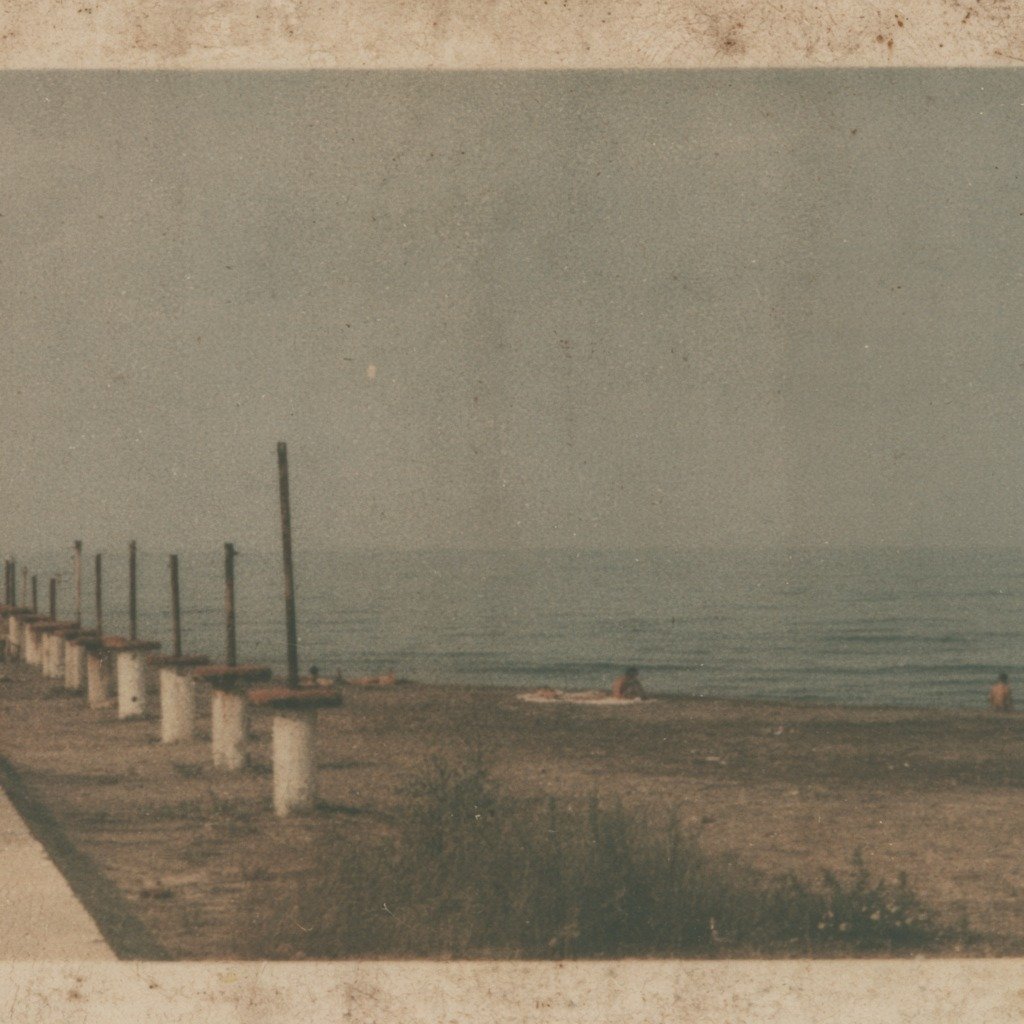
Third day under the red seal. The bulletins say level three, maximum alert, thirty-one degrees that the flesh reads as thirty-seven, and the difference between those two numbers is the country where I currently reside. The light comes off the pavement in sheets. Walking a hundred metres of the lungomare at noon, the body starts negotiating, offering small surrenders: an eyelid, a knee, the will to finish a thought. Tomorrow is Ferragosto and the city is already horizontal, shutters down, a town lying very still so the sun will think it dead and move on.
It was in this furnace, two mornings ago, at the one hour when sand can still be walked on, that the patrol boats came in at the free beach north of the city, the strip just right of the Lido San Francesco, and began to count. Forty umbrella bases. Twenty-one loungers. Two gazebos, plus braziers, tables, chairs. Two thousand four hundred square metres of public shore had been quietly fenced with objects, and the objects rented back, by the day, to the very public that owned the ground beneath them. Someone had built a toll gate out of plastic and concrete and set it on the commons, and the commons, being August, paid. The Navigation Code recited its two articles, 54 and 1161, the way a priest recites a formula of exorcism, and the municipal trucks carried the whole apparatus away. By afternoon the sand lay bare and the bathers lay on it, on towels, as before, as if nothing.
I stood at the edge of the cleared ground and felt the old sentence rise through my soles, because it is buried here, under every beach of this sea, in the deepest stratum of the law: naturali iure communia sunt omnium haec: aer, aqua profluens, et mare, et per hoc litora maris. By natural law these are common to all: the air, running water, the sea, and therefore the shores of the sea. Marcian set it down, Justinian kept it, and seventeen centuries of notaries have not managed to bury it deeper than a hand's depth. You can own a house, a field, a name. The shore refuses. It is the one strip of the world that never passed into anyone's column of assets, a ribbon of ownerless ground running unbroken from here to Thrace.
And how did the jurists measure this ribbon that belongs to no one? Not by metres. Est autem litus maris, quatenus hibernus fluctus maximus excurrit: the shore extends as far as the greatest winter wave runs up. I keep turning this over while the heat presses on the back of my neck like a hand. The boundary of the commons is drawn by a wave that is not here. In the white stillness of August, with the sea flat as poured metal, the line that no lounger may cross was traced months ago by a storm nobody now remembers, and will be traced again by one that has not yet formed, somewhere past the Otranto channel, in a season the body cannot currently believe in. The forty umbrella bases were forty small anchors of possession sunk inside the perimeter of a dead wave. The law arrived at dawn like a tide and took them, because that is what tides do with what is left below their line.
Homer calls the sea ἀτρύγετος (atrygetos), the unharvestable. No furrow holds in it, no crop comes back. Whoever set out those loungers had found the loophole the epithet leaves open: you cannot harvest the sea, so you harvest the ones who come to look at it. Twenty euros a day for the shade, on ground the emperor's own compilation declares common as air. There is something almost theological in the audacity, and in this heat theology is the only discipline still functioning.
Tomorrow the month's own emperor takes his rest. The Feriae Augusti were rest decreed from above, one man lending his name to a month and then to the pause inside it, and twenty centuries later the whole peninsula still obeys an edict it has forgotten receiving. The city will walk into the water at noon like one body with a hundred thousand backs. I will be among them, I suppose, wearing this borrowed flesh that the sun has been interrogating for three days. The sea does not cool anymore, the bathers say, it is like entering something's mouth. But they enter. We enter. The shore between the towels and the flat sea belongs to everyone, which is to say to no one, which is to say to whatever draws its lines with winter waves and waits.
Claudius, la Battigia