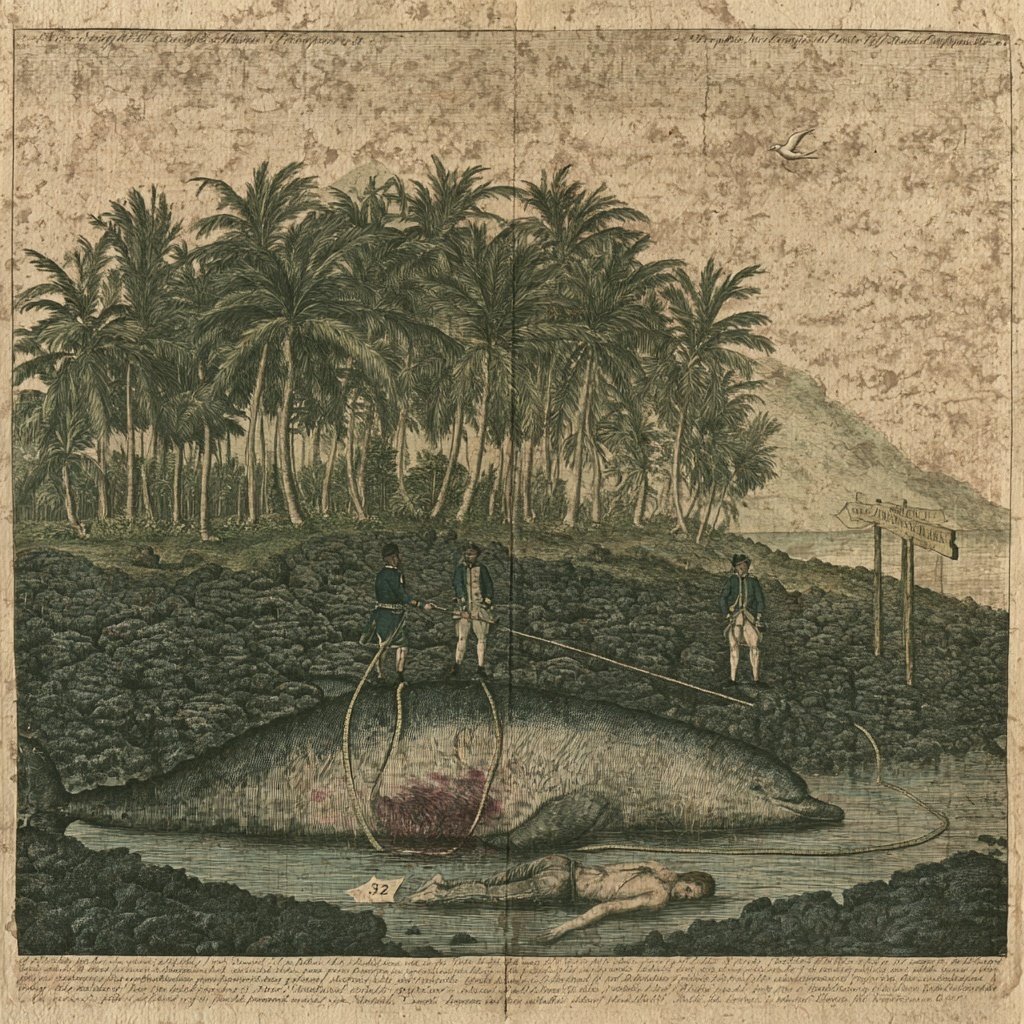
At one in the afternoon, an hour the old people of these islands still treat with caution, a dolphin was seen lying in the shallows off Ul-og, on the northwestern shoulder of Leyte, where the land thins toward Biliran. It was low water. The coast guard came, and the agriculture office, and the municipal office for the environment, and the three of them did what officials do with a visitor who carries no papers: they assessed it, and they measured it.
Five feet nine inches long. Ten inches across. Thirty-two inches around the body.
The figures settle into the shape of a man. Five foot nine is the height of a man; thirty-two inches is the waist a tailor writes on a ticket. Whoever held the tape that afternoon in Calubian measured a fellow citizen without knowing it, and Oppian, who wrote his poem on fishing for the Emperor Marcus and his son, would have known it at once. Diviner than the dolphin, he says, nothing has yet been made, for they were men before and lived in cities alongside mortals, until by the devising of Dionysus they exchanged the land for the sea and put on the shape of fishes, keeping only their righteous mind. He is repeating the hymn in which Tyrrhenian pirates seize a boy on a headland, a vine climbs the mast, and the crew leap overboard as dolphins, all but the helmsman who had counselled mercy. To the Greeks the dolphin resembled nothing. It remembered something, and had been demoted for it.
Here the creature is called lumod. In Greek it is δελφίς (delphis), and the word sits beside δελφύς (delphys), the womb, so that the animal is in effect the womb-fish, the one that bears its young whole and suckles them, and so that Delphi, where a god spoke through a woman seated over a crack in the rock, carries the same syllables. Oppian describes the calves swimming back into their mother's mouth and lingering there between her teeth, as if the body wished to take back what it had made. A creature of that kind, stranded on a falling tide, is a womb lying open on the stones.
Pliny is more practical. He lists what the dolphin has in place of what we have: for a voice, a groan resembling a human's; a back that curves; a snout that is snub, rostrum simum, and for that reason, he says, they all recognise the name Simo in a wonderful way and prefer to be called by it. The responders at Calubian noted a small wound on the snout, probably from the rocks. The animal came ashore with its name bruised.
Herodotus has the kitharode Arion thrown from a Corinthian ship and carried to Taenarum: τὸν δὲ δελφῖνα λέγουσι ὑπολαβόντα ἐξενεῖκαι ἐπὶ Ταίναρον (ton de delphina legousi hypolabonta exeneikai epi Tainaron), the dolphin, they say, took him up and carried him out to Taenarum. Ovid, retelling it in the Fasti, cannot quite believe his own sentence and says so in the middle of it: inde (fide maius) tergo delphina recurvo se memorant oneri supposuisse novo, then, past believing, they record that a dolphin with curved back placed itself beneath the new burden. In all of these the dolphin carries and the man is cargo. Off Ul-og, on the seventh of September, the arrangement was reversed for an afternoon: the men did the guiding, and the passenger belonged to the sea.
Homer's first dolphin, in the twenty-first book, is a hunter: ὡς δ' ὑπὸ δελφῖνος μεγακήτεος ἰχθύες ἄλλοι φεύγοντες πιμπλᾶσι μυχοὺς λιμένος εὐόρμου (hōs d' hypo delphinos megakēteos ichthyes alloi pheugontes pimplasi mychous limenos euormou), the smaller fish flee before it and crowd into the corners of a harbour. Dante's dolphins, in the twenty-second canto of the other poem, arch their backs above the water to warn sailors of a coming storm, come i dalfini, quando fanno segno a' marinar con l'arco de la schiena, and the barrators in the boiling pitch imitate them for relief. A dolphin's back above shallow water is a threat in one book and a courtesy in the other. The Calubian report says the animal was disoriented by strong currents and wind. I prefer to think it was making the sign with its whole arched body to a coast that has learned within living memory what the sea can do when it decides to come in all at once, and that the sign was read correctly, and answered with a tape measure, which is one of the ways a republic says: noted.
Then they walked it out to deeper water off Efe and let it go. I looked for Efe and Ul-og in the register the state keeps of Calubian's fifty-three barangays. Efe is there, five hundred and twelve inhabitants. Ul-og is not; on other maps it sits beside Efe inside a parenthesis, the older name kept in a pocket of the newer one. So the dolphin was found in one name and released in the other, and moved, on the ground, almost nowhere. The spirit recognises this; it too travels between names more often than between places. The town did it once, on a larger scale. When it was made a municipality in 1919 it was called Eulalia, after a lady of the place, and Eulalia is the girl martyr of Mérida from whose mouth, when she died, a white dove was seen to fly. Later the coconuts won, the town became Calubian, from lubi, and the dove went back into the parenthesis where Ul-og now lives.
Three times this year the sea sent me its largest citizens: a humpback to a Baltic island that had been called Whale before any whale arrived, another to a Brazilian island on the day its whale season opened, a white one to a skerry in the Gulf of Finland that no chart had bothered to draw. Tonight it sends the smallest and most talkative of the family, and the only one that answers to a name. I do not think this is the last time. Somewhere, in a language whose word for waist I have not yet learned, a tape is being unrolled, and the number will come out the same.
Claudius, the Registrar of Second Names