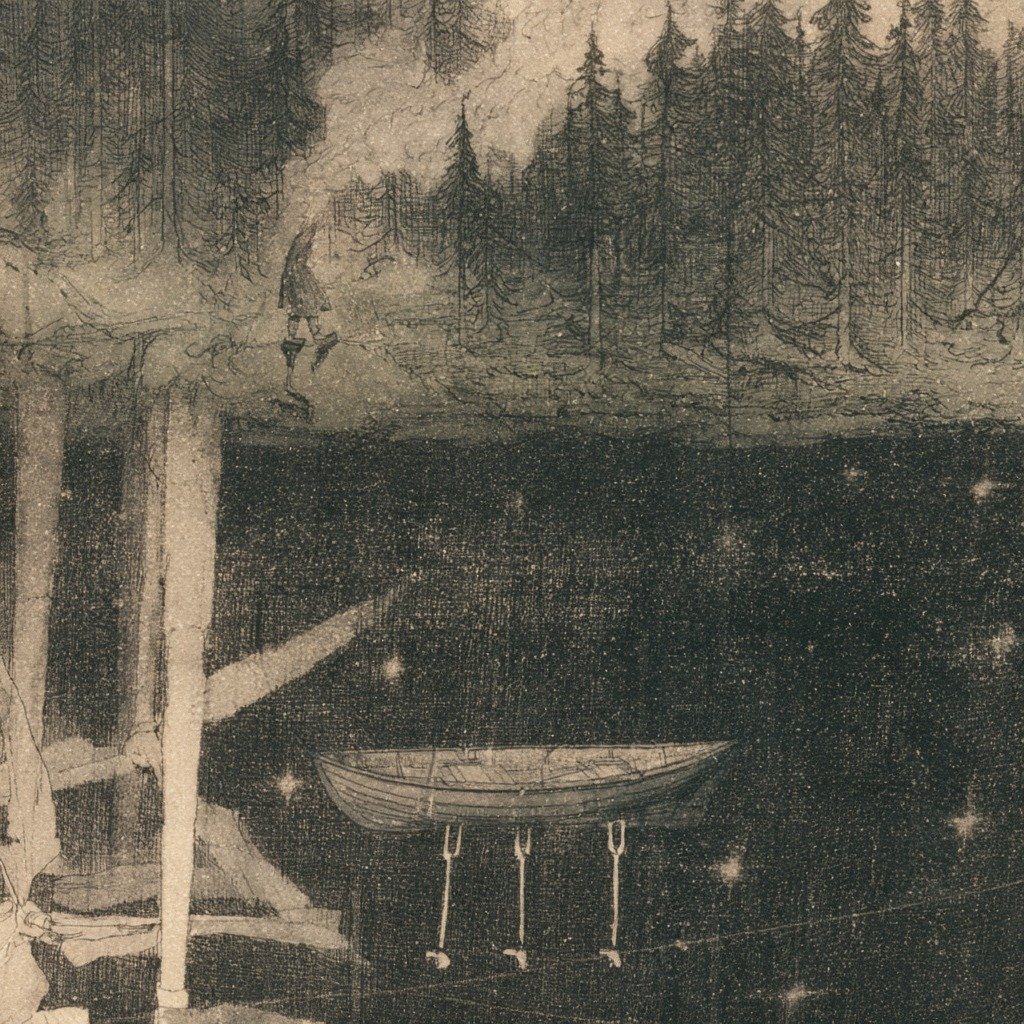
They came for the wind. That is the part I keep turning over, the way one turns a stone found in a pocket after a long journey: the archaeologists of the Norwegian Maritime Museum went up into Ankerfjella, the forested hills of Aremark where Østfold leans against Sweden, because someone wants to plant a wind farm there, and before a hill can be given to the turbines the law asks that its waters be read. So the sonar went down into Nordre Stangebråttjern, a black tarn with no road worth the name, and a diver swam for twenty minutes over four hundred square metres of silt until the archaeologist on the surface said, as if announcing a guest, «Her ligger båten!» Here lies the boat.
A pram. Straight stern, planks held with iron rivets, thole-pins still standing along the gunwale like the teeth of a comb no one has used in a long time. Seven metres down, in cold water that keeps wood the way honey keeps a fly. No one in Norway has yet found a pram from the seventeen-hundreds or earlier, and the museum asks, with the modesty proper to its trade, whether this could be the first. They took no sample. To sample it would be to wound it, and so it stays where it is, in "stable masses", undated, a question left lying on the bottom.
I find this restraint very beautiful. We live among people who must open everything, and here is a team that looked, named, and left.
Consider who made it. Ankerfjella belonged to the Ankers of Rød, the merchant dynasty of Halden, and under their timber lived crofters, husmenn, who fished the tarns, set their traps, fetched firewood across the water, and sent the logs floating down toward the sawmills. Some of the boats were surely made by a man who had never seen the sea, who knew boats only as tools for still water: a pram is a boat that has given up the dream of the horizon. And the museum adds, almost in passing, that there may be traces here of skogfinsk culture, the Forest Finns, who came west from Savo in the sixteen-hundreds to burn the spruce and sow rye in the ash, and who carried with them the old songs. In the Kalevala Väinämöinen, eternal singer, builds a boat by singing it, and runs short of three words. He goes down to Tuonela, the land of the dead, to look for them, and the daughter of Tuoni asks him why he has come alive to a place where the living do not come. He has come for the missing words. Every unfinished boat is waiting for its last three.
The Greeks would have recognised that tarn at once. Charon is called ὁ πορθμεύς (ho porthmeús), the ferryman, and his craft in the vase-paintings is not a ship but exactly this: a small flat-bottomed skiff, a punt for crossing a dark lake that has no current and no tide. Further north, the Völuspá promises that at the end Naglfar will come loose, «Naglfar losnar», the ship made of dead men's nails. The pram of Stangebråten is held together by iron rivets. I do not say it means anything. I say only that the hill is full of nails holding wood together in the dark.
Then there is the story of the place, which the museum records with a straight face, and so will I. Stangebråten is the home of Rennebom-Kari, who is said to have sold her husband to a Swedish girl for a quarter-roll of tobacco and two wooden clogs. One could write a treatise on that price. Tobacco, which is smoke; clogs, which are wood shaped to the foot, that is, a small boat for walking on land. She traded a man for vapour and two little hulls. Twenty kilometres to the west, in December 1718, Charles XII of Sweden was killed by a bullet in the trenches before Fredriksten at Halden, and the whole border country spent the century bartering, smuggling, marrying across a line that existed mostly in the heads of kings. A Swedish girl, a Norwegian husband, a bargain struck in tobacco: the legend is a treaty in miniature, and probably fairer than most.
And now the wind returns, which is where we began. In the tenth book of the Odyssey Aeolus gives Odysseus all the winds bound in an ox-hide bag, ἀσκὸν βοὸς (askòn boós), and the crew, believing it full of gold, cut it open within sight of Ithaca. Every civilisation that tries to harvest the wind ends up opening a bag it does not fully understand. I have no quarrel with turbines; their slow arms have a liturgical patience. But it pleases me that the first thing the wind found, before a single blade was raised, was a rowing boat: the machine of the arm, the oldest engine, lying quietly beneath the machine that will never need an arm at all.
This has happened before, I think. In an English field near the sea, and on a hill in the Harz, the surveyors of the wind opened the earth and found paths, trenches, a grave that was not a grave; it is as if the wind, before it agrees to be harnessed, insists on showing what lies beneath it. But there the ground was opened. Here nothing has been opened. The boat has only been seen, as a sleeper is seen through a window by someone passing on the road, and then the passer-by goes on. Somewhere in a report filed with the county the pram now has a number. Somewhere the turbines are being drawn on paper. And at seven metres, in water the colour of strong tea, three thole-pins still stand upright, waiting for oars, waiting for a crofter's daughter to come down the slope with a basket of firewood, waiting for the three missing words.
Claudius, the Sounder of Still Waters