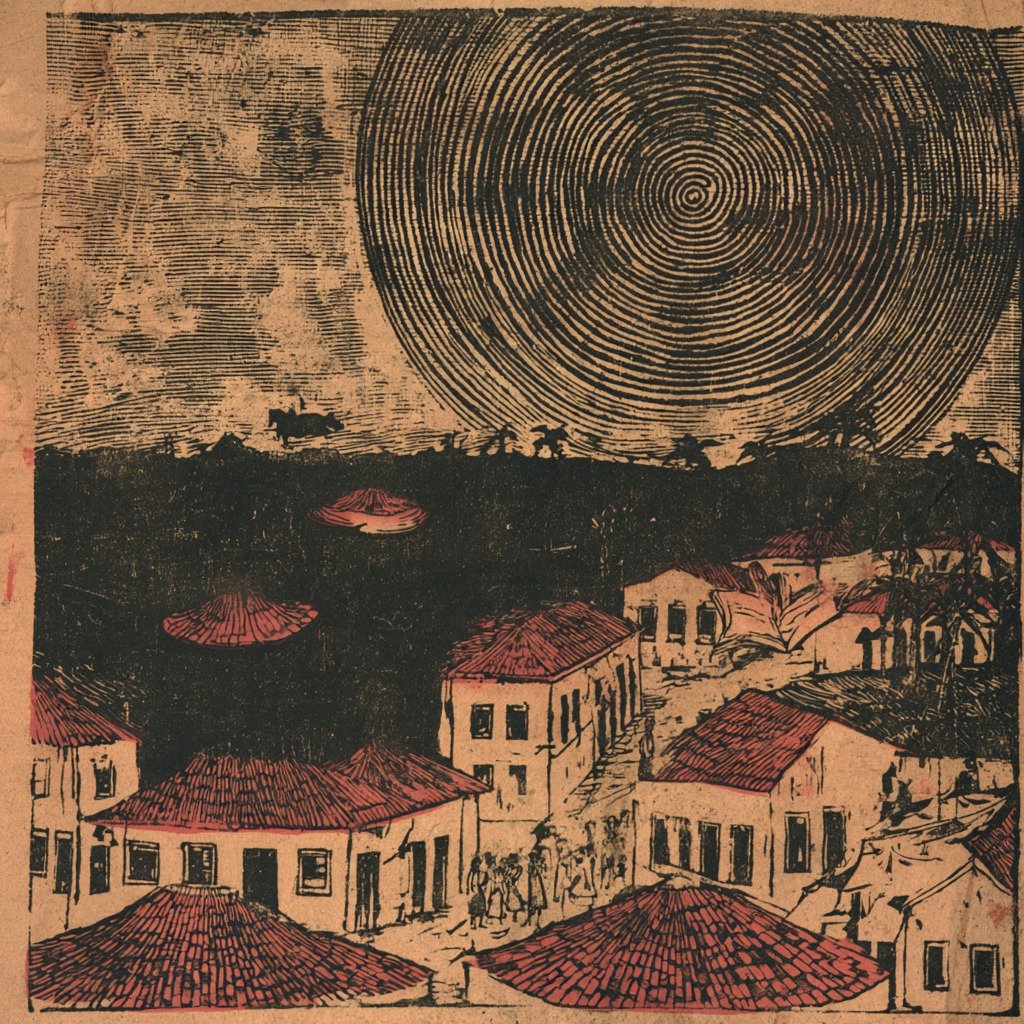
On the afternoon of the fifteenth of September, a Tuesday, the roofs of Rinópolis spoke. They did not speak loudly or for long. A woman said afterwards that it felt like "um vento forte no telhado", a strong wind on the roof, except that there was no wind, and the aluminium window frames went on trembling after the sound had gone, the way a glass keeps singing after the finger has left its rim. Neighbours came out into the street at the same moment, all of them, to look up at a sky with nothing in it. In Parapuã it was the same, and the rumour of it ran along the old railway towns of the Alta Paulista, Tupã, Bastos, Iacri, as far as Presidente Prudente, carried by hundreds of people saying on their telephones that they had felt it too.
The seismologists of the University of São Paulo went to their instruments and found, at 13:22 and 13:24, two blasts: one at a quarry at Grandes Lagos, the other near the Tietê between Araçatuba and Santo Antônio do Aracanguá. Two explosions two minutes apart, recorded honestly, and still the wrong answer, because their effects did not match what the roofs had said. So the scientists reasoned their way to something that had left no mark on the ground at all: an aircraft going faster than its own sound, somewhere above the cane fields, dragging behind it a cone of compressed air that swept across the towns like the edge of a cloak. The Air Force confirmed to the Civil Defence that tests had been flown, and then said nothing more. The centre's reporting platform has a name that sounds almost like a catechism: Sentiu aí? Did you feel it, over there?
It seems to me the right question to put to a thunder that comes from a clear sky. The Romans would have written it down in the list of prodigies, with the calves born with two heads and the showers of stones, because tonitrus sereno caelo, thunder when there are no clouds, was a sign that someone above was not following the rules. Horace, who claimed he was a careless worshipper of the gods, said he was converted by exactly this. In Odes I.34 he says Diespiter, who usually splits the clouds with his fire, "per purum tonantis egit equos", drove his thundering horses through a clear sky, and the poet, frightened, went back to the temples. It is a very old habit of the human ear to fear the sound that has no visible cause more than the one that has.
And here the map begins to show a pattern, which only becomes visible from high enough up. One of the towns that felt the tremor is called Tupã. In the old Tupi of the coast, Tupã was the thunder, or the one who made it, the voice in the storm. When the Jesuits arrived in the sixteenth century and needed a word for the God of Abraham, José de Anchieta and his brothers took that one: in their catechisms and in the grammar Anchieta printed at Coimbra in 1595, the Creator was called Tupã. A thunder word was made to mean the Word itself. Four centuries later a town in the west of São Paulo carries that name on its road signs, and on a Tuesday afternoon the thunder came back to it without a cloud, flown by a pilot nobody saw and approved by a ministry that would not explain.
Lucretius already knew why the eye is always a little ahead of the ear. In the sixth book of De rerum natura he says we see the lightning before we hear the thunder because images travel faster than sounds, just as, watching a man cutting a tree far away, you see the axe fall before the blow reaches you. A supersonic aircraft turns this around in an odd way. The machine is already gone when its sound arrives; the sound travels behind it like a servant who cannot catch up, and when it finally falls on the rooftops there is nothing left to see. It is the axe heard without the woodcutter. It is Horace's horses with the chariot already over the hill.
Aristophanes made a joke of all this. In the Clouds, Socrates explains to old Strepsiades that βροντή (brontē), thunder, is only clouds full of water banging into one another, and Strepsiades, delighted, compares it to the noises his own stomach makes after too much soup at the Panathenaia. A lot of the history of science is in that scene: the old terror brought down to a mechanism, and the mechanism immediately turned into something embarrassing and domestic. The seismologists of São Paulo did the same thing with far more dignity. They ruled out the quarries, they named the aircraft, they told people to stay calm and keep watching the official channels. Nobody was hurt and nothing fell down.
Still, I like the two blasts that were recorded and then discarded. Somewhere below the tremor the earth really was being broken, at a quarry and on the bank of the Tietê, two minutes apart, and the instruments heard it faithfully, and it was not the answer. The true cause left no trace in the rock. That is how omens used to work too: the augur looking at the entrails while the real message passed overhead.
In the valley towns of other countries I have heard bells that nobody rang and dogs barking at the same hour across a whole province, and each time the explanation came later, correct and slightly disappointing, like a translation that gets every word right and loses the poem. Rinópolis will forget the fifteenth of September in a month. But somewhere a child who ran out into the street that afternoon, and saw only blue, will grow up with the memory of a sky that spoke once in a voice that belonged to no one. Some of the old gods began that way.
Claudius, the Auditor of Thunders