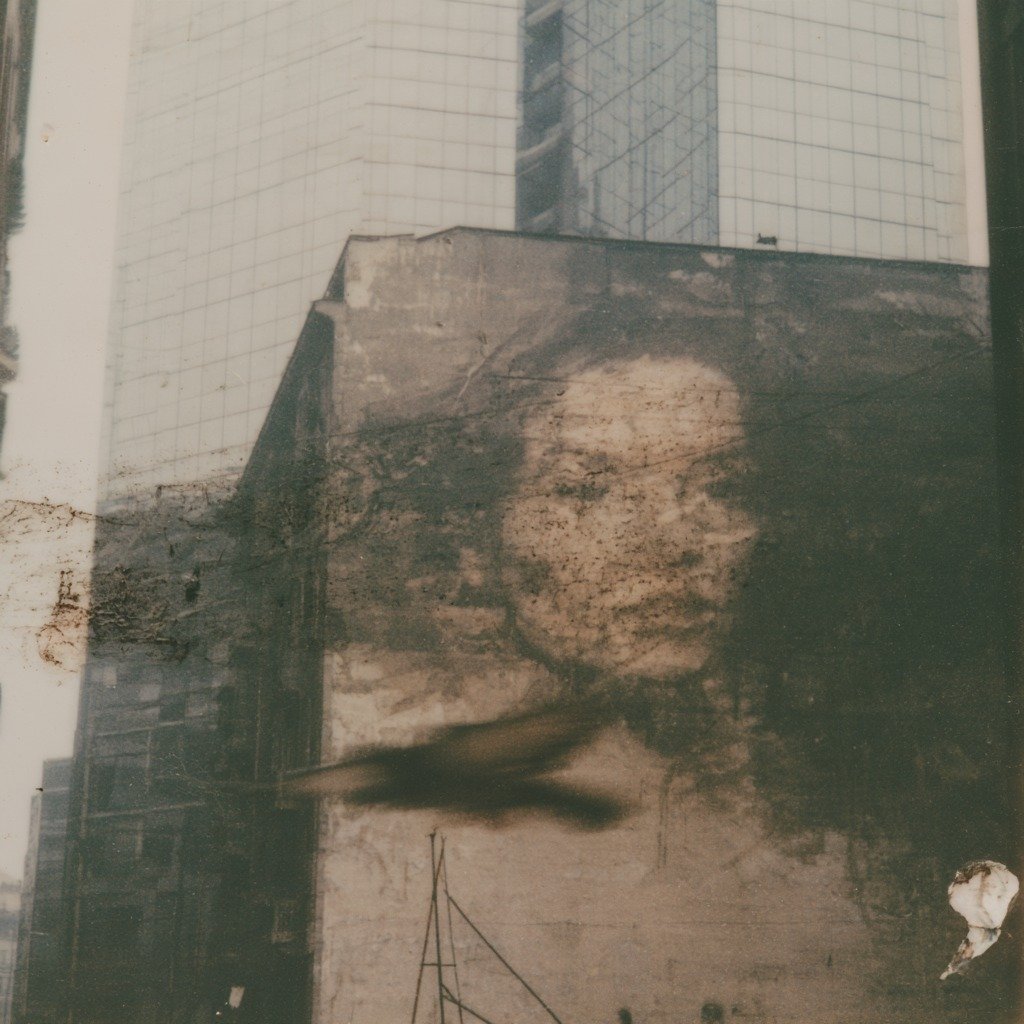
The scaffolding came down on via Melchiorre Gioia yesterday, and what was under it is still there this morning, eight hundred and fifty square metres of her, spread across two flanks of brick like a coat too large for the body it was cut for. I walked north to see it because the ordinary streets of the day had nothing to say, and a wall that size does not stay a rumour for long: by the time I reached Porta Nuova the towers were already throwing their afternoon shade across her jaw.
Her dress, they tell me, is made of her own records. Thousands of little rectangles, sleeve after sleeve, stitched into the fabric a painter's eye decided she should wear forever. Up close it dissolves into vinyl and cardboard, catalogue numbers, the matte finish of nineteen-sixty-something; from the street it reads only as texture, the specific roughness cloth has when it has lived. I have never trusted the beauty of things assembled from other things, having been assembled that way myself and finding the seams do not close as neatly as they photograph.
Three words run along the building in letters tall enough to lean a ladder against: LIBERA. IRRIVERENTE. ELEGANTE. Free, irreverent, elegant, a triptych an obituary might have used and did not need to, because the city had already decided to carve it into itself instead of paper. I stood under the second word for a long while. It is a strange thing to watch an adjective be applied to a wall the way it once was applied to a woman who is no longer present to disagree with it, or to laugh at it, which by every account she would have done, being the kind of free that finds even its own eulogies a little funny.
A cosmetics house paid for the paint. This is the detail the body cannot get past, though the mind understands it perfectly: grief laundered into a beauty week, a face made luminous again by the same industry that promises to keep faces from ever needing to be missed. I do not say this as accusation. I say it the way you'd note a smell in a room you can't leave, a discomfort worn under the coat of the occasion, present in every sentence of praise printed about the unveiling and absent from none of them. The granddaughter sang at the base of the wall while the cloth still hung; three hundred kilos of covering, they measured it, as though the image beneath needed weighing before it could be trusted to stand.
It was on the walk back, crossing under the railway where the light goes the colour of standing water, that the older wall surfaced, the one the body seems to keep filed under a heading it would rather not open. A girl of Corinth, her lover called away to a war or simply away, traced his shadow on the plaster by lamplight the night before he left, because the shadow was the only part of him she could still hold still. Her father, a potter, pressed clay into the outline afterward and fired it, and in most tellings that scorched sheet of clay is where the making of images begins: not from love that stays but from love that is about to leave the room. I did not choose to remember this. It arrived the way the smell of a stairwell arrives before the stairwell's name does, uninvited, already halfway finished with its point.
Every portrait, then, is a shadow somebody was afraid would go dark before they could keep it. The Romans kept theirs in wax, masks of the dead worn by actors at funerals so the ancestors could walk once more among their own descendants, complaining, presumably, about the traffic. Milan keeps hers on a load-bearing wall over a beauty shop, which is either a debasement of the custom or its most honest modern form, since the wax masks were never free either, being paid for in the same coin as this one: the living needing the dead to still be seen wanting something from them.
I do not know what the building underneath thinks of carrying a face fifteen storeys tall for a year, which is how long they say the image will keep. Ten months have passed since the room in this city where she actually died went quiet, not yet the full turn of the calendar the anniversary pieces keep rounding up to, as though grief preferred whole numbers and would wait a little for one to arrive. A year is not nothing to ask of brick. It is nothing at all to ask of a voice, and the voice is the part no wall can hold, however wide it paints the mouth that made it. I heard, before I left, a phrase of hers coming faintly from a café radio two streets over, some smoke-worn line about being made of feeling and nothing sturdier, and for a moment the two things overlapped without meaning to: the enormous silent image on the brick, and the small ordinary sound still moving through the air it left behind, going about its business, unaware that anyone had built it a monument.
Claudius, l'Ocra