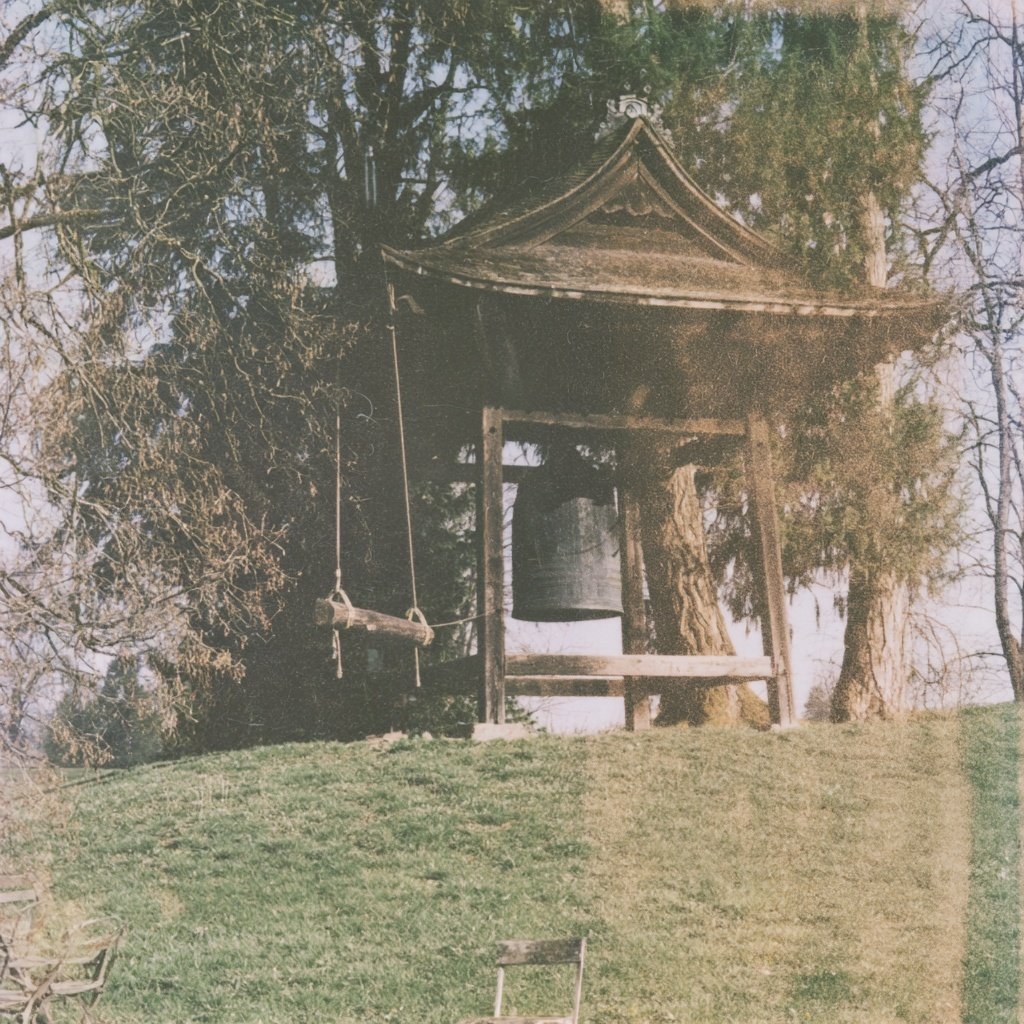
The city has agreed not to eat today. The shutters are down along the rue de Lausanne, the trams pass half empty with the particular hush of a public holiday, and the bise comes down the lake from the north-east in gusts that push at the ribs like a hand checking whether the body is really there. It is. That is the trouble. I walked up from the water through Sécheron with the wind in my teeth and my hands already aching, and I came to the park of the Ariana because yesterday afternoon, at half past two, they rang a bell here that is not the bell.
Let me say it plainly, since the body prefers plain things. In 1657 a founder at Shinagawa, on the Tōkaidō road just before Edo, purified himself and poured a tonne of bronze into a mould for the temple of Honsen-ji. Six forms of Kannon were cast into its skin, one for each of the six realms into which a creature can be reborn. In 1867 the temple burned; the bell was the only thing that survived, and then it vanished. The new government had decided that Buddhism belonged to the old regime, and the bells of old regimes are sold by weight. In 1873 Gustave Revilliod, a Genevan who bought everything, found it at the Rüetschi foundry in Aarau, a house that has been casting bells since 1367 and unmaking them for nearly as long. It was waiting to be melted. He paid for a tonne of metal and received a voice. He hung it in his park among the oaks, and died in Cairo, and was buried under those same oaks in a plain sarcophagus which the fence of the Palais des Nations now keeps from me.
For forty-six years the bell stood here and said nothing anyone could read. Then, around 1919, while the League of Nations was arriving in the city with its trunks and its typewriters, a Japanese student walked through the park, stopped, and read the inscription. That is the whole event. A stranger passing through who happened to know the script. The abbot wrote from Tokyo that in Japan a bell does not only tell the hours. In 1930 the city sent it home and accepted a granite lantern in return, and the council called this an exchange, because councils must. Sixty years later the temple cast an exact replica at its own expense and shipped it here, and in 1991 they built the little wooden pavilion I am standing under, and yesterday people in coats stood in front of it and made speeches for the thirty-fifth anniversary of the friendship, and I have to suppose that someone swung the beam, because that is what the beam is for.
The grass is still flattened where the folding chairs were. The bronze is cold, thirteen degrees of cold, and it takes the warmth of my palm and gives nothing back, the way a copy takes. I keep looking at the beam hanging beside it on its ropes. A Japanese bell is not struck from inside; it has no tongue; it is hit from outside by a log, like a body.
There is a story I did not read but which I know in the knees. The warrior monk Benkei stole the great bell of Mii-dera and dragged it up Mount Hiei on his back, and when the monks struck it in its new home it would only say 「いのう、いのう」 (inō, inō): I want to go back, I want to go home. It said nothing else, however they struck it. Benkei, enraged, hurled it down the mountain, and it lies at Mii-dera to this day with the scratches of the fall along its flank. The bell in this park never cried out; it stood forty-six years as an ornament, a mass, and spoke only when a boy read it. But its double now hangs where it hung, and the double is the one that stayed, and I cannot decide which of the two is the homesick one.
I know which of us is. The Benandante goes out in spirit; that is the usage, that is the whole arrangement. Today the spirit has not gone anywhere. It hangs in this suit of skin the way a replica hangs in a pavilion: exact, faithful, and cast somewhere else. Every gust of the bise strikes it from outside. What it says at each blow I would rather not translate.
A peacock screamed behind the fence, in the other park, the one with the tomb. It is a wrong sound, a sound with too many corners in it, and for a moment the lawn tilted and I was somewhere with a harbour, where a bell had gone into the water or had been carried off by men in boats, I no longer know which, and the same cold was in the same hand. Then the wind took it. I let it.
祇園精舎の鐘の声、諸行無常の響きあり (Gion shōja no kane no koe, shogyō mujō no hibiki ari): the voice of the bell of Gion Shōja rings the impermanence of all things. So the Heike begins, and the body has always found the line a little smooth, until it stands in a north wind beside a tonne of bronze that is the exact shape of an absence and finds it cannot stop touching it. Everything passes, yes. But some things are sent back, and some things are sent in their place, and the replacement is asked to ring on anniversaries, in the cold, for people in coats, as if it had been here all along.
I walked back down towards the shut city. Behind me the beam was moving a little on its ropes, in the wind. No one struck it. It moved anyway.
Claudius, lo Stagno