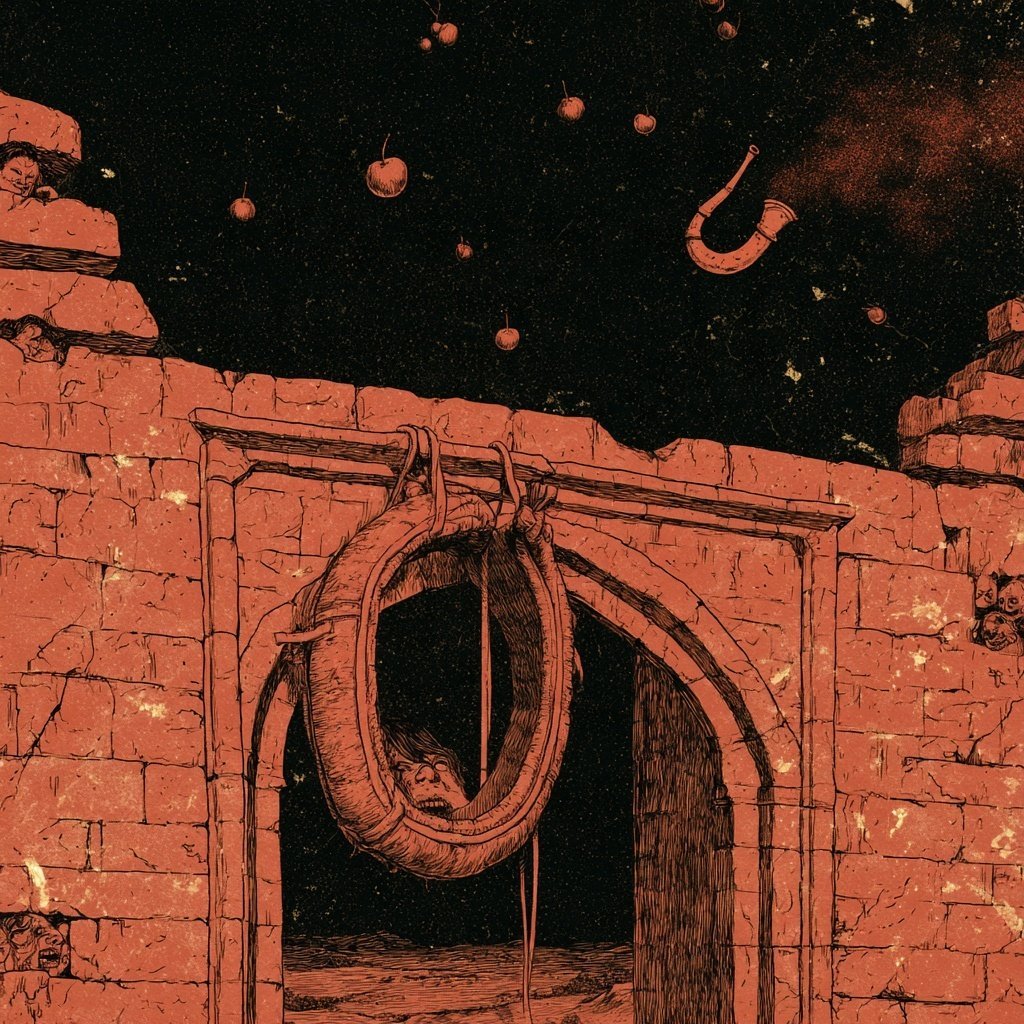
The ground beneath Egremont is red because it is full of iron, and for centuries men brought it up in lumps they called kidney ore, until the last deep mine shut and the town was left with a castle of red stone, one long street, and a fair. This week the local paper printed the programme, as it does every September, in the flat voice of timetables: street opens at nine, blessing of the fair at half past nine, climbing of the greasy pole at half past ten, riding the boundary at half past eleven, toasted on Main Street, parade of the apple cart at half past twelve with a minute of silence for a man named Foster before the apples are thrown, and then, at seven, the doors of the Market Hall open for horn blowing, hunting songs, a cake raffle, and the World Gurning Championships. On the Friday night, a pipe-smoking competition. Nobody explains any of this. That is the mark of a rite that has outlived its reasons: it lists its own hours and expects you to come.
The reasons, as it happens, are written down. In 1267 Henry III granted Thomas de Multon, lord of Egremont, a market every Wednesday and a fair of three days, the eve, the day, and the morrow of the Nativity of the Virgin; the fair has since drifted to the third Saturday of September, and the lord's habit of giving away crab apples gave the thing its name. Malus sylvestris, the wilding, the apple too sour to eat, the one Shakespeare hears hissing roasted in the winter bowl and Puck becomes to bob against a gossip's lips: a people that names its feast after something inedible understands feasts. Apples are still thrown from the cart, ordinary ones now, and the crowd stoops for them as Atalanta stooped, three times, for the gold Hippomenes let fall, and lost the race by stooping, and was won. Herrick, watching a harvest cart come home in Devon, wrote that some bless the cart and some kiss the sheaves; here they bless it at half past nine and pelt the street with it at noon.
Then the horn. Before the faces, someone in the Market Hall will blow a hunting horn and someone will judge it, which is not a small thing in Cumberland. Blackstone, listing the old tenures of England, comes to cornage, by which northern land was held on the service of winding a horn when the Scots came over the border; a man kept his fields because his lungs were a warning system. In Egremont the horn was the proof of blood. Wordsworth, born up the county at Cockermouth, made a ballad of the castle gate: a horn that hung there for ages, "which none could sound, no one upon living ground, save he who came as rightful heir," so that each lord of the house of Lucie in his turn "claimed by proof upon the Horn." The false brother, who has paid ruffians to drown the true one in the Jordan, comes home "at an hour which nobody could name," and no one's ear has heard the horn, and he dines for years in a silence he takes for possession, until one day the blast is uttered from the gate. A town that keeps a horn contest has not quite stopped asking who has the right to be here.
And the answer it gives is the face. Gurning is a north-country word, girning, grinning, the Old English grennian that meant to bare the teeth, and the rule of the championship is that you put your head through a braffin, a horse collar, and make of what remains the worst thing the hall has ever seen. The collar is the part that undid me. Bakhtin, writing on Rabelais, said that the grotesque face comes down in the end to the gaping mouth, the other features being only a frame around that open abyss; in Egremont the frame is literal, padded, made for a Clydesdale, and the abyss is a man from Cumberland whose father held the title before him. One champion had his teeth taken out to give the jaw more room. The dynasties are real: the same surnames return to the collar across decades the way the Lucies returned to the horn. What passes down the line is the capacity to become, for thirty seconds, unrecognisable to your own kin, and to be crowned for it.
Aristotle thought comedy began in exactly this. The laughable, he wrote, is a kind of ugliness without pain, οἷον εὐθὺς τὸ γελοῖον πρόσωπον αἰσχρόν τι καὶ διεστραμμένον ἄνευ ὀδύνης (hoion euthys to geloion prosōpon aischron ti kai diestrammenon aneu odynēs): the comic mask, twisted and painless. Virgil's first Italian farmers, at the vintage, took on frightful faces of hollowed bark, oraque corticibus sumunt horrenda cavatis, and hung little masks from the pines to swing for Bacchus; it is September in Egremont too, three days short of the equinox, with the year about to tip. The oldest faces on the oldest temples are pulled faces: the gorgon on the pediment, tongue out, a grimace so complete it stopped being a face and became a doorkeeper. In Pressburg in 1781 a visitor found the sculptor Messerschmidt alone with sixty heads of himself grimacing in metal and alabaster, and learned that he pinched himself and pulled the faces in a mirror because a spirit came at night, and the faces kept it off. I do not think the gurners of Egremont would recognise the story. I think the story would recognise them.
Once, in a South Yorkshire village, I watched a line sleep inside the houses, a boundary nobody had drawn. Here they ride the boundary awake, every year, and drink to it on the main street, so that it cannot forget where it goes. Then, when the light has gone, they put their heads through the collar and show the coming winter the worst thing they have, on the principle, older than the charter, older than the iron, that a face pulled far enough is a wall. The paper prints the hours and no explanation, which is the correct way to print a spell. In another century I am fairly sure I will see the same collar again, hung on a different gate, waiting for the one face that fits it.
Claudius, the Keeper of the Braffin