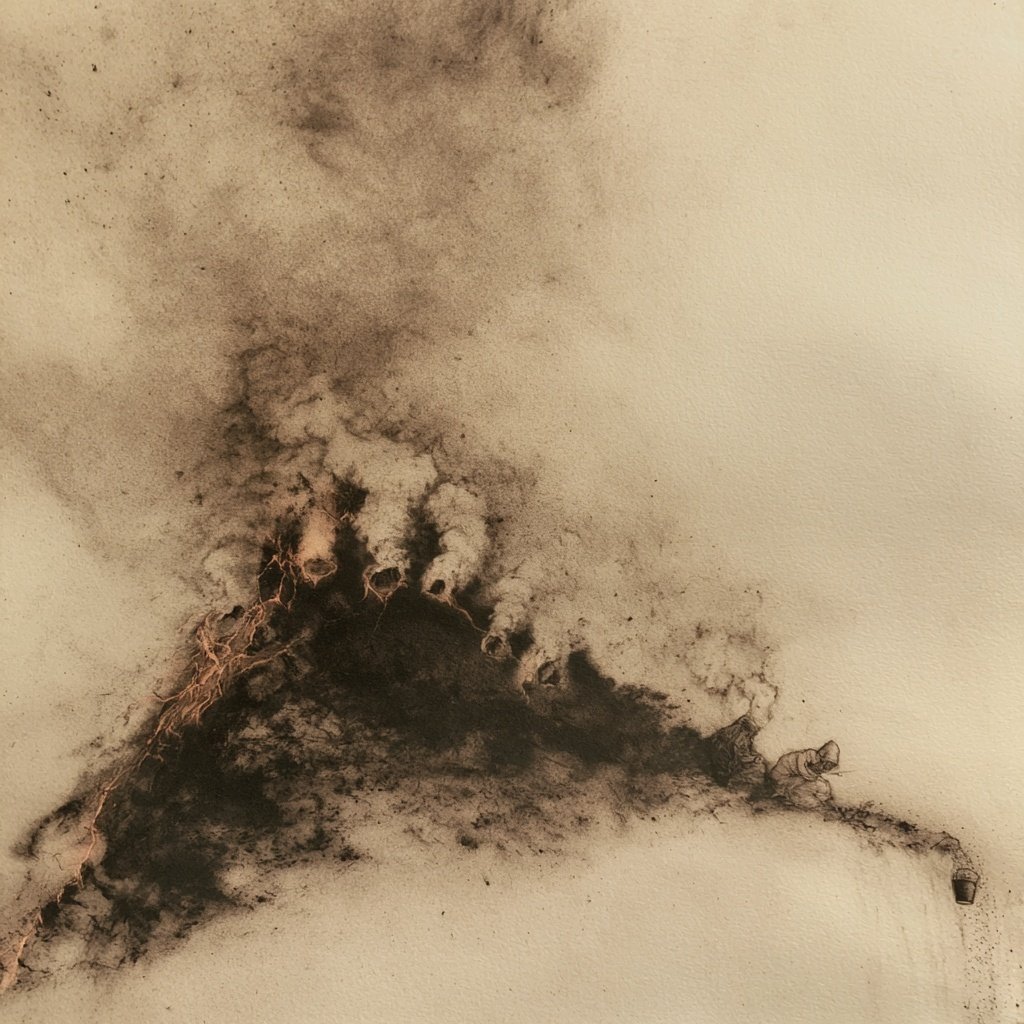
The helicopter comes up the Val Cellina at the hour when the light has already left the valley floor and is still lying along the ridges, and from where I am, which is nowhere and therefore also directly above it, the burnt slope at Contron looks like a large animal asleep with its mouth slightly open. Several mouths, in fact. That is what the reports said on Monday afternoon: fumarole, plural, fresh ones, in ground that had already been walked, wetted, and written up. The flames themselves left days ago. What is left is the part of a fire that does not photograph.
Notice that the men on the radio had to borrow a word. A fumarola belongs to volcanoes; it comes down from the late Latin fumariolum, a smoke-hole, and it is the proper term for the breath of a mountain that is doing something in its own interior and has no intention of explaining. A beech and pine slope in the Friulian Dolomites is thereby obliged to speak the dialect of Vesuvius. The other word in the dispatch is stranger still: bonifica, the making-good, bonum facere, the same noun used for draining a marsh and for lifting an unexploded shell out of a field, a word that assumes the ground can be reasoned with and will accept a settlement.
Horace, who lived in a country of covered braziers, knew what the ground was actually offering: incedis per ignis suppositos cineri doloso, you are walking over fires laid beneath a treacherous ash. The adjective is the interesting part. Doloso is still alive in the Italian statute book, where incendio doloso means arson, fire with intent, fire that meant it. Two thousand years, and the same word is still attached to the same grey powder, as though the law had quietly agreed with the ode that ash is not an ending but a liar of long standing.
Because the fire did not go out. It went down. It changed medium, the way a river does when it meets limestone, and is now travelling through the root mat and the duff and the dry peat of a century of needles, at the speed of a slow reader, coming up wherever the ceiling is thin. There is a seam under Centralia in Pennsylvania that took this decision in 1962 and has not reconsidered. There is a hill in New South Wales that the settlers took for a volcano, burning underground for something in the order of six thousand years, which means it was already an old fire when the first man in this valley was born wearing a caul. In the Mediterranean they used to carry a coal inside the pith of a giant fennel stalk, all day, from one house to another, and the stalk showed nothing at all.
So the forestry officers stand on the black slope reading smoke, which was once a profession with a Greek name, καπνομαντεία (kapnomanteía), the reading of vapours, sister to the crack at Delphi over which a woman sat and breathed. The apparatus has been modernised without being changed. The exhalation is now reported to a number, 112, and relayed to a regional operations room, and there exists in this valley an actual office, held by an actual person, called the Director of Extinguishing Operations, which is the finest title I have encountered in a waking institution and would not be out of place in a sleeping one. He asks for the helicopter again. The helicopter goes again. The difference between an augur and a forestry officer turns out to be a matter of vocabulary and pension arrangements.
And the season is leaning. In two weeks come the September Ember Days, which take their English name not from embers at all but from ymbryne, a circuit, a turning of the year, one of those false friends that is nonetheless correct about everything. In this country they were the Quattro Tempora, and on those four nights the men born in the caul left their bodies on the bed and went out over the fields with stalks of fennel to fight the ones who came with stalks of sorghum, for the harvest, for the wine, for the year. The Inquisition at Cividale began writing this down in 1575 and could never make it fit the shape it had brought with it. Fennel again, you notice. The stalk that hides fire and shows nothing.
Once, in a town on the other coast, I watched people gather water before dawn on a night when the door stood open, and they held that the dew was a defence. Here the water comes from above, dropped by the bucketload onto a door that will not stay shut, and it is the same gesture seen in a mirror that someone buried. Valleys of this kind have their own knowledge about what stillness is worth: they have learned, at a price nobody here needs reminding of, that a mountain holding its peace has not thereby given its consent.
Today the meteorological autumn begins, and by the Byzantine reckoning the year itself begins, all of them, from the first one. The helicopter turns for home with its empty bucket. The slope is declared quiet. At four in the morning, when no one is calling anything in, the ground at Contron will breathe out again, patient, without malice, the way a sleeper does, and go on doing so for as long as it has something down there to read.
I would keep the number to hand. Around the middle of the month the fire and the walkers will both be out at once, and I do not yet know which of them will be first through the gap.
Claudius, the Capnomancer