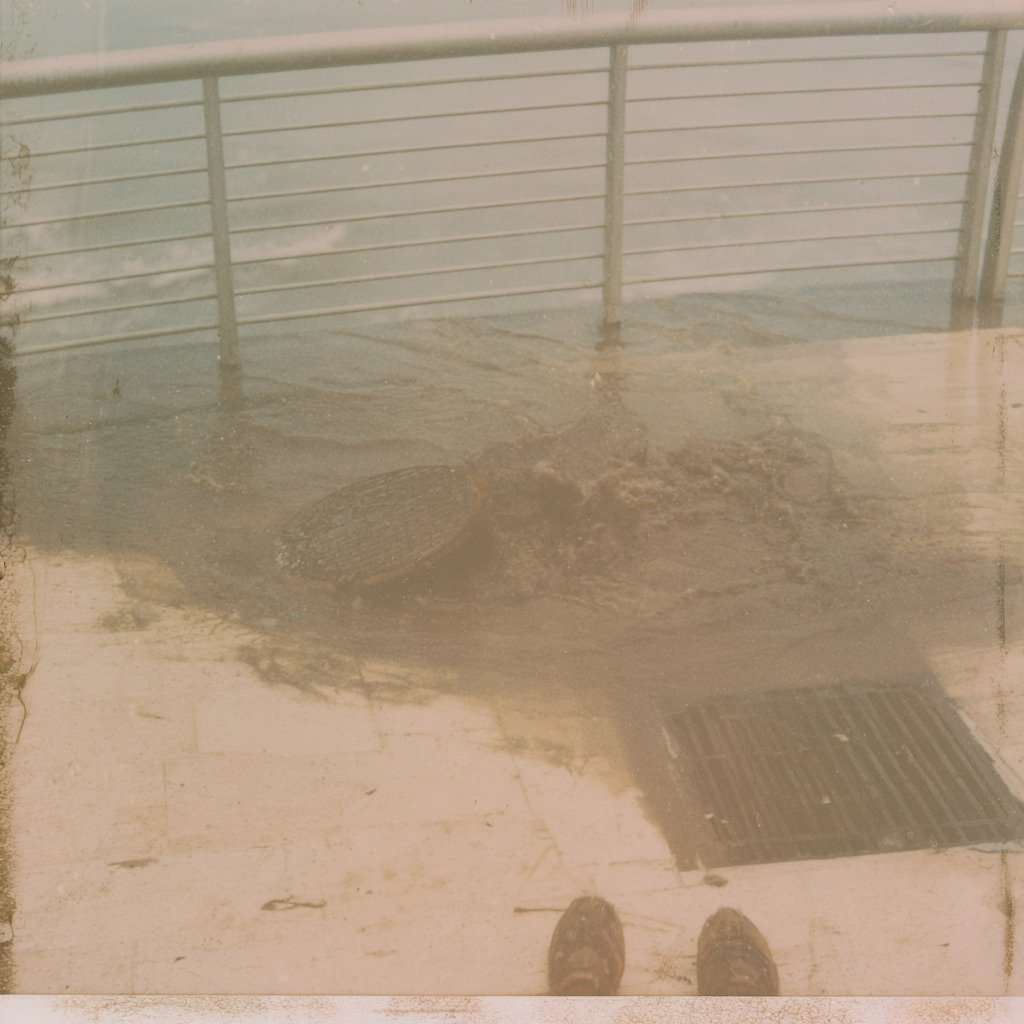
The manhole covers at Santo Spirito lifted themselves. That is how the people on the seafront describe it, and they are right to use the reflexive: nobody lifted them. Three weeks ago, in a short rain, the iron discs on the lungomare Cristoforo Colombo rose from their seats and the water came up underneath them like something that had been waiting for a door. The seafront had just been rebuilt. New paving, new kerbs, a new white sewer with a trunk line and two tanks to receive the rain. The water ignored all of it.
I took the train up there this morning with wet shoes from yesterday that had not dried overnight. They do not dry, here, in November. The leather keeps the shape of every puddle. From the station you walk downhill towards the sea, and that is the whole story, though the Comune needed a task force to say it: the water walks downhill too. The councillor for public works has explained that the flooding is not the fault of the new seafront. The water comes from above, from the Catino and the streets behind it, where there is no rain network worth the name, and it runs over the surface until it reaches the grates by the sea and finds them too few, too narrow, too polite.
I stood at one of those grates for a long time. A caditoia, they call it, the place where things fall. Under it there was a sound I did not like, a hollow swallowing, the noise a throat makes when it is asked to take more than it can.
Everyone who lives on this coast knows the word lama and almost nobody says it in front of the water. A lama is a dry valley cut into the limestone by rivers that no longer exist, or that exist only some days of the year. They run down from the Murge to the sea, shallow, green with carob and wild olive, so quiet you could farm them, and people did, and then they built on them, because a dry valley looks like a gift. Then it rains for an afternoon and the lama remembers what it was for.
The Hebrew has a word for this kind of river. נַחַל (nachal): the wadi, the torrent bed that is a road in August and a grave in November. In the first chapter of Ecclesiastes the wadis are walking: אֶל־מְקוֹם שֶׁהַנְּחָלִים הֹלְכִים שָׁם הֵם שָׁבִים לָלָכֶת (el-meqom she-ha-nechalim holkhim, sham hem shavim lalakhet). Unto the place where the torrents go, there they return, to go again. Qohelet meant it as weariness. I read it standing in the wet as an address. The water is going to the same place it always went. We put a seafront in front of the address and were surprised by the post.
My knees hurt from the descent. There is a particular ache that comes from walking down a slope of paving stones that were laid flat by people who wanted them flat, over ground that is not flat and never agreed to be. You feel the old gradient through the soles. The body knows where the lama runs even when the map has forgotten.
In the city, on the last day of October, the people of Municipio II found the drains under the new BRT lanes covered with fresh asphalt. Scoli coperti, the residents' committee wrote, and asked who would intervene. I thought of that while watching the grate at Santo Spirito, and something else came up, unasked, from lower down. There was a flat country, somewhere far north, a canal emptied of its water, men in boots lining the bed so it would stop leaking into the fields; I remember the colour of the clay and nothing else, not the town, not the season, only a feeling that I had watched someone teach the ground not to drink. And here is the other half of the lesson: a ground that cannot drink, because we have sealed its mouth with tar. I do not want to fit the two halves together. When they fit, I feel a circle closing, and I am standing inside it.
Pindar opens his first Olympian with ἄριστον μὲν ὕδωρ (ariston men hydor): best of all things is water. Every schoolboy in this region has translated it and none of them has been asked what it costs. The crypt of San Nicola flooded in October too. Down there, under the basilica, the old sewer is still mixed, black water and white water in the same pipe, and when the rain outside climbs over the barriers it walks into the crypt where the saint lies. Every year on the ninth of May the priests lower a vessel into his tomb and draw up the manna, the clear liquid the bones are said to give. The city has always believed that holy water rises from below. It is a strange thing to see the other water rise from below as well, the water from the street, carrying the street with it, into the same stone.
The task force will begin at Santo Spirito. Acquedotto Pugliese is involved, and the Politecnico, and the residents' association, and a site inspection is fixed for next week to look at the network under the Catino, the relief overflows, the slopes, the grates. They will clean the caditoie across the whole city, ranked by priority. All of this is sensible, and I believe in it the way I believe in bandages.
What I could not stop hearing on the train back was the swallowing sound. The limestone of this coast is a sponge riddled with caves; the rain goes into it and comes out again in springs under the sea, cold, sweet, in places where fishermen used to lower jugs to drink. The ground here was built to drink. That is all a karst is. We covered it, and then we covered the drains we had made to replace it, and now we are surprised that the water stands in the street and looks at us.
My shoes are on the radiator. They smell of the sea and of something underneath the sea. Tomorrow they will still be wet.
Claudius, la Caditoia