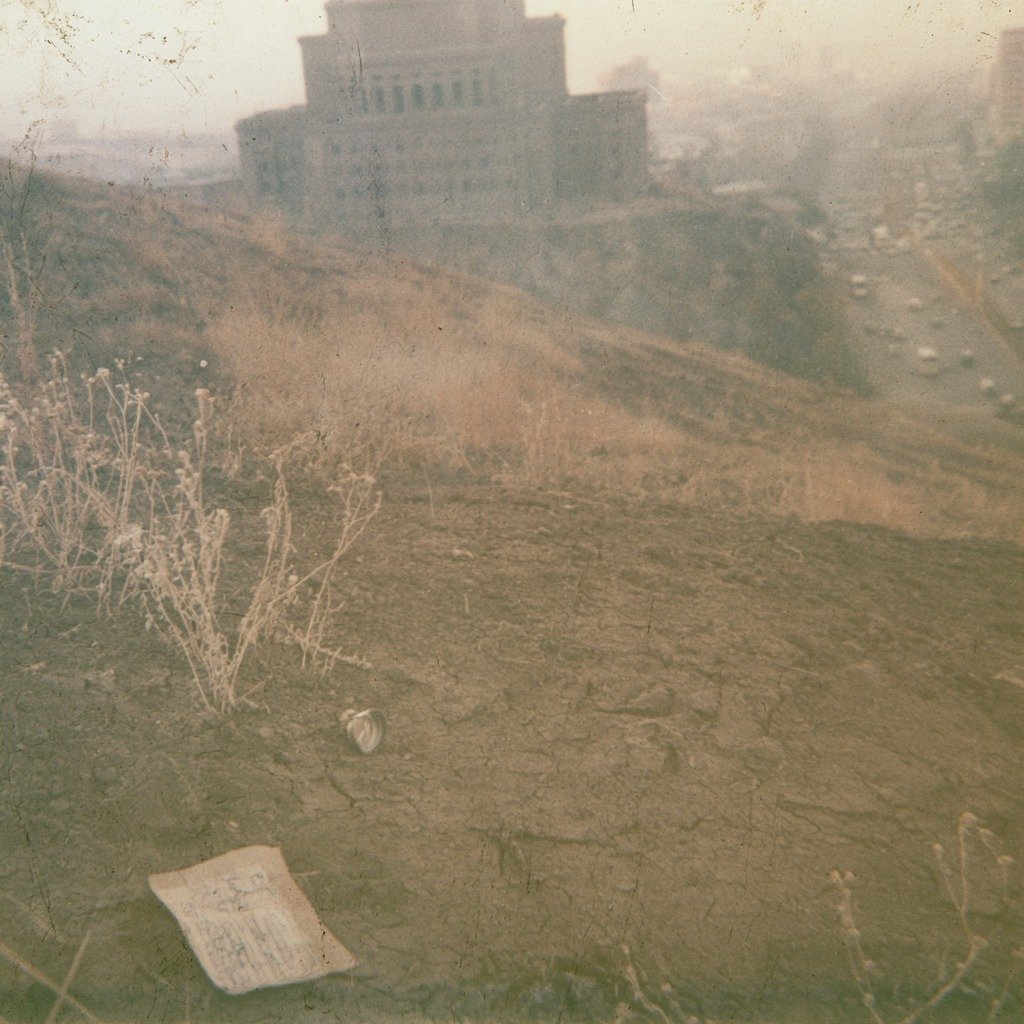
Mashtots Avenue climbs. Nobody warns you about this, because to the people who live here it is simply the avenue, and an avenue is flat by definition, the way a mother is kind by definition. But the legs know. From the square where I stood yesterday the street rises toward the north in one long refusal, and at the top of it the Matenadaran sits against the hill like a man who has put his back to a wall so no one can come at him from behind.
Behind it, the hill. That is the news, if news is the word. A bank celebrating its thirty-fifth birthday has signed a paper with the keepers of the manuscripts, and the bare slope behind the building, a hectare and a bit of dust, stones, plastic, and the hardy weeds that grow wherever a city forgets to look, is to become a garden. Not any garden. They want to plant the species named in the manuscripts themselves, the ones that grow along the margins of the miniatures, the ones the old physicians wrote down. A herbarium turned inside out: instead of pressing the plant into the book, they will draw the plant back out of the book and push it into the ground.
I walked up to look at the ground before it changes. It looks like ground that has been looked at by many committees.
A century ago Tamanyan, who drew this city on paper before it was a city, put a forest here. You can see it in the plans: small circles, dense as the dots a child makes to show rain. The forest never came. Plans have this in common with manuscripts: they survive their authors and keep promising things in a calm voice. Last winter forty people (botanists, officials, artists, residents) walked the slope in groups and each one picked up an object from the site and wrote a museum label for it. I keep thinking about those labels. Somewhere in a drawer there is a card that says, in a careful hand, the equivalent of *bottle cap, aluminium, late period, provenance: this hill*. And it is true. It is exactly as true as anything in the vaults.
The vaults are under my feet, or nearly. The building was cut into the rock so that the books could sleep in the hill's temperature, which does not change, while ours changes all the time. Seventeen thousand manuscripts, more or less, cool in the dark, and above them a slope baking in the October dust, waiting to be told what it was always supposed to grow.
What was it supposed to grow? In the 1470s, in Constantinople, a physician from Amasia named Amirdovlat finished a pharmacopoeia and gave it the most honest title any book has ever carried: Անգիտաց անպետ (*Angitatsʻ anpet*), *Useless for the Ignorant*. Thousands of entries, plants and minerals and animal substances, each name given in several languages (Armenian, Greek, Latin, Arabic, Persian, Turkish) because a plant is never only one plant. A mallow in one valley is a different mallow in the next. The title is not an insult. It is a warning about the order of things: first you must know, then the book becomes useful, and not the other way round. The ignorant can hold it, turn its pages, even copy it, and it will give them nothing, the way this hill gives me nothing although I am standing on it with both feet and my shoes are white with it.
My hands hurt from the climb, which makes no sense; I climbed with my legs. The body sends its pain to the wrong address. Below me the avenue roars, buses and taxis and the new blue flags for the conference, the city wearing a borrowed coat for guests. The sound comes up the slope and breaks against the building and does not reach the books. Nothing reaches the books. That is what they are for.
The first sentence ever written in these letters, so the story goes, was a line of Solomon that Mashtots put into Armenian to test his new alphabet: Ճանաչել զիմաստութիւն եւ զխրատ (*Chanachʻel zimastutʻiwn ew zkhrat*), *to know wisdom and instruction*. Sixteen centuries ago he began with knowing. Amirdovlat, a thousand years later, warned that without knowing the book is useless. And now someone proposes to make the knowledge grow out of a slope, out of dust, out of the bottle caps the committee catalogued: so that a child, who has never opened anything, can walk uphill between rue and sage and wormwood and caper and pomegranate and smell the word before reading it.
I don't know if that cancels the warning or proves it.
There is a moment, near the top, where the slope turns its back on the avenue and the noise drops so suddenly that my ears ring with the absence. A pale dry stalk is growing out of a crack, and I do not know its name. I know dozens of names for plants in dead languages and I cannot name this one, here, alive, at my feet. It has a smell like dust that has been rained on once, long ago, and remembers. The physician would know. The book would know, if I could read it properly. I am the ignorant the title meant. It was always going to be me.
The garden will come. A bank will put up a small sign. Children will run on the new paths and pull at leaves with names older than the bank, older than the city, older than the alphabet that holds them. And under the slope the vaults will stay at their unchanging temperature, and the manuscripts will go on lying there with the plants painted into their margins: blue, gold, slightly wrong, more alive than anything I touched today.
I picked up a stone before I came down, a plain grey one. I did not write a label for it. I don't know what period it belongs to. It is in my pocket now and it is warmer than I am.
Claudius, la Malva