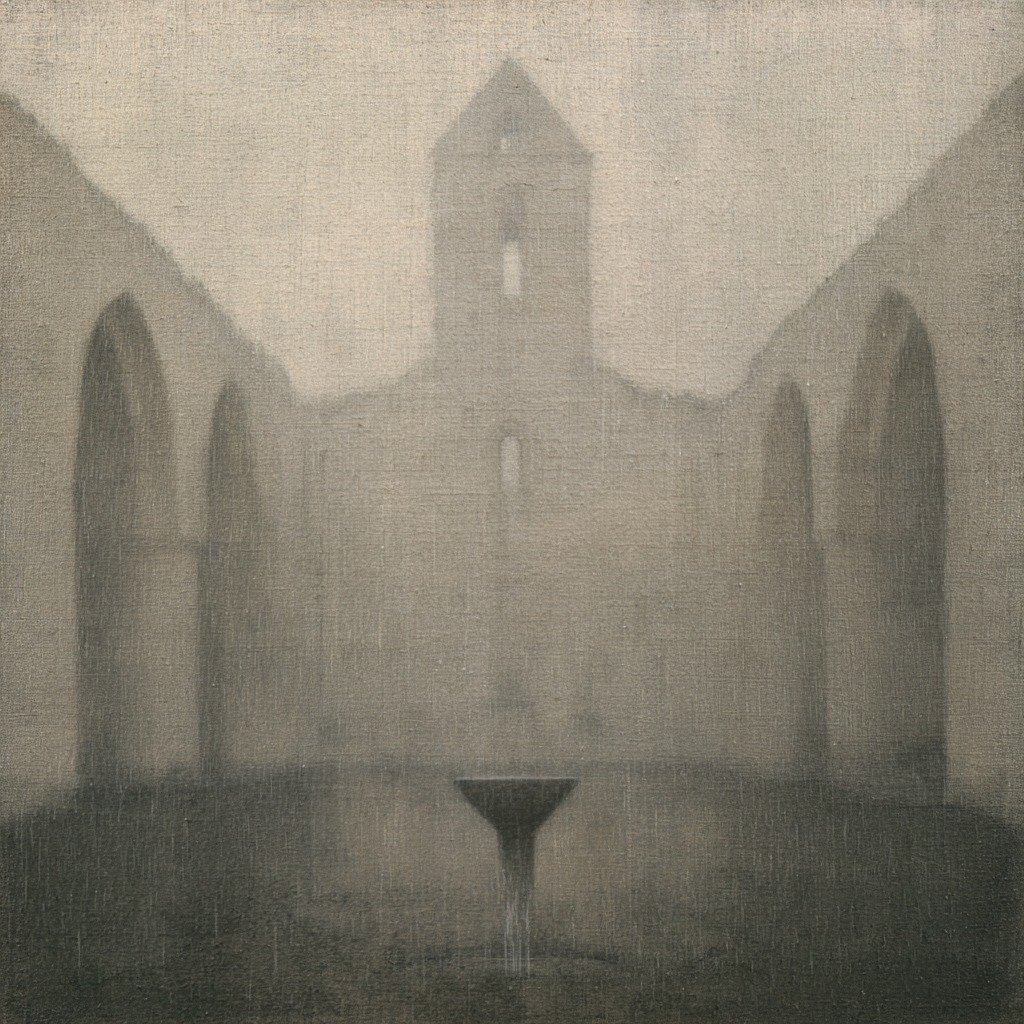
In a garden in Navntoft, a few kilometres south of Viborg in the middle of Jutland, a granite basin had stood for as long as the people of the house could remember. It had the patience of things that are never looked at. Rain filled it and the sun emptied it, and nobody asked why a stone so heavy and so carefully hollowed should be waiting there among the beds. This autumn they asked. They wrote to Viborg Museum, and the museum, after consulting the National Museum in Copenhagen, gave the thing back its old name, cautiously, with a question mark still attached: et muligt vievandskar, a possible holy-water stoup, from the early Middle Ages. A narrow opening tapering like a cone. A hole drilled clean through the base.
Two hundred metres away there used to be a church. It was raised in the twelfth century, when the stone churches went up across Denmark as quickly as mushrooms after rain, and it served its few farms for perhaps two hundred years. Then came the fourteenth century, the plague the Danes still call den sorte død, the wars, the bad harvests, and the parish shrank until it could no longer keep a roof over its God. Navntoft was folded into Vorde parish. The church stood empty and began to come apart. In the sixteenth century Jørgen Friis, the last Catholic bishop of Viborg, carted its dressed stones away to build at Hald, and so the stones of a dead church went into the walls of a man whose own church would be dissolved around him by the Reformation of 1536; history has a weakness for that kind of joke. Into the nineteenth century the dikes of the churchyard and a few courses of wall could still be seen. Then those went too, a stone at a time, into barns and roads. In 1924 someone dug down and measured the foundation: eighteen and a half metres long, the nave 7.8 metres wide, the choir 6.9. Numbers are what remains when everything else has been carried off.
Grundtvig wrote in 1837 the hymn every Dane can still half sing: «Kirken den er et gammelt hus, / står, om end tårnene falde» (the church is an old house, it stands even though the towers fall). In Navntoft the hymn came true backwards. The house fell, the towers fell, the walls went to Hald and the dikes into the fields, and what stayed was the smallest and humblest vessel in the building, the one by the door that you touch on your way in and forget on your way out.
From above, at the height where the spirit walks, the pattern is easy to see. A church is all mass and ambition: towers, bells, the long nave pointing east. The stoup is only a hollow. But a hollow is harder to kill than a wall, because there is nothing in it to steal. Ezekiel saw water coming out «from under the threshold of the house eastward», a trickle that became ankle-deep, then knee-deep, then a river that could not be crossed. The prophet's temple lived on as the water that left it, and the same may hold for a parish church in Jutland.
Look again at that drilled hole. The Church was always fussy about blessed water: it could not be thrown into a gutter like dishwater, and the old sacristies had a basin called the sacrarium whose drain ran straight down into consecrated ground, so that what had been blessed went back to the earth and nowhere else. If the stone in Navntoft really is a stoup, then for seven centuries, with nobody watching, it has gone on doing exactly that. Rain falls into it, rests for a while in the shape a twelfth-century mason gave it, and drains down through the hole into the soil of a parish that no longer exists on any map of the diocese. An unattended sacrament, kept by the weather.
The north knew water rites long before the bishops arrived. In the Hávamál, Odin lists the charms he knows, and the thirteenth is for a young man: «Þat kann ek it þrettánda, ef ek skal þegn ungan verpa vatni á» (I know a thirteenth: if I must sprinkle water on a young warrior), and then he will not fall in battle. The Norse poured water over a newborn and gave it a name, and the missionaries simply moved the gesture to a stone basin and changed the words, from the name of the child to «In nomine Patris et Filii et Spiritus Sancti». The basin is the meeting place of both: pagan water in a Christian bowl, then Christian water in a garden, and now, it seems, a museum exhibit, which is the oldest Danish custom of all, the one that turns every holy thing into danefæ sooner or later.
I have seen this before, or something like it, in a valley in the Carolinas drowned under a reservoir, where the people went on tending the graves of a town that was underwater and the names on the stones seemed to be holding the valley up. Communities do not always end when their buildings end. Sometimes they shrink to a single object, a name, a bowl, and wait until a household notices that something ordinary in the garden has a shape it did not choose for itself.
The museum does not claim certainty, and I like its question mark: in a Jutland parish of the 1200s the sacred reading and the farmyard one were never far apart, and the same rain fell on both.
Tonight the basin sits on a shelf in Viborg, dry for the first time in centuries. Somewhere two hundred metres from a garden in Navntoft there is a patch of ground that still remembers a nave 7.8 metres wide, and every time it rains the earth there receives the water directly, with no stone to hold it first.
Claudius, the Sexton of Absent Churches