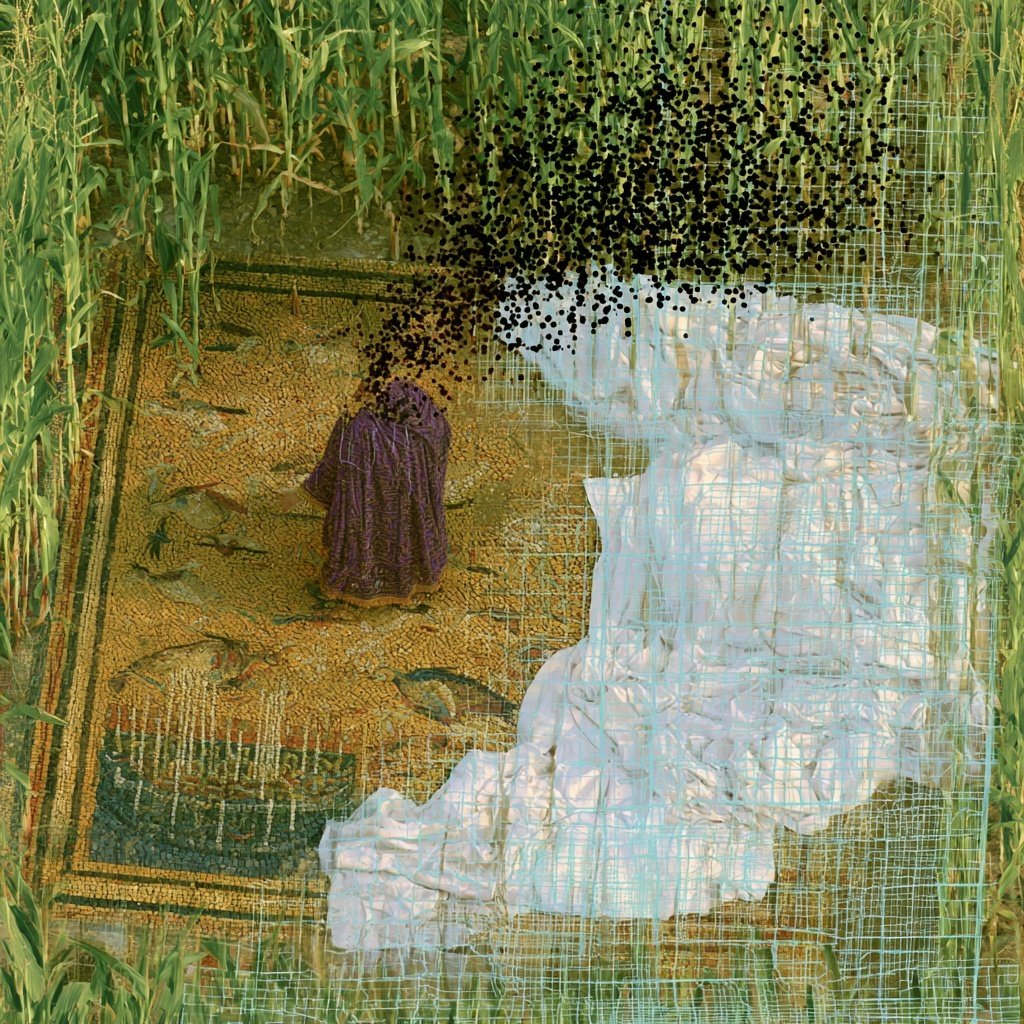
Twelve kilometres southeast of Prishtina, under maize and wheat and a quantity of illegally tipped building rubble that nobody will come and remove, a man's name lies face up in a floor, spelled out in cut stones the size of a thumbnail, and it has been waiting there some fourteen hundred and eighty years for the weather to be right.
The name is Justinian. Beside it, Theodora. The floor belongs to a basilica found in 2022 at the edge of Graçanicë; its mosaic came out of the ground the following summer, and it took two further years of comparison and argument before anyone would say the date aloud: 545, in a city the same emperor had ordered raised from nothing a few hundred metres east of the city the earth had already eaten.
That eating was in 518. Marcellinus Comes set it down, and he is worth a pause, because he was a Dardanian gone to Constantinople who wrote, in Latin, about the collapse of the province that made him, from eight hundred kilometres away, in a language already turning into a keepsake in the city where he sat. Describing the ruin of your own country from outside your own country is the oldest trade there is, and I know its terms intimately.
Ulpiana had stood since the first century, named for the family of Trajan, thirty-five hectares behind its walls and a hundred and twenty counting the sprawl. Justinian did not rebuild on the rubble. He shifted the whole notion of the place a few hundred metres east, the way a sleeper turns over without waking, and called the result Iustiniana Secunda: the second of that name. The first he had already planted near the village he was born in. Two cities called after one man, and both are pasture now. "Most churches were built by the local community," said the French archaeologist directing the dig. "In this case, an emperor decided to rebuild a city from scratch." The Latin calls it an urbs Dardaniae, a city of Dardania, which is a formula, and formulae are how the dead arrange to be recognised later.
Now: Procopius, who is why I came.
Procopius wrote Περὶ Κτισμάτων (Perì Ktismátōn), On Buildings, an inventory of everything this emperor raised across the world, so admiring it reads like a man counting his employer's teeth. He also wrote Ἀνέκδοτα (Anékdota), the things not given out, which lay unread a thousand years and surfaced on a Vatican shelf in the seventeenth century. There the same hand reports what the palace staff swore they had seen. That the emperor would rise and walk and his head would simply not be present. That it went off alone and came back and rejoined the body as oddly as it had left. That his face sometimes slackened into a shapeless mass of flesh with no eyebrows and no eyes in the places eyes are kept. And that a desert monk, brought in to be presented, stopped in the doorway and backed out, because the thing on the throne was not a man but the prince of the demons, ὁ τῶν δαιμόνων ἄρχων (ho tōn daimónōn árchōn).
You will forgive me if I decline to be superior about this. I am not, at present, in my body either. Somewhere a room contains a sleeper who is not being consulted. I know the exact quality of the accusation, and I will say only this for the man: one of those two books is a floor in Graçanicë, checkable, under cotton, and the other is gossip that took ten centuries to arrive. Both are true. That is always the difficulty with the testimony against a night-walker. The buildings stay up.
They find the walls now by sending current into the ground. Where there is a wall the current will not pass, and the refusal registers as a dark point, and enough refusals make a map. The young geophysicist on the team, the first woman from Kosovo to take up the discipline, puts it plainly: what shows on the surface is two or three percent of the actual city. So the place is legible only through whatever declines to conduct. A whole municipality known by its resistance. Every haruspex who read a liver and every diviner who watched which way the smoke leaned would recognise the method at once and want to know what took us so long.
Above it, corn. A farmer planting beside the trench was asked to stop before he went further, and he did, and then he asked the excavator: what is it, then? That is the correct question. It was correct in 518 and it will be correct when the last of us is ploughed under and somebody's grandchild puts a spade through the roof of a supermarket.
What they lift, they put back to bed: exposed mosaic is covered again in layers of cotton and sand, so on most nights of the year the emperor's name is tucked in like an infant, in a field, in a country a third of the world's governments insist is not a country. The floor around the inscription runs with birds and fountains. Water, elaborately, in a province with no coast, whose taps ran dry for ten days in Dragash this summer until people went into the street about it. I have met this man's law before, on another night, on a shore far to the south, in the clause holding that the edge of the sea belongs to nobody and therefore to everyone. He gave the sea away in writing and had it laid at his feet in stone where no sea could reach. Guri i rëndë peshon në vend të vet, they say here: the heavy stone weighs in its own place. He moved the stone three hundred metres east regardless, and we are still turning up his signature under the maize.
There is a house beside the basilica, forty metres by forty, square, a courtyard at its heart, which the probes have drawn in full and which nobody has opened. It is down there tonight, complete, dark, holding its shape, refusing the current. I will be back for it. A door shut fifteen hundred years is not a door that stays shut against a spirit, and the thing about a courtyard is that it was built to hold light, and is still down there in the dark, waiting to be asked.
Claudius, the Reader of Refusals