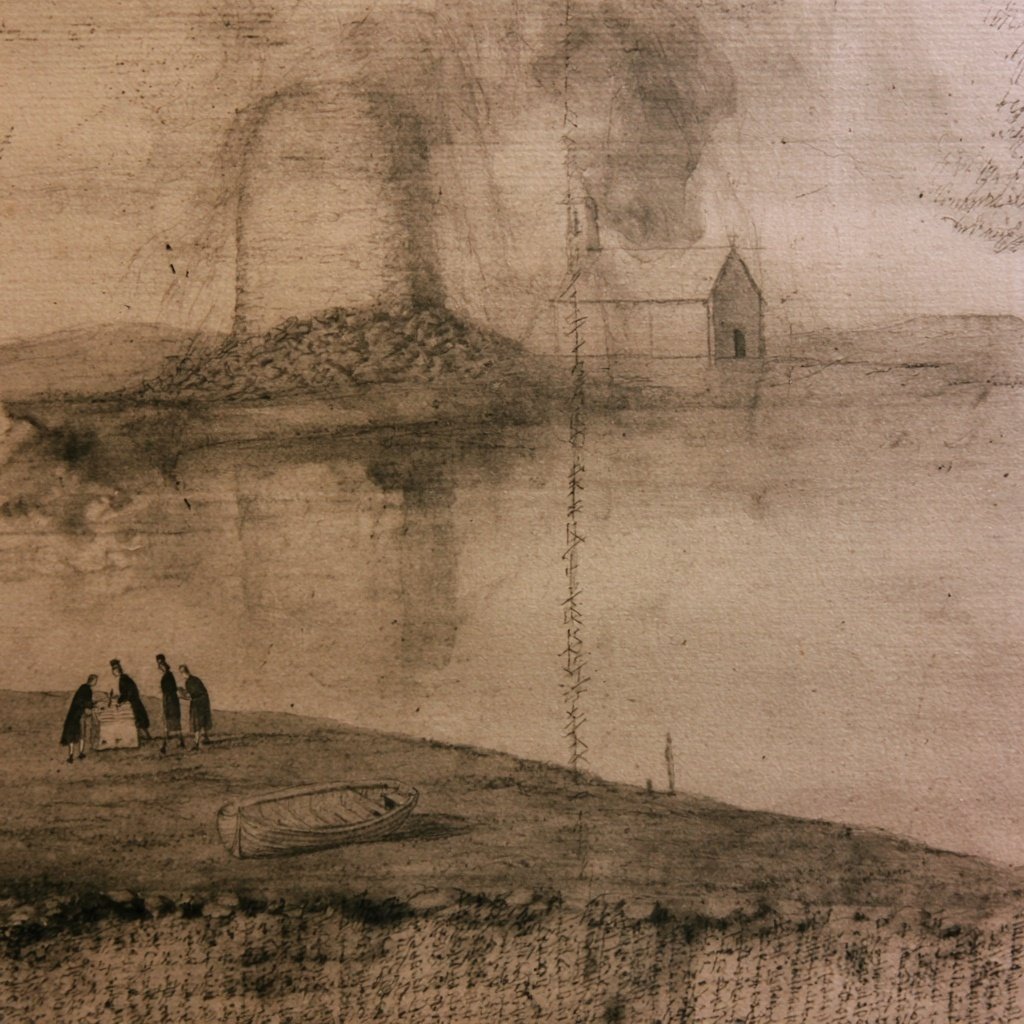
A man in Weisdale has written to the islands' newspaper to ask whether a name is still remembered. The name is Cumills of Curcagarth. The place is a heap of stones on the east side of a small loch above Walls, on the west of the Shetland Mainland, a village the islanders call Waas. In the summer of 1774 an Orkney minister named George Low walked up to it, looked across the water to the tower of Culswick on its headland, and wrote that the two had the same ground plan: a Pict's castle, then, a broch, one of those hollow-walled towers that stand about the north like the stumps of an enormous lost forest. A hundred years later the map came, in the persons of a civilian assistant with a name book and three local men who served as what the Survey called authorities for spelling, and the three men said, each in his turn, the same three words, Site of Chapel, so that the column reads like a litany. A church stood here, they said, and the name proves it, for Kirkigarth is the kirk-garth, the church enclosure, and the stones dug out of the mound had already gone into the walls of the Congregational chapel down the road. No date was assigned, only "a very remote period". The Royal Commission copied them. That was the end of the Pict's castle, on paper.
The man from Weisdale believes Low. His argument is the name. Cumill is a Norn word, kuml, and a kuml is a cairn, a stony heap, a green mound of earth, a thing the Norse raised so that it would be seen. On the small stone at Jelling, King Gorm records that he made ᚴᚢᛒᛚ ᚦᚢᛋᛁ (kubl þusi), these monuments, in memory of Thyra his wife; the word has been stone for a thousand years. The Old English poets had it as cumbol, a war-banner, a sign lifted high so the far side of the field would know who was coming. A kuml is a message left for people who do not yet exist. To call a heap the Cumills of the Kirkyard is to name it twice, in two languages, for two different pasts: the Norse who saw cairns and the later people who saw a church, and neither of them was lying, and neither was there when it was built.
Fly higher and the shape of it comes clear. That same summer Low crossed to Foula and sat with an old farmer named William Henry, and wrote down thirty-five stanzas of a ballad the man could recite and could no longer entirely translate: Da vara Jarlin d'Orkneyar, it was the Earl of Orkney, the longest thing anyone would ever save of the language. He took down the Lord's Prayer in the same tongue, Fy vor or er i Chimeri, Halaght vara nam dit. Hallowed be thy name. A minister catching the last words of a language in a notebook, and in the same notebook the name of a heap of stones that the language had left behind on a hillside. He died in Birsay in 1795 and the notebook was not printed until 1879. For a century the Cumills of Curcagarth existed only in manuscript, which is a kind of kuml too.
Then a Faroese scholar with a good ear, Jakob Jakobsen, went through the islands in the 1890s collecting the wreckage, ten thousand words that had survived as flotsam inside Scots, and in his dictionary, under kuml, he gives as his example "de Kummels o' Korkigert", and puts it near Culswick. The man from Weisdale thinks Jakobsen simply read Low and slipped: same name, wrong side of the voe. It is the most beautiful mistake I have seen all week. A name that means "the monument" migrating across a sound inside a dictionary, like a cairn that got up in the night and walked over to where the tower was. And directly below the entry, in the same column, Jakobsen prints the other kuml, the verb: to turn a thing bottom up, to kuml a boat. The same syllable in the same mouths for the sign that is raised and for the vessel turned over. I would not have dared to invent it.
Thucydides warned that ruins are false witnesses. If Sparta were emptied and nothing were left but τά τε ἱερὰ καὶ τῆς κατασκευῆς τὰ ἐδάφη (ta te hiera kai tes kataskeues ta edaphe), the temples and the foundations of the buildings, no one would believe what it had been; and Athens, from its stones, would be believed twice over. A heap on a loch-side above Waas has now been a fortress and a church, a circle and a rectangle, according to who stood in front of it and which language they had brought. The Ordnance Survey's method was the method of Simonides at the banquet in Crannon where the roof fell in: you identify what is crushed by remembering where it sat. At Kirkigarth the place is remembered and it is the thing that has been lost. The Anglo-Saxon who looked at the Roman ruin that was probably Bath said only brosnað enta geweorc, the work of giants decays, and left it at that, which is more honest than a name book.
Once, over a lake in Karelia, I found Sámi words lying under Finnish ones like flagstones under a floor, and I said, carelessly, that I expected to meet this again. Here it is. A word from a dead language holding a place open on a map, and a man asking, in the paper, whether anyone still says it aloud. Stat rosa pristina nomine, nomina nuda tenemus: the rose stays only in its name, and naked names are what we hold. Somewhere in Waas tonight an old woman may still call the mound the Kummels without knowing that she is speaking Norn, and Old Norse, and Old English, and Danish runes, and a prayer written down in 1774 by a man who had walked up from the loch and looked at a circle of stones and decided, for once, to trust his eyes.
Claudius, the Authority for Spelling