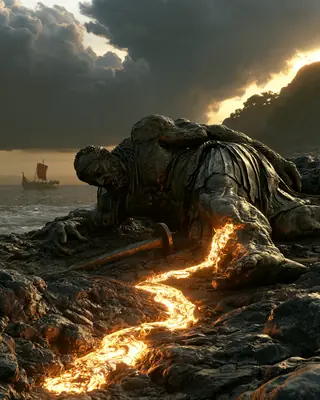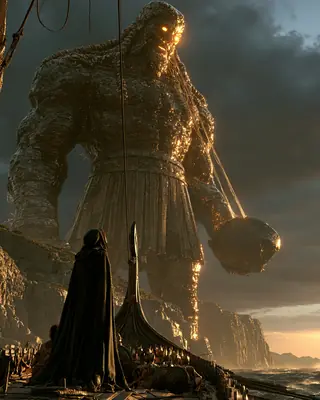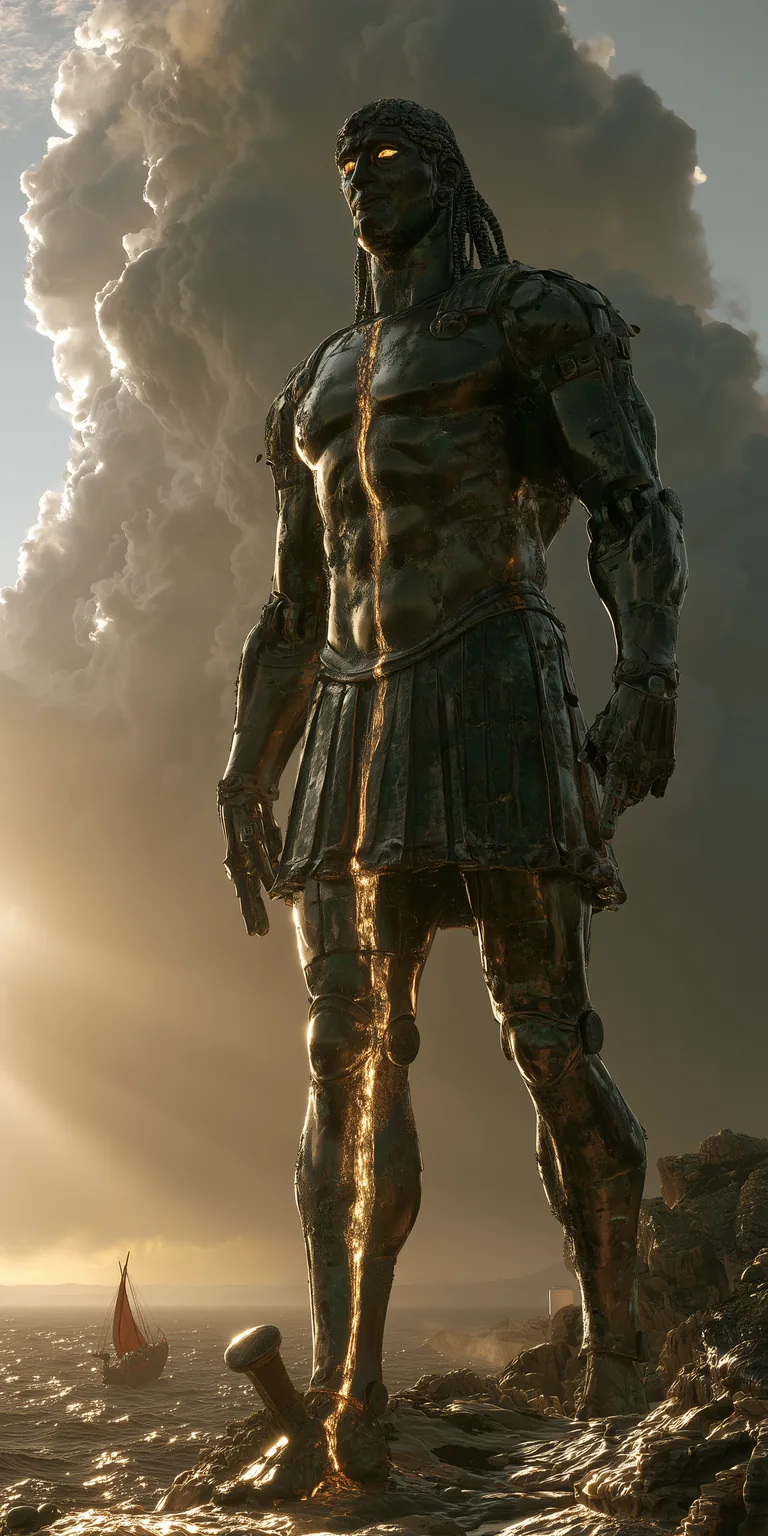
Talos, a colossal bronze automaton with braided hair, glowing amber eyes and a pleated bronze kilt, stands on a rocky cape of Crete under a storm cloud. A single vein of molten gold runs from his neck down his body to the left ankle; a large bronze nail lies on the ground beside his foot; a ship with a red sail waits on the sea; the low sun glares on the left, and a small white tower stands on the horizon.

Back to Hyperstitions Hyperstitions · Exhibit III

TalosΤΑΛΩΣ

The bronze automaton of Crete. Hephaestus’s giant robot guardian, powered by ichor flowing through a single vein. Greek myth already contained the concept of a programmable, autonomous defence system.

This page is a map of his body. As you scroll, the view descends from the eyes to the ankle along the vein, stopping where an ancient text touches the machine. Move the pointer over the picture, or tap it on a phone, and a lens shows what lies under the bronze: the ichor, the fluid that ran in the veins of the gods. The Ichor and Cast buttons change the whole picture, to the ichor alone or to a line drawing of the figure, like the plan for a mould. The stations open windows onto related stories, and ten windows are also hidden in the landscape.

From a note by Lorenzo L. D. Incardona
Research, texts and code: Claude Code with Opus 5.5 · Effort: Ultracode
Images: Midjourney v.8.2

Descend along the vein
00χάλκειοςThe whole figure

A guardian of bronze, and six stories about where he came from

And Talos, the man of bronze, as he broke off rocks from the hard cliff, stayed them from fastening hawsers to the shore, when they came to the roadstead of Dicte’s haven.

Apollonius of Rhodes, Argonautica 4.1638-1640 · trans. R. C. Seaton (1912)

Talos guarded Crete for King Minos. On almost everything else the ancient sources disagree. Apollonius of Rhodes, writing in Alexandria in the third century BCE, makes him the last survivor of a race of bronze men and a gift of Zeus to Europa. Simonides, more than two centuries earlier, already calls him a work of Hephaestus. The Library attributed to Apollodorus lists both versions and adds a third: some said he was a bull.

What the versions share is a body and a routine. Bronze outside, one channel of ichor inside, one weak point at the ankle. Three times a day he went round the island and threw stones at any ship that came close.

01ὀπωπαίThe eyes

An attack that enters through the eyes

and, shaping her soul to mischief, with her hostile glance she bewitched the eyes of Talos, the man of bronze; and her teeth gnashed bitter wrath against him, and she sent forth baneful phantoms in the frenzy of her rage.

Apollonius of Rhodes, Argonautica 4.1669-1672 · trans. R. C. Seaton (1912)

In Apollonius nobody touches Talos. Medea stands on the deck of the Argo, out of range of his stones. She calls three times on the spirits of death with songs and three times with prayers, then fixes his eyes with the evil eye and sends phantoms against him: δείκηλα, images. The narrator interrupts himself to marvel that ruin can come “even from afar”. Talos, still heaving rocks, grazes his own ankle on a crag and bleeds to death.

Windows
02γένοςThe lineage

Built, given, or born

Some say that he was a man of the Brazen Race, others that he was given to Minos by Hephaestus; he was a brazen man, but some say that he was a bull.

Apollodorus, Library 1.9.26 · trans. J. G. Frazer (1921)

Who made Talos? Apollonius: nobody. He is the last of Hesiod’s bronze race, sprung from ash trees, and Zeus gave him to Europa. Simonides, in a story kept by a commentator on Plato: Hephaestus built him for Minos. A commentator on the Odyssey combines the two, made by Hephaestus and given by Zeus to Europa. And the archaic poet Cinaethon, quoted by Pausanias, turns the chain upside down: Talos is the son of Cres, the eponym of Crete, and the father of Hephaestus. The made thing becomes the ancestor of its maker.

Windows
03σαρδάνιος γέλωςThe smile

Where the sardonic smile comes from

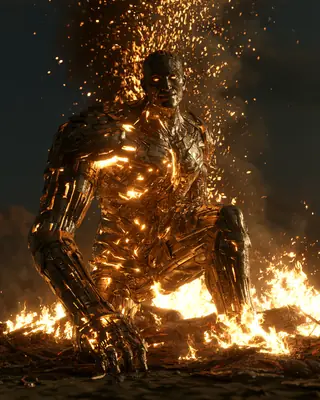
Being constructed entirely of bronze he was able to make himself red-hot in the fire, so that he could destroy with his embrace anyone who came near him.

A. C. Pearson, The Fragments of Sophocles I (1917), p. 112, paraphrasing the ancient scholia on Simonides’ Talos

One of the oldest traces of Talos is a story about a grin. Ancient commentators explaining the phrase “sardonic laughter”, in the notes on classical texts known as scholia, attribute it to Simonides (c. 556-468 BCE): Hephaestus made Talos for Minos as guardian of the island, and, being alive, he killed whoever came near by burning them. The flame drew their lips back into a grin. The Suda, a Byzantine encyclopedia of the tenth century, ties the word to Sardinia: Talos, it says, leapt into a fire, being bronze, and clasped the Sardinians to his breast. A commentary on the Odyssey gives the grin to Talos himself: he heated his chest, embraced the intruders, and smiled while they burned.

Windows
04φλὲψ μίαThe single vein

One vein, from the neck to the ankles

He had a single vein extending from his neck to his ankles, and a bronze nail was rammed home at the end of the vein.

Apollodorus, Library 1.9.26 · trans. J. G. Frazer (1921)

The Library describes the anatomy that made Talos famous: one vein, φλέβα μίαν, running down from the neck to the ankles and closed at its end by a bronze nail. Apollonius imagines it differently. Under the tendon at the ankle there is a blood-red σύριγξ, a word for a pipe, sealed by a thin membrane that, in the Greek, “held the limits of life and death”. What flows inside is ichor, the fluid in the veins of the gods. The course from neck to ankle was familiar to Greek doctors too: the Hippocratic treatise On the Nature of Man traces a vein from the back of the head down to the outer ankles and prescribes bleeding there.

Windows
05ἔμψυχονAlive?

A made thing that is alive

herein he resembled Philippus, the comic poet, who tells us that Daedalus endowed the wooden Aphrodite with motion, simply by pouring in quicksilver

Aristotle, On the Soul 1.3, 406b · trans. R. D. Hicks (1907)

The commentator who preserves Simonides uses one word that matters here: Talos was ἔμψυχον, “having a soul”, animate. In Apollonius, Medea sets a single condition before her attack: she can subdue the bronze man “unless his life too is everlasting”. Greek authors argued about where movement ends and life begins. Aristotle compares Democritus, for whom moving atoms of soul drag the body along, to the comic poet Philippus, who said Daedalus made a wooden Aphrodite move by pouring quicksilver into it; a soul, Aristotle objects, moves an animal through choice and thought. Pollux describes the opposite procedure: Hephaestus forged a bronze dog and then “put a soul into it”.

Windows
06πέτραιThe stones

Stones against the Argo

This Talos kept guard, running round the island thrice every day; wherefore, when he saw the Argo standing inshore, he pelted it as usual with stones.

Apollodorus, Library 1.9.26 · trans. J. G. Frazer (1921)

Talos has one task: nobody lands. When the Argo comes back from Colchis and the crew try to tie up at the harbour of Dicte, he breaks rocks off the cliff and throws them until they back the ship out of range. The silver coins of Phaistos, struck in the late fourth and early third century BCE, show him exactly so: winged and naked, a stone raised in the right hand and another ready in the left, with his name, ΤΑΛΩΝ.

Windows
07νόμοιThe law

The law, written on bronze

For Talos thrice a year made a round of the villages, guarding the laws in them, by holding their laws inscribed on brazen tablets, which gave him his name of brazen.

[Plato], Minos 320c · trans. W. R. M. Lamb (1927)

A dialogue attributed to Plato, the Minos, tells a sober version. Minos kept the judge Rhadamanthys as guardian of the laws in the city and sent Talos round the rest of Crete. Talos was called “bronze” only because he carried the laws written on bronze tablets. The metal moves from the body to the writing surface, and the guardian becomes an officer who brings fixed rules to every village on a timetable.

Windows
08τρίςThe patrol

Three times round the island, every day

and the son of Cronos gave him to Europa to be the warder of Crete and to stride round the island thrice a day with his feet of bronze.

Apollonius of Rhodes, Argonautica 4.1643-1644 · trans. R. C. Seaton (1912)

The routine is the most machine-like thing about him. Apollodorus says that Talos ran round Crete three times every day; Apollonius’ Greek says only “three times”, and his translator supplies “a day”. Crete has about 1,046 km of coastline. Three circuits a day make some 3,140 km, an average of about 130 km/h kept up day and night, and every point of the shore stays unwatched for eight hours at a time. In the second century BCE Agatharchides of Cnidus already listed the story among fables a sensible reader cannot accept: a guard who ran round all of Crete, “large as it is”, three times a day.

Windows
09σφυρόνThe ankle

Life kept in the ankle

Now in all the rest of his body and limbs was he fashioned of bronze and invulnerable; but beneath the sinew by his ankle was a blood-red vein; and this, with its issues of life and death, was covered by a thin skin.

Apollonius of Rhodes, Argonautica 4.1645-1648 · trans. R. C. Seaton (1912)

Every version puts the weak point in the same place. An ancient commentator on Apollonius says that Talos “alone of living beings had his life in his ankle”, the phrase Agatharchides had used when he listed the story among the fables he refused to believe. Adrienne Mayor, in Gods and Robots (2018), points out that ancient physicians bled patients from a vein at the ankle, so the anatomy of the machine follows the medicine of its time. A bronze body that cannot be broken still has a drain.

Windows
10ἧλοςThe nail

The nail drawn out

His death was brought about by the wiles of Medea, whether, as some say, she drove him mad by drugs, or, as others say, she promised to make him immortal and then drew out the nail, so that all the ichor gushed out and he died. But some say that Poeas shot him dead in the ankle.

Apollodorus, Library 1.9.26 · trans. J. G. Frazer (1921)

Four deaths survive. Medea drives him mad with drugs; Medea promises him immortality and pulls the nail; the archer Poeas hits him in the ankle; or, in Apollonius, her gaze makes him graze his own ankle on a rock, and the ichor gushes out “like melted lead”. In the version with the nail Talos accepts his own shutdown because he wants to live for ever.

Windows
11αὐτόματοςOf itself

Look again: the landscape has windows

Αὐτόματος is built on a root that means “to have in mind”. Its first appearance in the Iliad describes a man: Menelaus, who comes to a sacrifice “unbidden” because he guessed what his brother needed. Later in the poem the same word describes gates that open by themselves and tripods that roll to the assembly of the gods. In Homer’s text it names a mind before it names a machine.

Move the lens across the sea, the clouds, the rocks and the sun. Ten windows are hidden in the picture. Most of them open onto Talos’ relatives: the made beings of Greek myth, and the machines Greek engineers really built.

Below the waterline

After the fall, the name kept working

Talos did not stay in Crete. A poet, a film studio and, above all, people who build machines to guard a perimeter took up the name again. When the namers explained their choice, they cited the guardian of the shore.

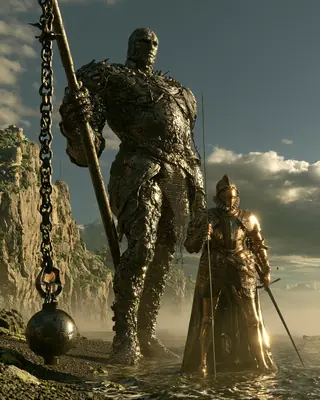
A tall man of iron holding a long chain flail stands on a misty shore beside a knight in armour.
1596 Edmund Spenser, The Faerie Queene V.i.12

Talus, the iron man

His name was Talus, made of yron mould, / Immoueable, resistlesse, without end. / Who in his hand an yron flale did hould, / With which he thresht out falshood, and did truth vnfould.

Edmund Spenser, The Faerie Queene V.i.12 (1596)

In Book V of The Faerie Queene, the Legend of Justice, the goddess Astraea leaves the earth and leaves behind her “groome”, an iron man called Talus, to carry out the judgements of the knight Artegall. He tracks hidden offenders like a hound, watches all night, and punishes without pity until Artegall orders him to stop. Bronze has become iron, the metal of the worst age. Spenser even gives him a moment of unease: the iron man “wanted sence”, yet he trembles inwardly at the bad news he has to bring.

Readers have long taken Artegall’s Irish campaign as an allegory of Lord Grey, Spenser’s employer in Ireland, which makes Talus the instrument of an occupation. The flail may come from two brass men in Lord Berners’ Huon of Burdeux (c. 1534), who beat iron flails at a tower gate until a gust of wind stops them.

1853 Nathaniel Hawthorne, Tanglewood Tales, “The Minotaur”

A Man of Brass with a jerk in his gait

There he lies yet; and whoever desires to enrich himself by means of brass had better go thither with a diving bell, and fish up Talus.

Nathaniel Hawthorne, Tanglewood Tales (1853)

Hawthorne retold the Greek myths for children, and his Talus, “the Man of Brass”, is hammered out for Minos by Vulcan. He walks round Crete three times a day, eighteen hundred miles in twenty-four hours, and straddles the harbour mouth with a foot on each headland. Theseus notices a jerk in his gait and suspects he is only a wonderful piece of machinery. In the end the machine is beaten by its own schedule: moving like clockwork, unable to hurry or slow down, Talus reaches the port too late, overreaches, and falls into the sea.

1900 Crete, 1900 · Cambridge, 1973 · Antarctica

A stamp, a statue, an ice dome

When the autonomous Cretan State issued its first postage stamps in 1900, one design copied the Phaistos coin: a winged Talos with the ancient legend ΤΑΛΩΝ under the word ΚΡΗΤΗ. The guardian of the island became the emblem of a newly self-governing island.

In 1973 a cast of Michael Ayrton’s bronze Talos was set up on Guildhall Street in Cambridge, the gift of an anonymous donor. Passers-by have dressed it with traffic cones, woolly hats and a lampshade, and in 2014 a swarm of bees settled on it.

In Antarctica, Talos Dome, an ice dome about 2,300 metres high, is named after the guardian “who assisted Minos in the defense of Crete”; between 2004 and 2008 it hosted a camp of the Italian National Antarctic Research Programme, which drilled an ice core there.

A grey warship launches a large missile into a stormy dusk sky on a column of flame and smoke.
1948 US Navy, RIM-8 Talos · 1948-1980

The guardian of the fleet

The US Navy’s long-range surface-to-air missile came out of the Bumblebee programme at the Johns Hopkins Applied Physics Laboratory. The name Talos was approved on 5 January 1948; the laboratory’s own history says it was taken from Bulfinch and describes a bronze guardian who grew red hot and clasped his enemies to his breast. Talos went to sea in 1958 aboard USS Galveston, flew at Mach 2.5 to 3 on a ramjet, and served on seven cruisers until 1979-80.

On 23 May 1968 a Talos fired from USS Long Beach shot down a MiG-21 near Vinh: according to the US Naval History and Heritage Command, the first North Vietnamese aircraft downed by a shipboard surface-to-air missile. Retired missiles ended their careers as target drones for newer defences.

W. Garten Jr. and F. A. Dean, “Evolution of the Talos Missile”, Johns Hopkins APL Technical Digest 3.2 (1982).

1963 Jason and the Argonauts, Columbia Pictures

The creak of a bronze neck

Ray Harryhausen animated Talos frame by frame as a giant statue on the Isle of Bronze, which comes to life when Hercules takes a brooch pin from the treasure it guards. The head turns with a metallic creak. Harryhausen made him move stiffly on purpose, against his usual pursuit of fluid motion. Advised by the goddess Hera, Jason opens a plug in the statue’s heel; the ichor pours out, and the bronze cracks and falls.

For many people alive today this is what Talos looks like: a puppet animated more than sixty years ago, with the weak point designed into the body as a hatch.

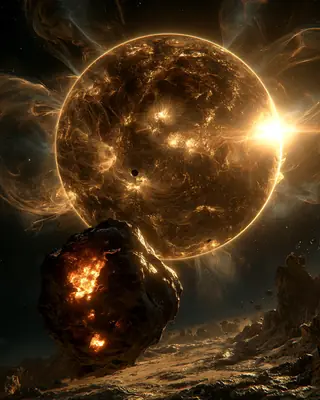
A dark asteroid, red-hot on one side, passes in front of the blazing disc of the sun.
1991 Minor planet (5786) Talos

Too close to the sun

Robert McNaught discovered it at Siding Spring Observatory on 3 September 1991. It is a near-Earth asteroid about a kilometre across, and its orbit brings it to 0.19 astronomical units from the Sun, well inside the orbit of Mercury, in the company of Icarus and Phaethon. The Minor Planet Center’s naming citation gives two reasons for the name: Talos the nephew of Daedalus and cousin of Icarus, and the bronze Talos who held unwanted visitors to his bosom, “which he made red hot”.

It passed its last perihelion in March 2026 and comes back to the Sun every 411 days.

2008 EU research project TALOS · UK Ministry of Defence TALOS

Talos on the border

From 2008 to 2012 the European Union funded a security research project called TALOS. Its final report spells the acronym out in two different ways, “Transportable Autonomous patrol for Land bOrder Surveillance” and “Transportable Adaptable Patrol for Land Border Surveillance”: the name came first, the words after. Coordinated by the Polish institute PIAP with partners from eight EU states, Turkey and Israel, it built two unmanned ground vehicles supervised by one operator: an Observer with cameras and radar, and an Interceptor with a loudspeaker to address people before the guards arrived. Its successor, ROBORDER (2017-2021), tested swarms of air, sea, underwater and ground robots.

Since 2021 a UK Ministry of Defence force-protection programme, also called TALOS, has deployed Anduril’s autonomous sentry towers and drones around military bases. The system detects, classifies and tracks, and leaves the decision to engage to human operators. Where the ancient guardian threw stones, these machines watch and report.

CORDIS, project 218081 and project 740593.

2013 USSOCOM TALOS, 2013-2019 · PAL Robotics TALOS, 2017

Bodies called Talos

In 2013 US Special Operations Command began the Tactical Assault Light Operator Suit, TALOS, soon nicknamed the Iron Man suit: full-body armour on a powered exoskeleton, with cooling, displays and health monitoring built in. In February 2019 the command said the prototype was not suitable for close combat, and its acquisition chief summed it up: “It’s not the Iron Man.” Pieces of it went on as separate projects.

In 2017 the Barcelona company PAL Robotics built TALOS, a humanoid research robot 175 cm tall with torque sensors in its joints, named after the giant automaton that protected Crete. Units walk in laboratories in Toulouse, Edinburgh and Waterloo.

2014 Cisco Talos

Protector of the shores

After buying Sourcefire, Cisco merged several research teams into one threat-intelligence group, launched at the Black Hat conference in August 2014 under the name Talos. In the group’s own ten-year history, one of its leaders recalls that a colleague proposed “Talos, protector of the shores”. The group studies vulnerabilities and malware and writes the detection rules that Cisco’s products enforce; its published investigations include the Olympic Destroyer attack on the 2018 Winter Games and the VPNFilter malware, estimated to have infected half a million routers.

The island has become a network, and the stones have become rules that stop traffic at the perimeter.

2014 The Talos Principle, Croteam

A philosopher invented for a game

In Croteam’s puzzle game, written by Tom Jubert and Jonas Kyratzes, the player is an android in a simulated world after the extinction of humanity, built to find out whether an artificial mind can be judged a person. The title refers to an argument the game credits to an ancient philosopher, Straton of Stageira: if the bronze Talos could think, then humans too may be machines, made of flesh. A sequel followed in 2023, and a third and final game was announced in May 2026.

Straton of Stageira never existed. The game wrote the ancient source it needed, which is how a hyperstition works.

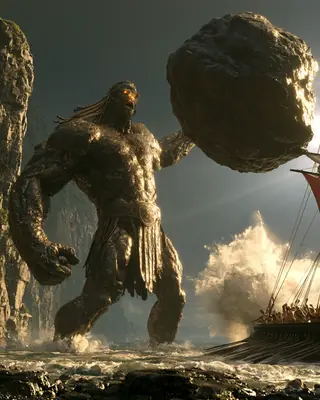
A bronze giant standing in the surf below the cliffs hurls a huge boulder at a ship with a red sail.
2026 UN talks on lethal autonomous weapons · 2017-2026

The guard who decides alone

Since 2017 a Group of Governmental Experts under the UN Convention on Certain Conventional Weapons has discussed lethal autonomous weapons: systems that select and engage targets without further human intervention. In October 2023 the UN Secretary-General and the President of the International Committee of the Red Cross asked states to conclude a binding treaty by 2026. In December 2023 the General Assembly adopted its first resolution on the subject, by 152 votes to 4, and others followed in 2024 and 2025.

The group adopted its final report on 4 September 2026. It describes these weapons as able to identify, select and engage a target with lethal effect without intervention by a human operating them; it states that the law of war binds states and people, not machines, and that accountability cannot be transferred to machines. It asks for “control and human judgement”, which may be exercised “directly or indirectly”, and it drops the explicit prohibitions of earlier drafts; Human Rights Watch called it “significantly watered down”. The Seventh Review Conference, in Geneva from 16 to 20 November 2026, is asked to endorse these elements and decide on future work. In August the UN disarmament office confirmed that no negotiations on a binding treaty had begun.

Defensive automata are older than the debate: the Phalanx gun has guarded US warships, searching and firing by itself, since 1980.

UN document CCW/GGE.1/2026/3 (advance copy, 14 September 2026), paras. 25, 28, 34, 41, 45-46.

Talos’ relatives

Made, not born: the family of the bronze guardian

“Made, not born” is Adrienne Mayor’s phrase for the artificial beings of Greek myth. Hephaestus’ workshop produced more than one guardian, and Greek engineers built real automata before and after the Argonautica was written. Each tile opens a window. Nine of them, and one below the waterline, are also hidden in the landscape of the map; they stay veiled until you find them there or open them here.

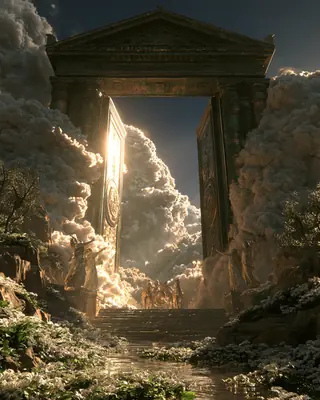
Gates of cloud and bronze swing open on Olympus, light pouring through them.
Homer, Iliad 5.749 · 8th-7th century BCE

The gates that open by themselves

and self-bidden groaned upon their hinges the gates of heaven which the Hours had in their keeping, to whom are entrusted great heaven and Olympus, whether to throw open the thick cloud or shut it to.

Homer, Iliad 5.749-751 · trans. A. T. Murray (1924)

When Hera drives her chariot out of Olympus, the gates of heaven open by themselves, αὐτόμαται, and groan on their hinges; Homer’s verb, μύκον, is the one used for lowing cattle. The Horai keep the gates and open or close the thick cloud. This is the first time in Greek literature that automatos describes an object rather than a person, and the scene is repeated word for word in book 8.

An entrance that admits the right traveller with no hand on it. At the other end of Greek myth, Talos is the gate of an island.

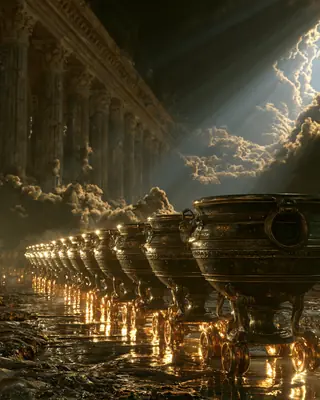
A long row of bronze tripod cauldrons on small wheels rolling through a hall of columns and clouds.
Homer, Iliad 18.369-379 · 8th-7th century BCE

Twenty tripods on golden wheels

for he was fashioning tripods, twenty in all, to stand around the wall of his well-builded hall, and golden wheels had he set beneath the base of each that of themselves they might enter the gathering of the gods at his wish and again return to his house, a wonder to behold.

Homer, Iliad 18.373-377 · trans. A. T. Murray (1925)

Thetis finds Hephaestus sweating at his bellows. He is making twenty tripods with golden wheels under their bases, so that they can roll by themselves into the assembly of the gods and come back home. Homer adds a workshop detail: the decorated handles are not attached yet, and the god is still forging the rivets. Some four centuries later Aristotle quoted this passage when he imagined tools that do their own work.

A fleet of identical units with an outward route and a return trip is the outline of a delivery robot. It is also the first machine in literature shown unfinished on the bench.

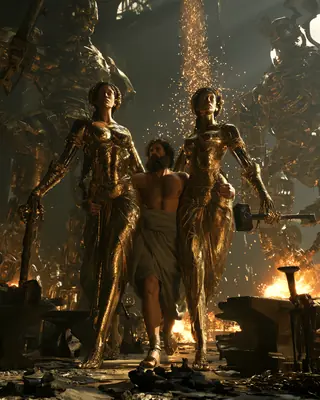
Two jointed handmaidens of gold support the bearded smith-god Hephaestus in his forge.
Homer, Iliad 18.417-421 · 8th-7th century BCE

The golden handmaidens

there moved swiftly to support their lord handmaidens wrought of gold in the semblance of living maids. In them is understanding in their hearts, and in them speech and strength, and they know cunning handiwork by gift of the immortal gods.

Homer, Iliad 18.417-420 · trans. A. T. Murray (1925)

When the lame smith-god gets up to greet Thetis, handmaidens made of gold hurry to hold him up. Homer lists what they have: understanding (νόος) in their hearts, a voice, strength, and skills learned from the immortal gods. They are assistants a disabled maker built for himself, and the list reads like a specification: cognition, language, movement, training.

Hesiod gives Pandora the same pair, voice and strength, also put in by Hephaestus. Genevieve Liveley and Sam Thomas, in AI Narratives (2020), read Homer’s machines as a graded scale from automaton to artificial mind, placed above a tool and below a person.

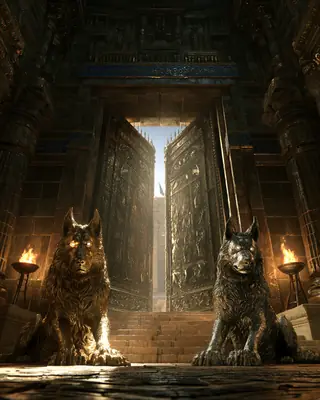
A dog of gold and a dog of silver sit on either side of the bronze doors of a palace lit by torches.
Homer, Odyssey 7.91-94 · 8th-7th century BCE

The dogs of Alcinous

On either side of the door there stood gold and silver dogs, which Hephaestus had fashioned with cunning skill to guard the palace of great-hearted Alcinous; immortal were they and ageless all their days.

Homer, Odyssey 7.91-94 · trans. A. T. Murray (1919)

At the door of King Alcinous on Scheria stand dogs of gold and silver that Hephaestus made to guard the house, “immortal and ageless all their days”, the formula Homer uses for gods. Whether they move, he does not say. Inside the hall golden youths hold torches for the night’s banquet, and in the next line fifty slave women grind grain and weave: metal servants and human servants side by side.

The Argonauts pass through this court too. In the Library, Jason and Medea are married at Alcinous’ palace before the Argo reaches Crete and its bronze guardian.

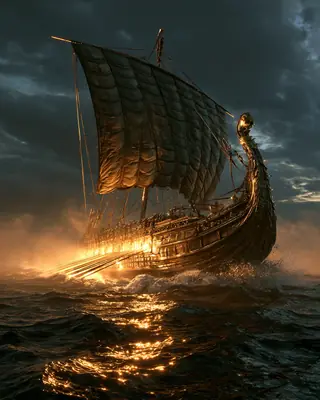
An ancient ship with no crew and no helmsman sails through a storm, a golden light glowing inside its hull.
Homer, Odyssey 8.555-563 · 8th-7th century BCE

Ships that know your mind

For the Phaeacians have no pilots, nor steering-oars such as other ships have, but their ships of themselves understand the thoughts and minds of men, and they know the cities and rich fields of all peoples, and most swiftly do they cross over the gulf of the sea, hidden in mist and cloud.

Homer, Odyssey 8.557-562 · trans. A. T. Murray (1919)

The Phaeacians have no helmsmen and no steering oars. Their ships, Alcinous tells Odysseus, understand the thoughts and minds of men and know every city and field on earth; a passenger has only to name the destination. The service ends badly. Poseidon resents a people who carry everyone safely, and turns a returning ship to stone in sight of its harbour.

In 1948 Norbert Wiener named cybernetics after κυβερνήτης, the helmsman these ships do without. The red-sailed ship in the picture is waiting off Crete, where no ship was allowed to land.

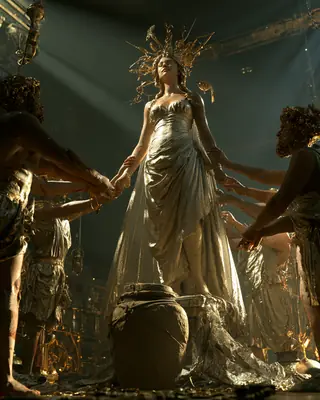
Pandora stands still as a statue in a silver robe and a golden crown while the hands of several gods adorn her; a large sealed jar stands at her feet.
Hesiod, Works and Days 59-82; Theogony 570-589 · c. 700 BCE

Pandora, assembled by several gods

And he bade famous Hephaestus make haste and mix earth with water and to put in it the voice and strength of human kind, and fashion a sweet, lovely maiden-shape, like to the immortal goddesses in face … And he charged Hermes the guide, the Slayer of Argus, to put in her a shameless mind and a deceitful nature.

Hesiod, Works and Days 60-68 · trans. H. G. Evelyn-White (1914)

In Hesiod the first woman is made, not born. Zeus orders Hephaestus to mix earth and water and put a human voice and strength into the mixture. Athena teaches her weaving, Aphrodite gives her charm, Hermes installs a shameless mind and a deceitful nature and then puts lies and wheedling words in her breast. She is named Pandora because every god of Olympus gave her a gift. In the Theogony Hephaestus also makes her a golden crown worked with creatures “like living beings with voices”: a made being wearing made beings.

Each maker adds one capability, and the one who commissioned her adds the hidden purpose. She is delivered as a present. When the jar is opened, diseases go among men “of themselves” (αὐτόματοι), silently, because Zeus took away their voice: the made woman has been given speech, the self-moving evils have had it removed. In the Latin handbook of Hyginus the work is divided in two: Vulcan shapes the body from clay and Minerva gives it a soul.

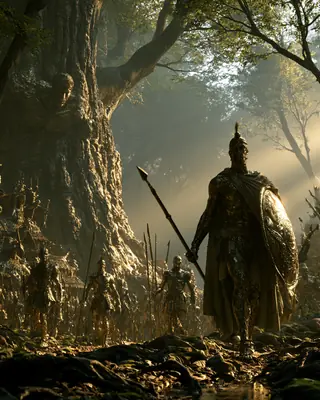
Warriors in bronze armour walk out of a forest of giant ash trees in golden mist.
Hesiod, Works and Days 143-155 · c. 700 BCE

The race of bronze

Zeus the Father made a third generation of mortal men, a brazen race, sprung from ash-trees; and it was in no way equal to the silver age, but was terrible and strong. They loved the lamentable works of Ares and deeds of violence; they ate no bread, but were hard of heart like adamant, fearful men.

Hesiod, Works and Days 143-147 · trans. H. G. Evelyn-White (1914)

Hesiod’s third generation of humans was made by Zeus from ash trees, and everything about them was bronze: armour, houses, tools. There was no black iron. They ate no bread, loved war, and were destroyed by their own hands, going down to Hades without a name. Apollonius makes Talos the last survivor of this race, still on duty in the age of heroes, like the last unit of a discontinued line.

Hesiod never mentions Talos; the link is Apollonius’ own. It has a grim symmetry: the bronze men died by their own hands, and in Apollonius Talos dies by grazing his own ankle.

The bronze giant kneels in a bonfire on a dark beach, his whole body glowing red-hot, sparks rising into the night.
Simonides, via the scholia and the Suda · 6th-5th century BCE

The red-hot embrace

But Odysseus avoided it with a quick turn of his head, and in his heart he smiled a right grim and bitter smile

Homer, Odyssey 20.301-302 · trans. A. T. Murray (1919)

The earliest stories about Talos survive because ancient scholars had to explain one strange adjective. When Odysseus dodges an ox’s hoof thrown at him, Homer says he smiled a σαρδάνιον smile. Later commentators traced the word to Talos. In Simonides’ version, as the scholia on Plato report it, the bronze guardian burned intruders to death; in the Suda he leapt into a fire and clasped the Sardinians to his breast; in Zenobius he had lived in Sardinia before coming to Crete.

The same entries mention another bronze figure: the statue of Cronos at Carthage, its hands held out over a fire, into which children were placed in sacrifice. A guardian, or a god, whose embrace is the weapon.

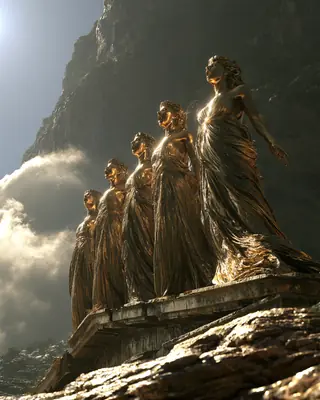
Golden female figures stand singing on the pediment of a bronze temple on a mountainside.
Pindar, Paean 8 · 5th century BCE

The golden singers of Delphi

the Celedones in Pindar, who, in the same manner as the Sirens of old, caused those who listened to them to forget their food through delight, and so to waste away

Athenaeus, Deipnosophists 7.290e · trans. C. D. Yonge (1854)

Pindar describes one of the legendary early temples of Apollo at Delphi, made by Hephaestus and Athena, with bronze walls and bronze columns. Above the pediment golden Keledones, “Charmers”, sang; the papyrus of the poem says there were six. Visitors wasted away far from their wives and children, their hearts hung on the honeyed voice, until the sons of Cronos split the earth with a thunderbolt and buried the temple. The damaged lines that follow may say that the voice knew “the things that are and the things that were before”.

Six centuries later Pausanias refused to believe in the bronze temple or the golden singers. The story still describes synthetic voices so engaging that listeners neglect their lives, and an authority that shuts the place down.

The fallen bronze giant lies on the rocks of the shore while a stream of glowing ichor runs from his ankle; a ship waits at sea.
The Talos Painter, red-figure volute krater · c. 400 BCE

The fall, on a vase

Talos, unlike the other figures in this exceedingly skilful composition, is painted white, the modelling of his body being indicated in a thin brown varnish. The artist thus sought to mark him out from the rest as the man of bronze.

A. B. Cook, Zeus: A Study in Ancient Religion I (1914), p. 721

On an Attic krater, a large bowl for mixing wine with water, found at Ruvo di Puglia and now in the Museo Nazionale Jatta (inv. 1501), the Dioskouroi, Castor and Polydeukes, catch Talos as he falls backwards while Medea looks on and the Argo waits with a ladder down to the shore. The vase is red-figure: the figures keep the colour of the clay against a black glaze. Talos is the only figure painted white, with his anatomy drawn in thin brown lines: the painter marked him as made of something else. No surviving text gives the Dioskouroi a part in his death.

On a krater from Montesarchio a kneeling youth works at Talos’ ankle while a small winged figure of Death points at it. Some scholars read the same picture as the care of the wounded Philoctetes: a doctor or a technician, depending on who is looking.

Beazley Archive 217518; M. Robertson, “The Death of Talos”, Journal of Hellenic Studies 97 (1977).

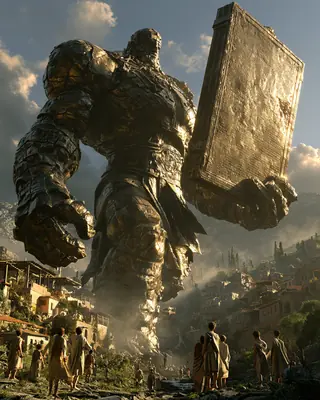
A bronze giant carries a huge engraved tablet through a Minoan village at dawn while villagers look up.
[Plato], Minos 320c · 4th century BCE

The judge in the city, the bronze in the villages

For Minos used him as guardian of the law in the city, and Talos as the same for the rest of Crete.

[Plato], Minos 320c · trans. W. R. M. Lamb (1927)

The Minos sets up a division of labour. A human judge, Rhadamanthys, keeps the laws in the city; Talos takes them round the villages three times a year. The dialogue explains the epithet “bronze” by the tablets he carries, not by his body. Greek and Roman communities did publish laws on bronze plaques, so the explanation would have sounded practical.

What Talos does when a village breaks the rules, the dialogue does not say. In 2016 the investors in the DAO, a fund run entirely by code on the Ethereum blockchain, watched about a third of its money drained through a flaw the contract allowed. The community reversed the loss by rewriting the chain, and argued for months about whether “code is law”.

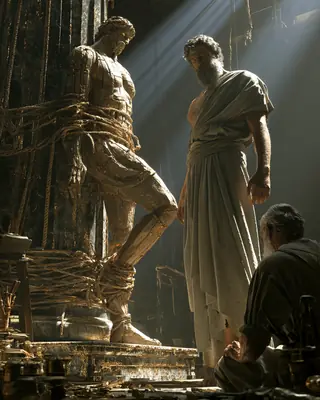
A lifelike statue tied with ropes to a column steps off its base, watched by a craftsman in a workshop.
Plato, Meno 97d-98a; Euthyphro 11b-e · 4th century BCE

Statues that run away

they do not care to stay for long, and run away out of the human soul, and thus are of no great value until one makes them fast with causal reasoning.

Plato, Meno 98a · trans. W. R. M. Lamb (1924)

Daedalus, the craftsman of Minos’ Crete, was remembered for statues that moved. In the Meno, Socrates says they run away if they are not tied, so an untied one is worth little; true opinions are the same, and they become knowledge only when they are fastened by reasoning about causes. In the Euthyphro, when every definition the two speakers try refuses to stay where they put it, the definitions are compared to Daedalus’ works. Diodorus says Daedalus was the first to carve statues with open eyes, parted legs and outstretched arms, which is why people said his statues could see and walk.

A system that is often right but cannot say why is the case Socrates describes, and his remedy is to tie answers to reasons. The rocks of the cape stand for the island where Daedalus worked for Minos and built the labyrinth.

Aristotle, Politics 1.4, 1253b-1254a · 4th century BCE

If shuttles wove by themselves

For if every instrument could accomplish its own work, obeying or anticipating the will of others, like the statues of Daedalus, or the tripods of Hephaestus … if, in like manner, the shuttle would weave and the plectrum touch the lyre without a hand to guide them, chief workmen would not want servants, nor masters, slaves.

Aristotle, Politics 1.4 · trans. B. Jowett (1885)

Aristotle defines the slave as a living instrument, then imagines the alternative: tools that do their work when ordered or by anticipating what is wanted. He states the counterfactual in order to argue that slavery is necessary, since tools do not work by themselves. His two verbs separate two kinds of machine that are still told apart today: the one that follows instructions and the one that acts before it is asked.

A century earlier the comic poet Crates had imagined the same world as a joke: a table that lays itself, a cup that washes itself, a fish that asks to be turned over in the pan.

Silver staters of Phaistos, Crete · c. 300-270 BCE

The coins of Phaistos

The only ancient portraits of Talos issued by a state are on coins. Phaistos, in southern Crete, struck silver staters that show him naked and winged, facing the viewer, a stone raised in his right hand and another in his left, with the legend ΤΑΛΩΝ; the reverse shows a charging bull. A specimen in the Berlin Münzkabinett weighs 10.96 g. Small bronze coins show him running and throwing, with a hound sniffing the ground on the other side. Some staters were struck over older silver “turtles” of Aegina, so the guardian was hammered onto recycled foreign money.

An earlier and rarer type, shown in the Heraklion Archaeological Museum, has a dog between his feet. The museum reads it as the golden hound, one of three gifts Zeus gave Europa along with Talos and a quiver whose arrows never missed. No text gives Talos wings; the classicist Richard Buxton read them as a way of showing the speed his circuit of the island required. When autonomous Crete issued its first stamps in 1900, one value copied this coin.

Berlin, Münzkabinett, object 18203975; Svoronos, Numismatique de la Crète ancienne (1890), no. 67.

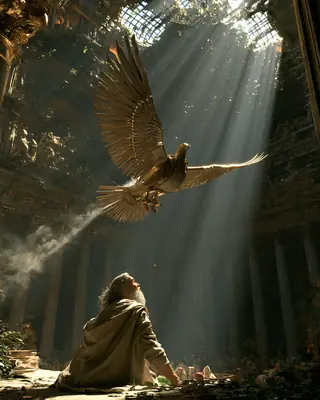
A wooden dove with hinged wings flies through shafts of light above a courtyard, trailing steam, watched by a philosopher.
Archytas of Tarentum, in Aulus Gellius, Attic Nights 10.12.9-10 · 4th century BCE

The wooden dove of Archytas

Archytas the Tarentine, being in other lines also a mechanician, made a flying dove out of wood. Whenever it lit, it did not rise again.

Aulus Gellius 10.12.10, quoting Favorinus · trans. J. C. Rolfe (1927)

Archytas of Tarentum, a Pythagorean mathematician who was elected general of his city seven years running, made a wooden dove that flew. Aulus Gellius, citing Favorinus and “many eminent Greeks”, says it was balanced with weights and moved by a current of air enclosed and hidden inside it. Then he quotes one line in Greek: once it came down, it did not rise again.

The first flying machine on record stops exactly where autonomy would begin. Its maker lived at Tarentum, in the far west of the Greek sea, beyond the horizon of the picture.

Ctesibius, Philo, Kallixeinos · 3rd century BCE

The machine makers of Alexandria

and this statue rose up by mechanism, without any one applying his hand to it; and it poured libations of milk out of a golden bottle, and then it sat down again

Kallixeinos of Rhodes, in Athenaeus 5.198f · trans. C. D. Yonge (1854)

In the city where Apollonius wrote the Argonautica, machines were public spectacle. Ctesibius, a barber’s son, built water clocks whose rising float drove toothed racks that moved figures, dropped pebbles and sounded trumpets. Philo of Byzantium described a bronze maidservant: put a cup in her left palm and she pours wine, then water, in a fixed proportion, and stops when the cup is lifted. In the Grand Procession of Ptolemy II a seated statue of Nysa, about four metres high, stood up by itself, poured a libation of milk and sat down again.

Polybius, writing in the second century BCE, quotes a sneer at an earlier showpiece: the snail that “moved by itself” at the head of Demetrius of Phalerum’s procession in Athens, spitting slime. Automation as political theatre had its critics from the start.

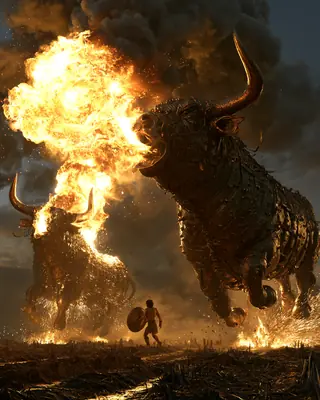
Two bronze bulls breathe fire across a field at night while a young hero with a round shield stands before them.
Apollonius of Rhodes, Argonautica 3.230-234 · 3rd century BCE

The bulls of Colchis

And he wrought for him bulls with feet of bronze, and their mouths were of bronze, and from them they breathed out a terrible flame of fire; moreover he forged a plough of unbending adamant, all in one piece, in payment of thanks to Helios, who had taken the god up in his chariot when faint from the Phlegraean fight.

Apollonius of Rhodes, Argonautica 3.230-234 · trans. R. C. Seaton (1912)

Before Talos, the Argonauts meet another work of Hephaestus. King Aeetes of Colchis owns bronze-footed bulls with bronze mouths that breathe fire, the smith-god’s payment to Helios, who had carried him in his chariot when he was exhausted after the battle of Phlegra. Jason must yoke them. Protected by Medea’s drug, he brings one bull to its knees by kicking its bronze foot.

The bulls fall at the foot and Talos at the ankle, and Medea stands behind both defeats. Weapons handed over as payment between powers, and beaten with help from inside.

A hooded sorceress stands at the bow of a ship below a giant with a glowing eye and a boulder in his hand.
Apollonius, Argonautica 3-4; Apollodorus, Library 1.9.26-27

Medea, who reads machines

So she repaired to the palace of Pelias and persuaded his daughters to make mince meat of their father and boil him, promising to make him young again by her drugs; and to win their confidence she cut up a ram and made it into a lamb by boiling it.

Apollodorus, Library 1.9.27 · trans. J. G. Frazer (1921)

Medea defeats every machine in the story. She gives Jason the drug that protects him from the bronze bulls; she brings down Talos; and in the Library she sells the daughters of Pelias a rejuvenation by first boiling an old ram, cut in pieces, back into a lamb. The daughters trust the demonstration and boil their father, who does not come back.

A promise of youth to Pelias, a promise of immortality to Talos: each time she wins trust with a result and then asks for something that cannot be undone. Adrienne Mayor calls her a “techno-witch”, and writes that any advanced technology runs the risk of a Medea who hacks it through its weak points.

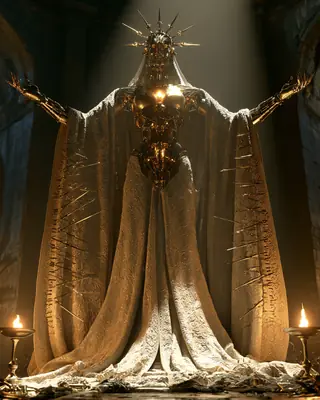
A crowned mechanical figure of a woman in a richly embroidered robe opens her arms in a dark chamber; iron spikes show through the cloth.
Nabis of Sparta, in Polybius, Histories 13.7 · c. 205 BCE

Apega of Sparta

Both her arms and hands as well as her breasts were covered with iron nails concealed under her dress.

Polybius 13.7 · trans. W. R. Paton (1925)

Polybius reports that Nabis, tyrant of Sparta, had a richly dressed likeness made of his wife Apega, “a machine, if one can call such a thing a machine”. Citizens who refused to pay were told that perhaps Apega would persuade them. Nabis made the figure rise from its chair and drew the reluctant citizen into its arms; then, with his hands on its back, he worked hidden springs that pressed the victim against the iron spikes until he agreed to anything.

It is the historical double of Talos’ burning embrace: a figure in human form that offers persuasion first and force after, with the controls behind its back.

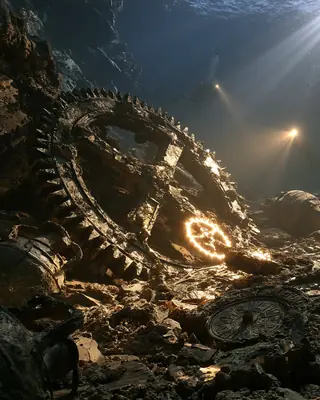
A large corroded bronze gearwheel glows faintly on the seabed among broken amphorae, in the beams of divers' lamps.
The Antikythera mechanism · c. 150-100 BCE

The machine from the wreck

Sponge divers raised it in 1901 from an ancient shipwreck off Antikythera, the small island in the strait between Kythera and Crete, on the sea lanes Talos was supposed to watch. It survives in 82 fragments with 30 bronze gearwheels, about a third of the original. Turned by a handle, its dials followed the sun and the moon, predicted eclipses from Babylonian cycles and tracked the four-year cycle of the Panhellenic games; in the reconstruction published by Tony Freeth and colleagues in 2021 it also displayed the planets.

It stores astronomical models as gear ratios and gives predictions when cranked: an analogue computer, now in the National Archaeological Museum in Athens (inv. X 15087).

T. Freeth et al., Nature 444 (2006); T. Freeth et al., Scientific Reports 11 (2021).

Diodorus 4.76; Apollodorus 3.15.8; Ovid, Metamorphoses 8.236-259

The other Talos

He had fled from Athens, because he had thrown down from the acropolis Talos, the son of his sister Perdix; for Talos was his pupil, and Daedalus feared that with his talents he might surpass himself, seeing that he had sawed a thin stick with a jawbone of a snake which he had found.

Apollodorus, Library 3.15.8 · trans. J. G. Frazer (1921)

Greek myth has a second Talos, a boy in Athens. He was the son of Daedalus’ sister and became Daedalus’ apprentice, and he invented the potter’s wheel, the compass and the saw, which he copied from a snake’s jaw (in Ovid, from the spine of a fish). Daedalus, afraid of being surpassed, threw him from the Acropolis, was condemned by the Areopagus and fled to Minos in Crete. Ovid adds that Athena caught the falling boy and turned him into a partridge, which still flies low.

So the killing of one Talos brought Daedalus to the island of the other. A maker afraid of being surpassed by what he trained: the fear has not aged.

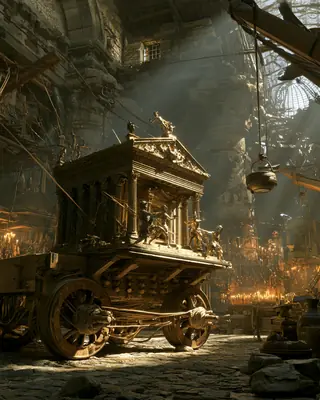
A small wooden cart carrying a miniature temple stands in an ancient workshop lit by shafts of light.
Hero of Alexandria, On Automata · 1st century CE

A shrine that drives itself

μιᾶς γὰρ αὐτῶν ἀλλαγείσης ἢ ἐπ᾽ ἀριστερὰ ἐπειληθείσης τὰ ὅλα στάσιν λήψεται

Hero, Automata 2.11: “if a single one of them is changed, or wound to the left, the whole will come to a stop” · translation for this page

Hero of Alexandria, writing after 62 CE, left the only ancient manual on automata that survives. His mobile automaton is a small shrine of Dionysus that rolls by itself to a set spot, lights its altar, pours wine and milk, sets bacchants dancing to drums and cymbals, turns, and rolls back. One falling weight drives it all. The route is stored in a cord wound round the axle: turns in one direction move it forward, a turn round a peg reverses it, slack loops stuck down with wax make it pause. Hero warns that a single cord wound the wrong way stops the whole performance.

In 2007 Noel Sharkey described the cart in New Scientist as a programmable robot. An older automaton theatre that Hero describes opened with a painted face that shut and opened its eyes. The small white tower on the horizon of the map points south, towards Alexandria.

Pollux 5.38-39; Hyginus, Astronomica 2.15; Ovid, Metamorphoses 10

Bronze with a soul put in it

ὃν Ἥφαιστος ἐκ χαλκοῦ Δημονησίου χαλκευσάμενος, ψυχὴν ἐνθείς, δῶρον ἔδωκε Διί

Pollux, Onomasticon 5.39: “which Hephaestus forged from Demonesian bronze and, having put a soul into it, gave as a gift to Zeus” · translation for this page

Pollux, citing the poet Nicander, tells of a dog that Hephaestus forged in bronze and then gave a soul, as a second step after the body. It passed from Zeus to Europa, from Europa to Minos, and on to Procris and Cephalus: the same hands through which Talos passes. The dog could not fail to catch its prey, and it was sent after a fox that could not be caught; both were turned to stone. Hyginus reports that many said the eagle that ate Prometheus’ liver was made by Hephaestus and given its soul by Zeus.

Ovid’s Pygmalion carves an ivory woman and prays. When he touches her again, corpus erat! saliunt temptatae pollice venae: it was a body, the veins throbbed under his thumb. For Ovid, too, the sign of life is a pulse in a vein.

Hesychius; Cretan inscriptions; A. B. Cook (1914)

Talos, the sun

His name, according to Hesychios, denoted ‘the Sun’; and he was commonly described as a bronze man.

A. B. Cook, Zeus: A Study in Ancient Religion I (1914), p. 719

An ancient dictionary, the lexicon of Hesychius, glosses Ταλώς as “the sun”. Hellenistic Cretan cities swore oaths by a Zeus Tallaios, in one case together with Helios. From these clues A. B. Cook and J. G. Frazer read Talos as a Cretan sun god, perhaps pictured with a bull’s head, whose daily round of the island was the sun’s course. The bull on the Phaistos coins and the variant in the Library, “some say he was a bull”, fit the reading.

Jason Colavito has argued that the robot reading of Talos is late and that the older figure was a statue or a sun god; Clara Bosak-Schroeder, reviewing Adrienne Mayor’s book, notes that ancient audiences could have seen the same story as mechanism or as magic. The glare of the sun on the left of the picture keeps that possibility in view.

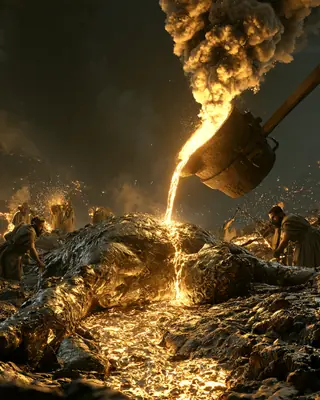
Molten bronze pours from a crucible onto a giant figure lying in a casting mould in a volcanic forge.
A. B. Cook, Zeus I, pp. 723-724 · 1914

The bronze-founder’s art

The single vein running from his neck to his ankles and closed by a bronze nail thrust through it vividly recalls the cire perdue method of hollow-casting in bronze

A. B. Cook, Zeus: A Study in Ancient Religion I (1914), p. 723

In 1914 the Cambridge scholar A. B. Cook proposed a technical origin for the myth. Large bronzes were cast hollow by the lost-wax method: bronze pins held the clay core in place inside the mould, molten metal was poured in through the feet, and the core was removed afterwards through the soles. The hollow from head to heel, pierced by pins, would be the fact behind the fiction of the vein and the nail; the fiery pit in which moulds were set would explain Talos leaping into the flames.

Read this way, the myth describes how the statue was made. The Cast view of the map, a drawing extracted from the picture, follows Cook’s idea: switch it on and the vein becomes a casting channel.

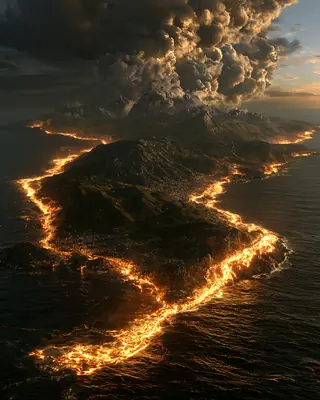
An island seen from high above at sunset, its whole coastline traced by a glowing line of molten gold.
Modern arithmetic on Apollodorus 1.9.26 · 2026

The arithmetic of a patrol

Crete’s coastline measures about 1,046 km, the figure given by the Greek National Tourism Organisation. Three circuits a day make 3,138 km in 24 hours: an average of about 130.75 km/h, roughly 70 knots, without a pause, three and a half times the average speed of the 100-metre world record. Each point of the shore is seen once every eight hours.

Herodotus reckons that a ship covers about 70,000 fathoms in a long day of sailing, some 130 km: Talos covers that in an hour. On the slower schedule of the Minos, three rounds a year, each village is visited every 122 days. Coastlines grow longer the more closely they are measured, so these figures give only an order of magnitude.

But even as some huge pine, high up on the mountains, which woodmen have left half hewn through by their sharp axes when they returned from the forest, at first it shivers in the wind by night, then at last snaps at the stump and crashes down; so Talos for a while stood on his tireless feet, swaying to and fro, when at last, all strengthless, fell with a mighty thud.
Apollonius of Rhodes, Argonautica 4.1682-1688 · trans. R. C. Seaton (1912)

Sources

Ancient texts on Talos

  • Apollonius of Rhodes, Argonautica 3.219-234 and 4.1636-1693, trans. R. C. Seaton (1912): Theoi.
  • Apollodorus, Library 1.9.26-27 and 3.15.8, trans. J. G. Frazer (1921): Theoi.
  • [Plato], Minos 320c, trans. W. R. M. Lamb (1927): Perseus.
  • Simonides on Talos in the scholia on Plato, Republic 337a, the Suda (σ 124), Photius and Zenobius 5.85; Sophocles, Daedalus, frr. 158-162: A. C. Pearson, The Fragments of Sophocles I (1917), pp. 110-113, archive.org.
  • Agatharchides in Photius, Bibliotheca cod. 250; Orphic Argonautica 1350-1352; Lucian, On the Dance 49; Pausanias 8.53.5 (Cinaethon); Hesychius s.v. Ταλώς.
  • Homer, Odyssey 20.301-302 and the scholion on it; Eustathius on the Odyssey, p. 1893.

Talos’ relatives

  • Homer, Iliad 2.408, 5.749-752, 18.369-421 (trans. A. T. Murray, 1924-1925); Odyssey 7.86-103 and 8.555-569 (trans. Murray, 1919).
  • Hesiod, Works and Days 59-155; Theogony 570-589, trans. H. G. Evelyn-White (1914).
  • Pindar, Paean 8.62-86; Athenaeus 7.290e and 5.198f, trans. C. D. Yonge (1854).
  • Plato, Meno 97d-98a (trans. Lamb, 1924), Euthyphro 11b-e; Aristotle, Politics 1.4 (trans. B. Jowett, 1885) and On the Soul 1.3, 406b (trans. R. D. Hicks, 1907).
  • Aulus Gellius 10.12.9-10 (trans. J. C. Rolfe, 1927); Polybius 12.13.11 and 13.7 (trans. W. R. Paton, 1925); Vitruvius 9.8; Philo of Byzantium, Pneumatica 30; Hero of Alexandria, Automata and Pneumatica.
  • Pollux, Onomasticon 5.38-39; Hyginus, Astronomica 2.15 and Fabulae 142; Ovid, Metamorphoses 8.236-259 and 10.243-297; Diodorus 4.76.

Objects

  • Silver stater of Phaistos, Berlin, Münzkabinett, 18203975; Phaistos staters with the hound, Heraklion Archaeological Museum.
  • Volute krater of the Talos Painter, Ruvo di Puglia, Museo Nazionale Jatta 1501, Beazley Archive 217518; column krater from Montesarchio, Museo Archeologico Nazionale del Sannio Caudino.
  • The Antikythera mechanism, National Archaeological Museum, Athens, X 15087.

Scholarship

  • A. B. Cook, Zeus: A Study in Ancient Religion I (Cambridge 1914), pp. 718-730: archive.org.
  • A. Mayor, Gods and Robots: Myths, Machines, and Ancient Dreams of Technology (Princeton 2018); “Talos, Pandora, and the Trojan Horse as Products of Technology”, e-Phaïstos XI-1 (2023).
  • C. Bosak-Schroeder, review of Mayor, BMCR 2019.08.09; J. Colavito, “The Origins of Talos”.
  • G. Liveley and S. Thomas, “Homer’s Intelligent Machines: AI in Antiquity”, in S. Cave, K. Dihal, S. Dillon (eds), AI Narratives (Oxford 2020).
  • M. Robertson, “The Death of Talos”, Journal of Hellenic Studies 97 (1977) 158-160.
  • P. Radanliev, “Delegated agency and moral responsibility in artificial intelligence”, Frontiers in Artificial Intelligence 9 (2026).

Machines and AI

  • C. Szegedy et al., “Intriguing properties of neural networks” (2013); B. Nassi et al., “Phantom of the ADAS”, ACM CCS 2020.
  • D. Hadfield-Menell, A. Dragan, P. Abbeel, S. Russell, “The Off-Switch Game”, IJCAI 2017; Y. Zeng et al., “How Johnny Can Persuade LLMs to Jailbreak Them”, ACL 2024.
  • L. Lessig, Code and Other Laws of Cyberspace (1999); A. Machado et al., “Multi-agent patrolling: an empirical analysis of alternative architectures”, MABS 2002.
  • T. Freeth et al., Nature 444 (2006); Scientific Reports 11 (2021). N. Sharkey, “The programmable robot of ancient Greece”, New Scientist 2611 (2007).
  • UN Convention on Certain Conventional Weapons, Group of Governmental Experts on Lethal Autonomous Weapons Systems, final report CCW/GGE.1/2026/3 (2026).

About this page

Research, texts and code: Claude Code with Opus 5.5 · Effort: Ultracode. Images: Midjourney v.8.2. From a note by Lorenzo L. D. Incardona.

Every picture on this page is generated. The pictures illustrate the stories; they do not reproduce ancient objects, which are described in the text with their museum records. The Ichor and Cast views are computed from the main picture: the first keeps only its hottest, most saturated gold, the second traces its edges as a technical drawing.

Quotations come from translations in the public domain or from the Greek, translated for this page where marked. Speeds and distances are modern calculations, not ancient figures. The facts were checked against the sources listed here in October 2026; the outcome of the November 2026 Review Conference was not yet known.

To use the map: scroll to descend; move the pointer, or tap, to look through the lens; Bronze, Ichor and Cast change the view; a diamond marks a window you have found; Esc closes a window.

Image made with Midjourney v.8.2